Antarctic Krill Discovered Living in Deepsea Hydrothermal Vents
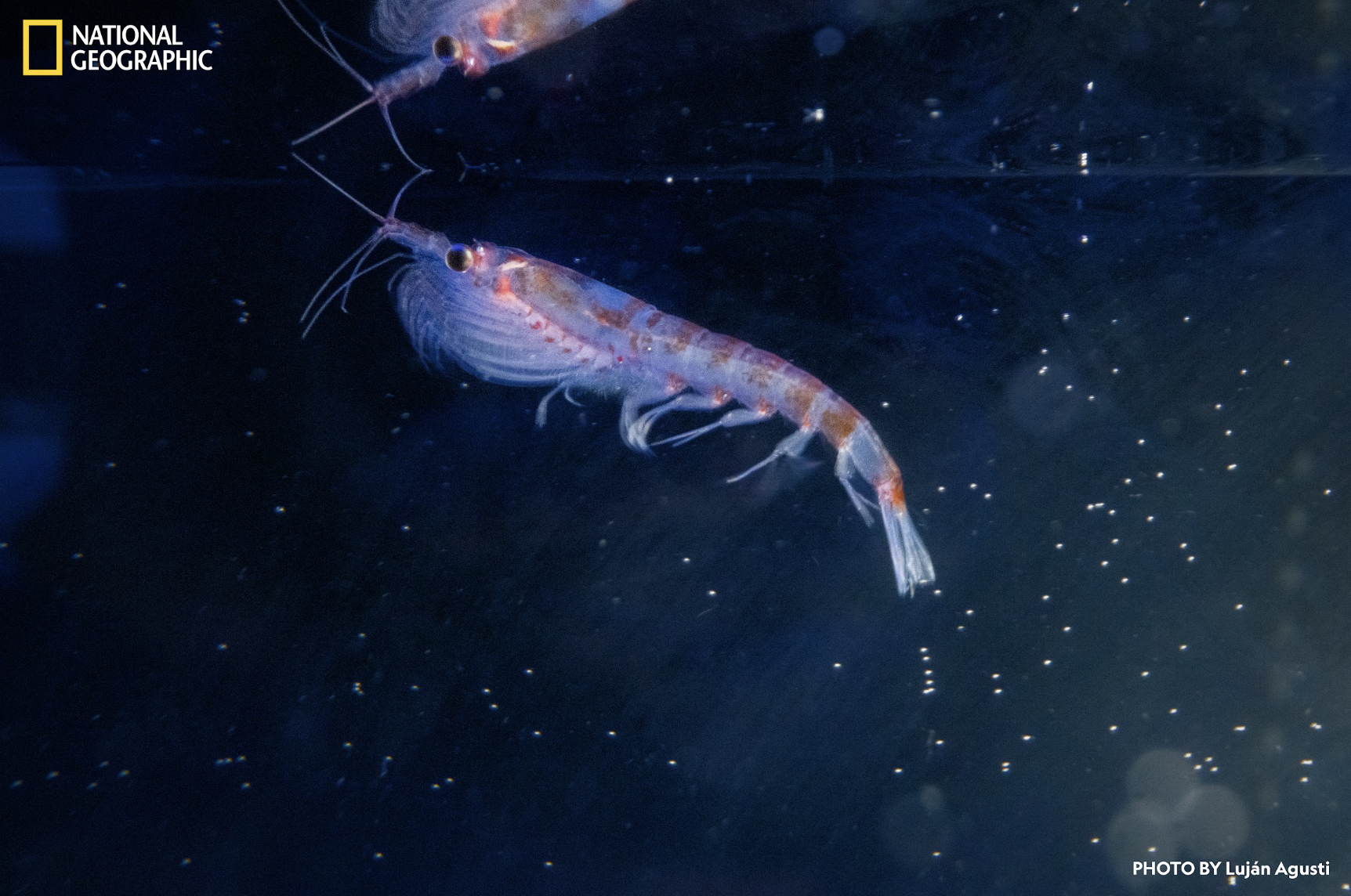
Weddell Sea, Southern Ocean, Antarctica - 2024/12/26: Antarctic krill specimens retrieved during a dive by ROV SuBastian. Credit: Luján Agusti/National Geographic
A new paper published in Communications Biology reveals that Antarctic krill, a crucial species that underpins the Southern Ocean food web, use deep-sea hydrothermal vents as a habitat, challenging long-held assumptions about where they live and thrive.
For the first time in scientific history, researchers have observed Antarctic krill — all reproductive females — gathering near and feeding at hydrothermal vents, which act as hot springs on the ocean floor, more than 3,000 feet below the ocean’s surface. These findings have significant implications for Southern Ocean marine policy. The paper’s lead author, National Geographic Explorer and biological oceanographer Kim Bernard, made this discovery during the National Geographic and Rolex Perpetual Planet Ocean Expedition "Into the Southern Ocean," conducted in collaboration with the Schmidt Ocean Institute.
Every single krill Bernard and her expedition teammate, marine ecologist Rachel Kaplan, sampled from the vent was an egg-bearing female, representing the deepest collection of reproductive krill researchers have ever recovered. In their analysis of the stomach contents of the krill, Bernard, in collaboration with National Geographic Explorer Andrew Thurber, found evidence that these females were feeding on chemosynthetic microbes that produce organic carbon from sulfur and other chemicals emitted by the hydrothermal vents, rather than from sunlight. The reproductive females Bernard and her colleagues found at the hydrothermal vent also had elevated levels of minerals, like manganese, zinc and iron, which are essential for reproduction and early embryonic development in their young. They also had extremely high levels of toxic heavy metals, including lead and cadmium. The paper suggests that if reproductive females actively use this habitat, it should be factored into marine protected area planning.
Bernard made the discovery while watching the live feed from ROV SuBastian aboard the Schmidt Ocean Institute’s state-of-the-art R/V Falkor (too). Alongside Kaplan, Thurber and fellow National Geographic Explorers and co-authors Angelo Bernardino, Aaron Micallef and Sarah Seabrook, she spotted the characteristic movements of the shrimp-like crustaceans twirling and bolting along the mineral-rich fissures of the ocean crust.
“It was shocking, to say the least,” said Bernard, who has spent 16 years studying the species. “Antarctic krill possess the largest biomass of any wild animal species on the planet and serve as the ultimate foundational species. They are a crucial part of the entire Southern Ocean food web, supporting marine mammals, seabirds and fish, while simultaneously aiding in the fight against climate change by ingesting organic carbon in the form of phytoplankton — the ocean’s microscopic plants — and sequestering it at the ocean floor. Finding krill feeding on chemosynthetic microbes at a hydrothermal vent changes our current understanding of their ecology.”
Furthermore, this discovery addresses critical data gaps. According to the paper, Antarctic krill have been studied for over 100 years, but most research on the species has focused on the upper 300 meters of the ocean rather than the deep sea below. Krill are also the primary target species for most of the Southern Ocean’s largest commercial fisheries in the region, but it is difficult to manage that fishery effectively when key parts of the krill life cycle remain unresolved.
Bernard added, “One key aspect of the krill life cycle that is necessary to understand is where the reproductive females release their eggs — a process known as spawning. For decades, scientists have assumed spawning occurs in the upper waters of the ocean. Finding ready-to-spawn females at the seafloor forces us to rethink this assumption.” The video footage and physical samples the team collected provide unprecedented insights into krill behavior and population dynamics in the deep sea.
The paper, “Deep Sea hydrothermal vent habitats support gravid Antarctic krill,” was published in Communications Biology on Sept. 15, 2026.




 August 2026