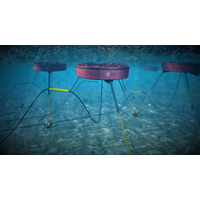
Carnegie, Oceantera to Collaborate on Wave Energy Projects
.The two companies will investigate potential CETO project opportunities in South East Asia or other mutually agreed locations.They've also committed to exploring collaborative opportunities to use Carnegie's Garden Island Microgrid with a view to supporting the development of the wave energy industry."This MOU formalizes discussions ongoing between the two parties over the past year including a visit by one of Oceantera’s Directors to Carnegie’s Rous Head research facility and Garden Island Microgrid [in Western Australia] in 2019," Carnegie said.The Garden Island
New US Wave Energy Test Facility
and technology of wave energy devices, and to identify the challenges we will ultimately need to overcome in order to achieve commercial deployment.” More than 50 percent of the U.S. population lives within 50 miles of coastlines, offering America the potential to develop a domestic wave energy industry that could help provide reliable power to coastal regions. Recent studies estimate that America's technically recoverable wave energy resource ranges between approximately 900–1,230 terawatt hours (TWh) per year, distributed across the coast of Alaska, the West Coast, the East Coast

LR Awards First Technology Qualification for Ocean Energy
to manage costs and the associated risks of bringing new technology to market.” AW-Energy’s WaveRoller product is a near shore wave energy converter, mounted to the seabed with a panel that oscillates with the wave surge. It paves the way to commercialization for the wave energy industry and with ongoing projects in Portugal, Ireland, France and Chile. AW-Energy expects to see rapid growth in the next few years for its WaveRoller product as governments, operators and geo-energy policy collectively strive for cleaner and more sustainable power generation solutions
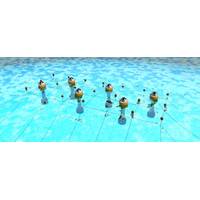
Global Maritime to Support EU Wave Energy Project
yet today, wave energy costs remain high compared to conventional forms of energy.” He continues: “That’s why OPERA is such a ground-breaking project and why Global Maritime is delighted to be involved in the mooring and risk management element. For the first time, the wave energy industry will be able to access high quality, open-sea operating data, see some of the latest mooring and other technology innovations tested offshore, and look forward to long-term cost reductions of up to 50%.” Inside the WEC is an oscillating water column (OWC) that forces air through
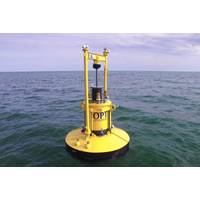
Wave Energy's Power Play
as the first utility scale offshore wind farms “failed catastrophically,” wave power too is encountering its own growing pains. “[Early offshore wind farms] failed because the industry was not ready for survivability first, then reliability second,” Heinz said. “The wave energy industry is going through the same problems. . . Everyone is trying to build these very large devices at utility scale because that’s where the influence and money.” With that in mind, and vying against more than 150 global competitors trying to secure niche capabilities to turn
Modelling to Unlock the Potential of Wave Energy Farms
ARENA today announced $770,000 funding for Swinburne University of Technology to develop modelling on the performance of wave energy farms. The wave energy industry is emerging world-wide and there are few multiple device installations operating today. Predicting the best way to arrange future projects will help to better understand how different technologies will behave in certain circumstances. The modelling aims to discover the best ways of positioning wave arrays so that devices move in synergy with one-another, creating greater efficiencies. Swinburne is collaborating with interested
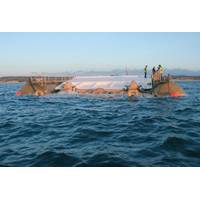
WaveRoller Obtains DNV GL Verification
and experimental modelling exercises, which have now been extended to the comparisons with full-scale results. The results are very encouraging, and demonstrate AW-Energy’s adherence to the industry best practices. This positions the WaveRoller WEC technology at the forefront of the wave energy industry.” said Joao Cruz, Head of Wave and Tidal Energy at DNV GL. “To our understanding, AW-Energy is the first wave energy technology company to conduct such an extensive independent verification of its operational results. This proves that wave surge converters like WaveRoller are

 February 2026