Marine Technology News Search
Search term • "advanced navigation"
Create an email alert for "advanced navigation"
GE Spotlights Hi-tech Portfolio at OTC 2013
GE continues to expand its technology portfolio to address the challenges of offshore drilling & production and the rigors of deepwater drilling. Several GE business units showcased their latest products and services for the offshore sector in at the 2013 Offshore Technology Conference (OTC), which was expected to draw nearly 90,000 attendees. “With one of the industry’s most comprehensive portfolios of advanced technology solutions and services…
Guidance for NSF on National Ocean Research Priorities
Within the past decade, new science and technologies have led to breakthroughs and discoveries that have fundamentally altered our basic understanding of the oceans and their relationship to human populations. The value of the ocean to society has been highlighted by multiple commissions (the Pew Oceans Commission; the U.S. Commission on Ocean Policy) and a science-based National Ocean Policy has been developed.
Ocean Science and Exploration Focus on Capitol Hill
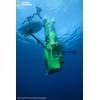
Explorer and director James Cameron will be on Capitol Hill on Tuesday, June 11, with Dr. Susan Avery, president and director of Woods Hole Oceanographic Institution for a series of public events and a Senate hearing. Central to their visit is the display of the Deepsea Challenger, the only human-occupied vehicle currently able to access the deepest parts the ocean. Cameron developed the vehicle over seven years and used it in March 2012 to dive to the deepest spot in the ocean…
Tideland Solar Buoys Mark Wrecks in Norwegian Arctic
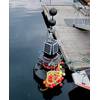
Two SB-138P polyethylene buoys with solar-powered ML-140 LED lanterns from Tideland Signal are being used to mark wrecks in the approaches to the port of Narvik in the far north of Norway. The new SB-138P buoys are replacing old battery-operated steel buoys from the 1980s that required extensive maintenance and costly battery changes. They are wreck-markers for the British 8770 ton iron- ore carrier Romanby and the Swedish 8…
HoOK R&D Project Examines Offshore Crane Ops
With funding from the Federal Ministry of Economics and Technology and supported by “Projektträger Jülich” (PTJ) [project sponsors Jülich], over the next three years Hamburg University of Technology, Mareval AG Hamburg and the maritime engineering company HeavyLift@Sea will conduct research into the improvement of tools for the simulation of offshore crane operations. The project is named HoOK - Hochseeoperationen mit Kranen [Offshore Operations with Cranes].
Acoustic Pingers for Submarines and AUVs
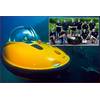
U-Boat Worx reported that personal submarine and autonomous underwater vehicle (AUV) sales are on the rise. Not long ago personal submarines were high tech toys available only to the super wealthy and AUVs were expensive pieces of equipment used primarily by the military and oil industry. Thanks to advances in technology that reduced their cost, both are now in widespread use by individuals, businesses and universities.

OFG Expands AUV Capability
OFG has invested in a 3000m-rated Hugin Autonomous Underwater Vehicle (AUV), Chercheur, equipped with a sensor and software suite for efficient inspection of pipelines and infrastructure, pipeline route studies, site geohazard surveys, environmental monitoring surveys, and other seafloor-based applications such as UXO, archeology, salvage, and minerals exploration. Chercheur is equipped with high resolution interferometric synthetic aperture sonar (HiSAS)…
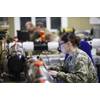
Unmanned Warrior: The Science behind the Systems
It is an exciting time to be a science advisor in the Navy. I am fortunate to be assigned by the Office of Naval Research to Adm. Phillip Davidson, commander of U.S. Fleet Forces, and work to identify and provide technical solutions to capability gaps currently facing our operational naval forces. Office of Naval Research-Global sponsors 25 science advisors at naval commands around the world. Our job takes us to the front lines to understand challenges facing our Navy and Marine Corps…
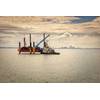
Engineering Representative Appointed for Lake Erie Wind Project
The Lake Erie Energy Development Corporation (LEEDCo) in Cleveland, Ohio has appointed international engineering and operations support services contractor Offshore Design Engineering Limited (ODE), part of the DORIS Group located in the U.K., as the engineering representative for Icebreaker Wind, a 20.7 megawatt offshore wind project in Lake Erie, and the first freshwater offshore wind project in North America.
Lloyd’s Register, TCOMS Partner on Technology Development
Lloyd’s Register (LR), an engineering, technical and business services organization, and the new Technology Center for Offshore and Marine, Singapore (TCOMS) have agreed to jointly develop technology, infrastructure and skills necessary for future marine and offshore systems, digital and data innovation, and robotic autonomous systems in a marine environment. TCOMS will allow industry partners, technology partners…
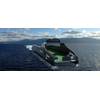
World First: Unmanned Autonomous Boat for Offshore Ops
While talk of autonomous operations in the maritime sector have swirled for years, the talk becomes reality as Automated Ships Ltd. (an M Subs Ltd subsidiary) and Norway’s Kongsberg Maritime signed a Memorandum of Understanding to build the world’s first unmanned and fully-automated vessel for offshore operations. In January 2017, Automated Ships Ltd will contract the ‘Hrönn’, which will be designed and built in Norway in cooperation with KONGSBERG.
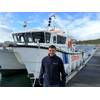
Sonardyne Appoints Tena as Global Business Manager
Subsea technology company Sonardyne International Ltd. UK, has announced the appointment of Ioseba (Joe) Tena as its new Global Business Manager for Marine Robotic Systems. Tena joins Sonardyne with immediate effect and brings with him more than 20 years of experience working with marine robotic systems, most recently at SeeByte. Early in his career Tena worked with marine robots as a Research Associate at Heriot-Watt University.

SEA’S KraitArray Sonar Performs at UW16
Cohort plc company SEA completed demonstrations of its KraitArray array sonar system towed from the Liquid Robotics SHARC Wave Glider Unmanned Surface Vessel (USV) and a BAE Systems P950 rigid hulled inflatable boat (RHIB), also performing in unmanned mode, at the Royal Navy’s Unmanned Warrior 16 (UW16) exercise off the West Coast of Scotland. SEA has developed the advanced KraitArray which is a configurable…
TechnipFMC Begins Operations Post-merger
TechnipFMC has begun operating as a unified oil and gas services company following completion of the merger of Houston-based FMC Technologies and paris-based Technip. Now with a combined 44,000 employees, the new TechnipFMC will work on oil and gas projects, technologies, systems and services “from concept to project delivery and beyond” with headquarters in Houston, London and Paris. A key focus for TechnipFMC will be project economics across subsea…
New Inertial Sensors for Unmanned and Autonomous Vehicles
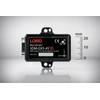
Embedded sensing systems developer LORD Sensing MicroStrain said it has expanded its portfolio of sensors for unmanned and autonomous vehicles for air, land and sea with the introduction of the 3DMGX5 family of inertial sensors. “We have a large portfolio that shares the same software and protocol, allowing customers to move up and down the product line where they need varying levels of precision with MEMS Inertial Sensors or GNSS,” said Andy Winzenz, Commercial Director, LORD Sensing.
Boskalis JV wins Santos Port dredging contract
Royal Boskalis Westminster N.V. (Boskalis) and joint venture partner Van Oord have been awarded a contract by The Brazilian Ministry of Transport, Ports and Civil Aviation for the capital and maintenance dredging of the port of Santos, the largest port of South America. The contract carries a total value for the joint venture of approximately EUR 110 million. In the coming months, studies will be undertaken and the design of the navigation channels and berths of the port will be reviewed.
Why Did the El Faro Sink?
On October 1, 2015, the 790-foot cargo ship El Faro sank near the Bahamas during Hurricane Joaquin. All 33 crew members died in the tragedy. The ship was equipped with a voyage data recorder, or VDR, that could reveal clues to understand what happened, but it was lost in the depths. The VDR was mounted on the mast on the ship’s navigation bridge. A search expedition mounted in October located the wreck and discovered that the bridge had separated from the hull.

NOAA Honors Fugro
Fugro’s global ocean mapping efforts have earned the company a formal commendation from the U.S. National Oceanic and Atmospheric Administration (NOAA). The recognition came during a recent industry briefing with Fugro and NOAA about The Nippon Foundation-GEBCO Seabed 2030 Project, a global initiative to map the world’s oceans by the year 2030.Given that more than 80 percent of the world’s oceans remains unexplored and unmapped…
Meet Kraken’s Tentacle Autonomous LARS
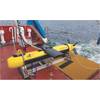
From elephant trunks to octopus legs, nature abounds with tentacles that are adept at precise manipulation.At Kraken Robotics, we wanted to see what nature could teach us about better manipulation methods for launching and recovering marine vehicles and equipment. Inspired by the sophisticated feedback loops and dynamic response times found in creatures such as the elephant, octopus and jellyfish—and…
NATO Center Tests Wave Glider in ASW Exercise
An energy-efficient robotic vehicle debuts as a communications gateway of an experimental network developed by CMRE within the Proud Manta ‘13 framework. The Antisubmarine Warfare (ASW) Exercise Proud Manta ‘13 (POMA ‘13), which includes participating ships and aircraft from ten NATO nations, will be held from 23 February to 6 March off the coast of Sicily. As in 2012, the 2013 POMA includes again…

 February 2026