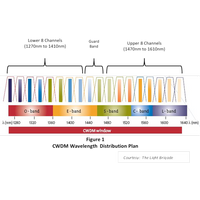
CWDM for the Subsea Market
multiplexing techniques that can be utilized, depending on the number of wavelengths. Standard WDM (Wavelength Division Multiplexing) utilizes either two, three or in some instances four wavelengths using standard lasers. CWDM technology can multiplex up to 18 individual wavelengths onto a single fiber. DWDM (Dense Wavelength Division Multiplexing) can typically multiplex 40 or 80 wavelengths on a single fiber. More elaborate DWDM techniques allow even higher density wavelength multiplexing. The most common method for wavelength multiplexing in the subsea market is CWDM where lower cost lasers and laser
Hibernia Express Ready for Service
services up to 100 Gbps speeds and is capable of 200 Gbps service on select segments. The six-fiber-pair cable is optimized for lowest latency performance, offering an unmatched roundtrip delay of sub-60 milliseconds on the New York to London route. Leveraging a dense wavelength division multiplexing (DWDM) platform, Hibernia Express is engineered to potentially scale up to 400 Gbps per circuit and beyond, enabling customers to meet bandwidth requirements as they increase over time. "Network latency has become a critical performance factor for financial firms, content providers, and web-based
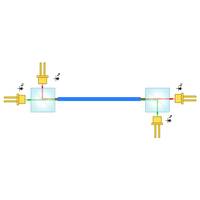
Multi-channel Fiber Optic System Design: Going Big in Small Packages
Data channels can be added to fiber optic systems by adding fibers, adding wavelengths, or adding both. Dense wavelength divisional multiplexing (DWDM) allows a single fiber to carry multiple data channels. Passive components, such as optical circulators, double a fiber’s capacity by allowing information to flow in both directions. While these technologies are well known in the terrestrial communications industry, subsea designers may be less aware of what tools are available to them. These technologies allow the subsea designer to pass many data channels through small, single or limited fiber

IslaLink Deploys Infinera Intelligent Transport Network
only commercially available single-card 500 gigabit per second (Gb/s) FlexCoherent super-channel solution, which is based on Infinera's widely deployed photonic integrated circuits. These 500 Gb/s super-channels are engineered to enable IslaLink to scale to terabits of transmission capacity, integrating DWDM optical transmission in a single platform that are designed to be capable of supporting up to 12 terabits per second of non-blocking OTN switching as their traffic requirements grow in the future. Infinera's intelligent software, combined with this converged platform, automates network operations

 February 2026