Darkocean Launches YU Weather Forecasting for Offshore Operations
© Darkocean
Darkocean officially launched YU, a marine weather service on its NAVBathy platform that tells offshore teams which days they can work. For any site at sea, YU forecasts waves, currents and wind, then gives a daily go or no-go for four common operations: personnel transfer, marine survey, heavy lift and diving and ROV work.
Offshore planners are not short of weather maps. What they need is a decision for one site, one operation and one set of limits. Today that usually means reading several forecasts and checking each day against the limits by hand. YU makes that check for them. Each day is judged on its maximum wave height, wind and current, against limits the team sets for each operation. If a limit changes after the forecast has run, the go/no-go days update at once, without running the forecast again.
What a YU forecast includes:
- A daily go/no-go for each operation, with the share of workable days
- A 3-hourly table of significant and maximum wave height, peak and mean wave period, wind sea and swell, wind at 10 m and 50 m with estimated gusts, surface current and sea temperature
- Wind and wave roses
- A printable PDF report for the project file
- Waves and currents about 10 days ahead, and wind up to 15 days ahead
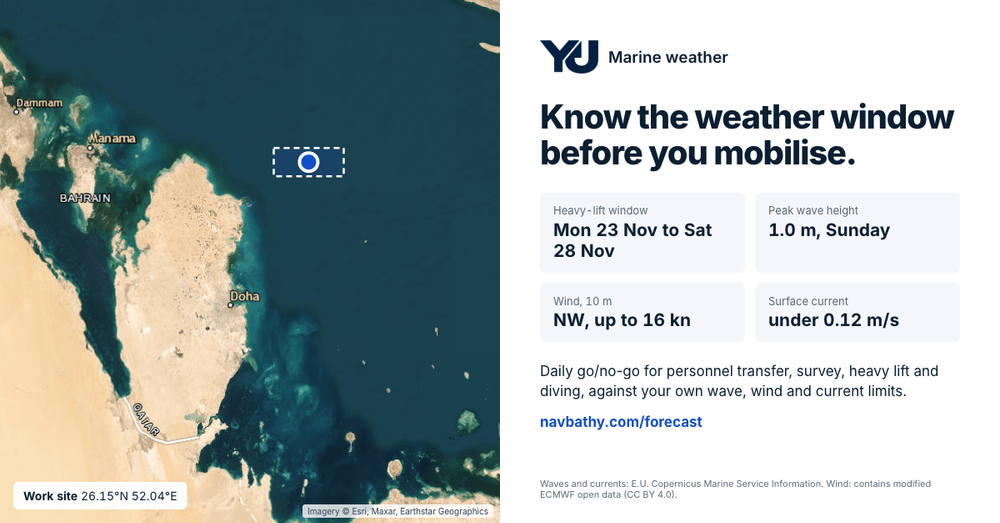
A real forecast: offshore Qatar
A forecast run on November 22 for a work site offshore Qatar (26.15°N, 52.04°E), covering November 22-28, showed:
- Sunday, November 22: waves peaked at about 1.0 m, above the 1 m limit set for heavy lift and diving, so both were no-go.
- Monday to Saturday, November 23-28: waves stayed below 1 m, wind from the north-west built to 16 knots, and surface currents stayed at or below 0.12 m/s.
- Heavy lift and diving were workable on 6 of the 7 days; personnel transfer and marine survey on all 7.
For heavy lift and diving, the weather window opened on Monday, November 23 and stayed open through Saturday.
YU uses Copernicus Marine wave and ocean models, and wind from AIFS, the AI forecast model of the European Centre for Medium-Range Weather Forecasts (ECMWF), all sampled at the work site. Where a model has no data for a location (the Copernicus ocean model does not cover the Caspian Sea, for example), YU shows the gap instead of estimating a value.





 August 2026