
PML Study Explores Marine Protection Opportunities Amidst Deep Sea Mining


-
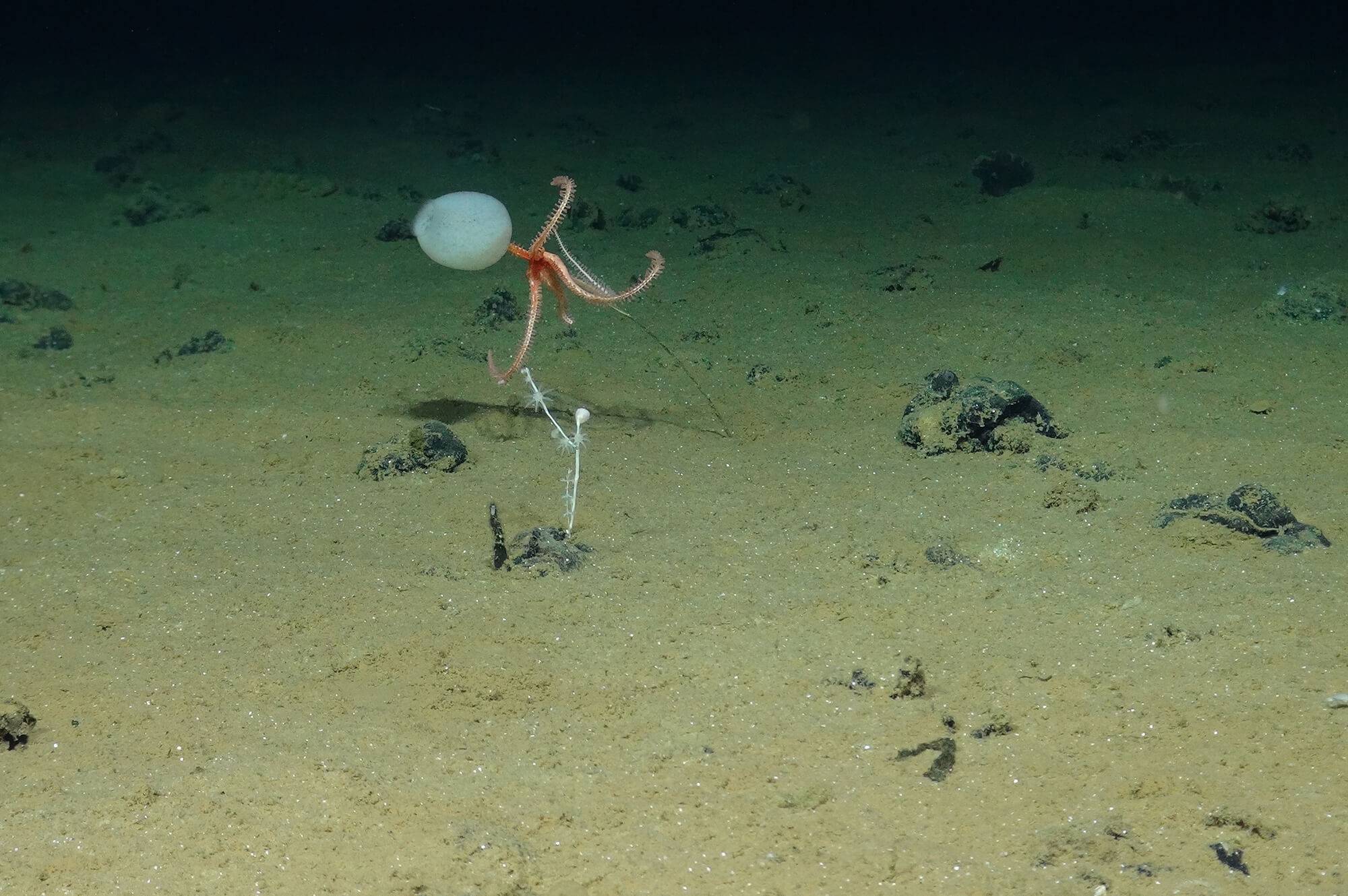
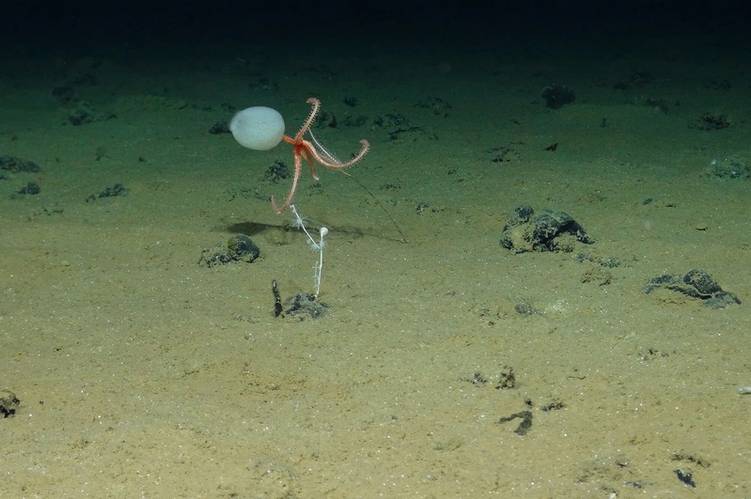 Clarion Clipperton Zone (CCZ) courtesy of the National Oceanography Centre and the Trustees of the Natural History Museum, with acknowledgement to the NERC SMARTEX project.
-
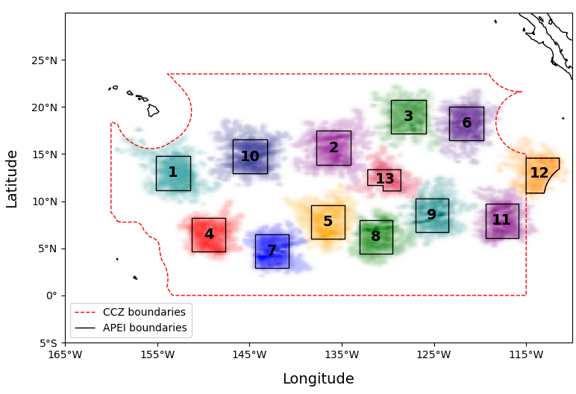
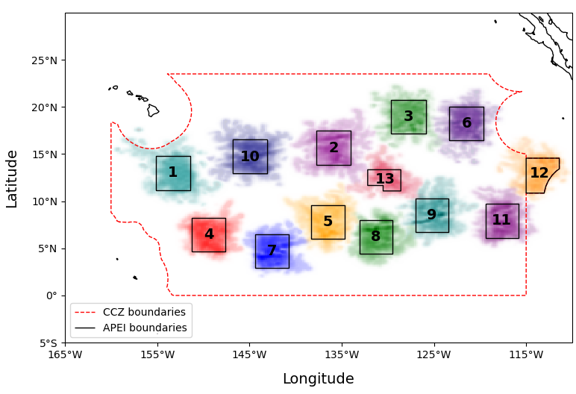 Larval dispersal footprints and spatial configuration of the 13 Areas of Particular Environmental Interest (APEIs - outlined in black) in the Clarion Clipperton Zone, numbered according to their official designation. Colored dispersal footprints represent the spatial extent of larval settlement originating from each APEI at the end of their planktonic larval duration (cumulative results for 19-,35- and 69 days of simulated dispersal for 4 time periods: January 2019; July 2019; January 2023; and
Protected areas have been set up to shield deep-sea life from the impacts of seabed mining in the Pacific Ocean. However, new research led by scientists at Plymouth Marine Laboratory (PML) and published in Nature Ecology & Evolution, highlights an opportunity to make these protections even more effective. The study suggests that adding a small number of strategically located protected areas could help transform existing reserves into a more connected network, enabling tiny drifting larvae that have been cast adrift after disturbance to recolonize more successfully.
The research team focused on the Clarion Clipperton Zone (CCZ), a stretch of abyssal seafloor in the central Pacific roughly the size of Europe, lying around 5,000 meters down. This area has become a global hotspot for prospecting because its floor is scattered with polymetallic nodules, which are potato-sized lumps of rock rich in nickel, cobalt and other metals used in all electronics.
More than 1.1 million square kilometers of the CCZ are already licensed for mining exploration, and commercial extraction could begin within years. However, governments, scientists and environmental groups have long been concerned about the significant impact mining operations would have on these types of valuable habitats.
Why protecting the abyssal seafloor matters:
- Habitat scale: The abyssal seafloor is a vital and globally significant habitat that covers over 50 percent of Earth's surface.
- Carbon cycling: The muddy plains play a critical role in the global carbon cycle by sequestering carbon and regulating climate.
- Biodiversity support: Despite the extreme cold, crushing pressure and total darkness, the seafloor supports unique microbes, invertebrates and fish.
- Mineral substrates: features like the highly-sought after polymetallic nodules offer hard surfaces for sponges and corals to grow in an otherwise soft sediment landscape.
To protect biodiversity from the impact of mining, the International Seabed Authority set aside a network of 13 ‘no-mining’ reserves, called ‘Areas of Particular Environmental Interest (APEIs)’, covering nearly two million square kilometers. The reserves were chosen mainly to represent a spread of different seafloor habitats but ensuring that marine life in one reserve could help replenish another if it was damaged was not a key consideration.
Using computer models of ocean currents across the whole CCZ, the PML-led team, that included partners from the National Oceanography Centre (UK), University of Plymouth (UK), Aarhus University (Denmark) and the Joint Nature Conservation Committee (UK), tracked the likely journeys of larvae drifting just above the seabed, where deep-sea larvae are known to concentrate.
The team found that even larvae capable of drifting for over two months typically travelled less than 100 kilometers. In contrast, the protected reserves sit between 200–800 kilometers apart, and fewer than two in every 10,000 simulated larvae released from one reserve ever reached another.
The researchers also modeled what would happen if mining went ahead and disturbed larval supply within the licensed mining areas themselves. Under that scenario, the protected reserves currently contribute only a small fraction of the larvae needed to help mining-affected areas recover, with most replenishment instead coming from the seafloor nearby that has no legal protection at all.
The team then used the same models to identify where new protected "corridors" could be added to stitch the existing reserves together. Adding a small number of carefully chosen extra sites, covering a relatively modest area and mostly outside current mining claims, was enough to link every reserve into a single connected network.
This increased simulated larval exchange between reserves by more than 400-fold and under a mining-disturbance scenario, the contribution of protected areas to replenishing damaged sites nearly doubled.
The International Seabed Authority is currently considering how to strengthen environmental protection in the CCZ ahead of possible mining approvals. The authors say their approach, using freely-available ocean circulation data rather than scarce biological surveys, could be applied to other deep-sea regions facing similar pressures and wherever detailed ecological data are lacking.
The researchers caution that their models simulate the physical possibility of dispersal driven by ocean currents near the seabed, rather than proving that populations actually exchange genes or recover this way in practice. Testing these will require future fieldwork, including direct current measurements and genetic sampling in the areas the models highlight for protection.
The full paper can be read here.






 August 2026