Breaching the Barriers: Executing MCM in Contested Environments
VideoRay, an AV company, and AEVEX Maritime Systems Division demonstrate how an unmanned system-of-systems transforms contested mine countermeasures.
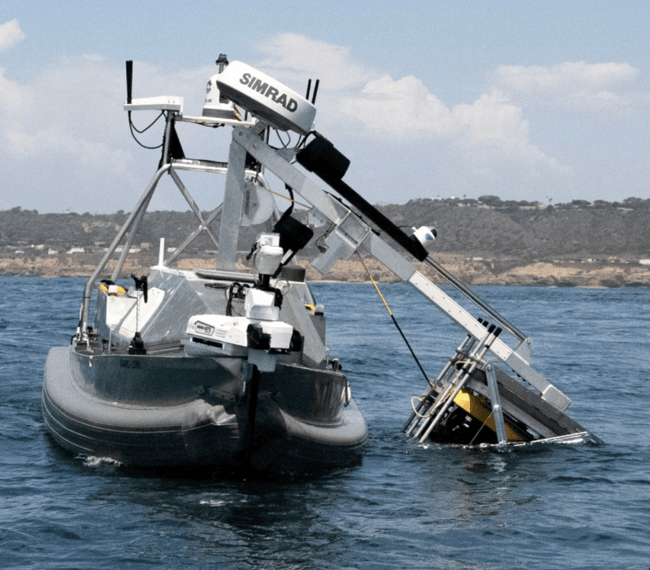
The U.S. Navy and Defense Innovation Unit (DIU) recently challenged industry to accelerate autonomous mine countermeasure (MCM) capabilities for contested environments. AEVEX Maritime Systems Division was selected among the prize recipients, working with VideoRay, an AV company, to demonstrate an unmanned surface-to-subsea approach. We spoke with Chris Gibson, Vice President of UUV, and Eric Wirstrom, Senior Director, Sales & Business Development for VideoRay about the challenge and the role of VideoRay’s automated Launch & Recovery System (LARS).
What was the Navy and DIU trying to accomplish with this challenge?
CHRIS: The objective was to accelerate practical autonomous MCM capabilities that increase mission speed, reduce the cost of detecting and neutralizing mines, and move warfighters and crewed vessels farther from the threat. Working with AEVEX, we demonstrated how commercially available autonomous surface and subsea systems can operate together as an integrated solution, extending operational reach and enabling multiple detect-to-engage missions from the sea surface to the seabed.
What role does VideoRay’s Launch & Recovery System play in contested MCM?
ERIC: Deploying an ROV has traditionally required people aboard a vessel to launch, manage and recover it. LARS enables an unmanned surface vessel to deploy, operate and recover a VideoRay Mission Specialist Defender ROV over the horizon without personnel on the host vessel. The USV and ROV can enter the threat area while operators remain at a safer distance.
What capabilities are built into the system?
CHRIS: LARS combines automated launch and recovery, integrated tether management, coordinated operations through a low-level API, and failsafe redundancies. Its modular, platform-agnostic architecture supports remote and distributed operations across unmanned surface vessels. The technology also has compelling applications for several of our commercial customers, making it a true dual-use capability.
Why is the AEVEX Maritime Division partnership significant?
CHRIS: AEVEX provides the autonomous surface platform that carries capability into the mission area, while VideoRay provides the subsea system for inspection, reconnaissance, manipulation, neutralization and other underwater tasks. VideoRay’s LARS connects those two domains, creating an integrated surface-to-subsea capability and extending the reach of both platforms.
How does this capability build on the evolution of mine countermeasures, and why is it significant?
ERIC: MCM has evolved from operations heavily dependent on crewed vessels and personnel entering the mine threat area toward remote and autonomous systems that create greater standoff. What we demonstrated moves us closer to what could be considered a “Holy Grail” for MCM: conducting more of the mission remotely through an integrated, unmanned surface-to-subsea system while keeping sailors and crewed vessels farther from the minefield. The technology also has potential beyond defense. Remotely deploying and recovering ROVs from unmanned surface platforms could support offshore infrastructure inspection, subsea maintenance, environmental monitoring and other hazardous commercial maritime operations.
What does this demonstration suggest about the future of mine countermeasures?
ERIC: The future is increasingly distributed and autonomous. Rather than positioning a crewed vessel over a potential underwater threat, autonomous surface and subsea systems can execute missions remotely. LARS helps enable that transition by connecting the surface and subsea domains, accelerating mission execution while keeping personnel farther from the threat.
To learn more about VideoRay, an AV Company, visit videoray.com.


 August 2026