Eye on the Navy: Navy extends Life for Research Ships, but Says Farewell to FLIP
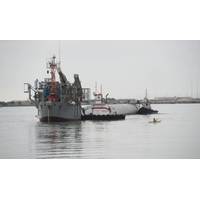
The U.S. Navy’s three Global class oceanographic research ships (AGORs) have received a new lease on life. The ships-- R/V Thomas G. Thompson (AGOR 23), R/V Roger Revelle (AGOR 24) and R/V Atlantis (AGOR 25)-- which entered service between 1991 and 1998--were built with 30-year expected service lives. Thanks to extensive overhauls on all three they have been returned to service with another 15 years of useful service.AGOR 23 is operated by the University of Washington; AGOR 24 is operated by Scripps Institution of Oceanography; and AGOR 25 is operated by Woods Hole Oceanographic
US Navy-owned Research Vessel Back in Action
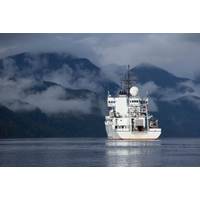
Research vessel (R/V) Thomas G. Thompson (AGOR-23) has gained a new lease on life following a recently completed 18-month upgrade to improve operating systems, bolster its research capabilities and extend its working life for the U.S. Navy and scientific organizations.The Navy-owned vessel has been operated and maintained University of Washington since 1991, under a charter lease agreement with the Office of Naval Research (ONR)-which manages the ship on behalf of the service.The $52 million refit, which was sponsored by ONR, the University of Washington and the National Science Foundation, extended
RV Sally Ride Enters Dry Dock for Maintenance
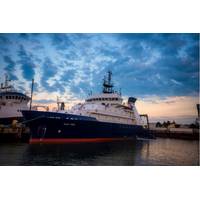
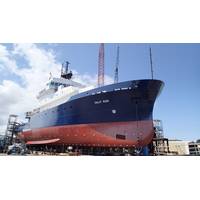
The Sally Ride, a Neil Armstrong Class Auxiliary General Oceanographic Research (AGOR) vessel, dry docked at Bay Ship and Yacht on April 15, 2017, to carry out modifications to superstructure and to perform general vessel maintenance. Named for the late astronaut Sally Ride, the ship is 238 feet long and incorporates the latest technologies, including high-efficiency diesel engines, emissions controls for stack gases, and new information technology tools both for monitoring shipboard systems and for communicating with the world. It will serve to provide scientists with the tools and capabilities
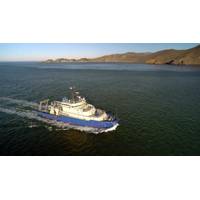
Research Vessel Neil Armstrong Joins WHOI Fleet
Navy officials worked with the science community to hammer out details of the ships' design, four oceanographic institutions competed for the job of operating the new vessels, and in 2010, the Navy awarded the first of the class to Woods Hole Oceanographic Institution (WHOI). What was then known as AGOR-27 would become the latest in a long line of WHOI-operated ships that began in 1930 with the first Atlantis. Five more years passed as the ship slowly took shape, first on paper and then in steel on the shipyard of Dakota Creek Industries (DCI). All that planning and hard work culminated
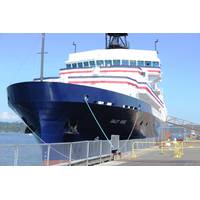
RV Sally Ride Completes Builder's Trials
The U.S. Navy's new Auxiliary General Purpose Oceanographic Research Vessel (AGOR), R/V Sally Ride (AGOR 28), has completed builder's trials, February 21, off the coast of Anacortes, Wash. Builder's trials for Sally Ride tested various shipboard systems and ensured readiness prior to conducting acceptance trials with the U.S. Navy's Board of Inspection and Survey. The propulsion system, mission-over-the-side handling equipment, anchor handling system and work/rescue boat launch system were among the systems successfully demonstrated. "R/V Sally Ride performed
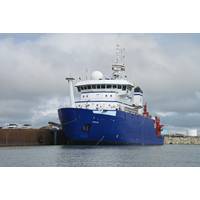
New Ships Join the US Research Fleet
The nation’s newest oceanographic research vessel, the R/V Neil Armstrong (AGOR 27), has completed acceptance trials, and the U.S. Navy turned the ship over to Woods Hole Oceanographic Institution (WHOI) on Sept. 23, which will operate the vessel as part of the U.S. Academic Research Fleet (ARF). “The U.S. Navy is proud to support the national research fleet by delivering state-of-the-art research vessels like the R/V Neil Armstrong,” said Chief of Naval Research Rear Adm. Mat Winter about the event. “The Navy’s innovative scientific mission will directly benefit from
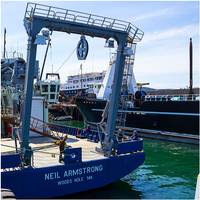
Allied Marine Crane Outfits R/V Neil Armstrong
The U.S. Navy’s research vessel Neil Armstrong (AGOR-27), scheduled for completion this year, is equipped with a modern array of oceanographic research equipment. To handle this equipment, Allied Marine Crane, a division of Allied Systems, Co., was chosen to design and manufacture two cranes, one A-frame, one davit, two handling systems and two hydraulic power units. Allied Marine Crane equipment was specified based on their history with research equipment handling, their proven design and build capabilities, and strong working relationship with marine winch supplier Markey Machinery.
Markey Equips Research Vessel Sally Ride
for the first American woman launched into space aboard the Space Shuttle Challenger, the Research Vessel Sally Ride was commissioned August 9 at Dakota Creek Industries (Anacortes, Washington). Sally Ride is a U.S. Navy Office of Naval Research sponsored Auxiliary General Oceanographic Research Vessel (AGOR-28). The vessel’s advanced deck machinery will be operated by Scripps Institution of Oceanography personnel during extended scientific missions upon the seven seas. Missions to explore and study the hostile ocean environment implore low maintenance deck machinery designs for rugged durability
Oceanographic R/V 'Sally Ride' Christened
to a reality, but also of the spirit of exploration and discovery shared by Sally Ride and the United States Navy,” said Mabus. “For decades to come, the men and women who will man this ship will look past the horizon, beyond man-made boundaries, searching, learning, and honoring the pioneer AGOR 28 is named after – the great Sally Ride.” The Neil Armstrong-class, of which R/V Sally Ride is a member, features a modern suite of oceanographic equipment, state of the art acoustic equipment capable of mapping the deepest parts of the oceans, advanced over-the-side handling gear

 February 2026