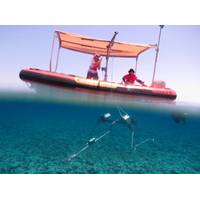
Lander Lab: Cost Efficiency of Baited Ocean Landers
include a sensor suite to measure and record the effect of fluctuating oxygen minimum zones, and other physical oceanographic events on local populations of animals. Multiple BRUV/ocean lander systems can be deployed at one time, making it a time-efficient survey method of a large area.Multi-camera digital imaging systems with overlapping fields of view can provide 360° panorama views of the seafloor around a lander. Thermal cameras are finding relevance in marine studies.As Isaacs showed, deeper waters can be accessed by an autonomous ocean lander in the same manner as a BRUV, relying on the lander&rsquo
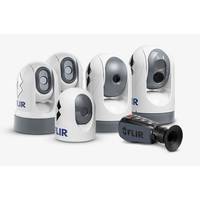
Teledyne Acquires FLIR
Industrial conglomerate Teledyne Technologies Incorporated (NYSE:TDY) said it has completed its acquisition of thermal imaging cameras and sensors company FLIR Systems, Inc. (NASDAQ:FLIR). FLIR will now be included in Teledyne’s Digital Imaging segment and operate under the name Teledyne FLIR.Under the terms of the cash-and-stock deal announced in January, FLIR stockholders received $28.00 per share in cash and 0.0718 shares of Teledyne common stock for each FLIR share, which implies a total purchase price of approximately $57.40 per FLIR share based on Teledyne’s closing price on May 13.
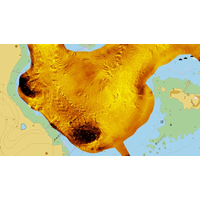
Teledyne to Acquire CARIS
chart production and management software. Approximately 90 percent of the world’s hydrographic offices use CARIS in their workflow. “By providing powerful data processing, mapping and geospatial imaging software, CARIS ideally complements both our marine instrumentation and digital imaging businesses,” said Robert Mehrabian, Chairman, President and Chief Executive Officer of Teledyne. “CARIS immediately extends our marine capabilities, advancing the delivery of imaging and information from Teledyne’s broad portfolio of marine sensors and systems. Furthermore
Teledyne Takes Stake in AUV Designers Ocean Aero
underwater/surface vehicles, powered by wind and solar, complement Teledyne’s battery-powered Gavia AUVs and market-leading autonomous gliding vehicles using buoyancy-based propulsion.” About Teledyne Teledyne Technologies is a leading provider of sophisticated instrumentation, digital imaging products and software, aerospace and defense electronics, and engineered systems. Teledyne Technologies’ operations are primarily located in the United States, Canada, the United Kingdom, and Western and Northern Europe. www.teledyne.com.
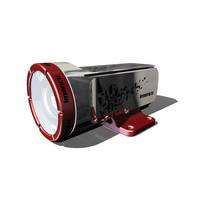
Imenco and High Resolution Subsea Digital Imaging
Imenco challenges established standards with the introduction of an all-digital system that it says will have considerable ramifications in the way the subsea industry carries out inspection tasks. The solution, and all of Imenco’s future systems, will be run with Ethernet using the latest TCP/IP Standard. With the ‘PC’ inside the camera rather than on the surface, customers will be able to tailor how they use the subsea system to meet their own specific demands using Apps supplied by Imenco or written specifically for their need. Imenco has designed and written the software providing
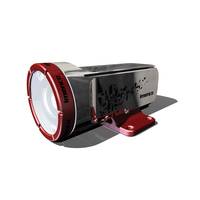
Imenco & High Resolution Subsea Digital Imaging
Digital transmission is something most of us use - knowingly or otherwise - everyday, whether it be smart phones, tablets or via other electronic devices. The subsea industry is the exception with its reliance on analogue (SD or Standard Definition) cameras in the belief that analogue systems have sufficiently low latency. Latency is the time it takes for the signal to travel from the subsea camera to the operators screen, via the ROV umbilical (wire). For the signal to make this journey, it needs to be converted to an analogue signal in the camera before travelling up the umbilical. Delays can be
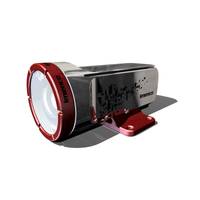
High Resolution Subsea Digital Imaging
Digital transmission is something most people use - knowingly or otherwise - everyday, whether it be smart phones, tablets or via other electronic devices. The subsea industry is the exception with its reliance on analogue (SD or Standard Definition) cameras in the belief that analogue systems have sufficiently low latency. Latency is the time it takes for the signal to travel from the subsea camera to the operators screen, via the ROV umbilical (wire). For the signal to make this journey, it needs to be converted to an analogue signal in the camera before travelling up the umbilical. Delays can


 February 2026