
Follow the Money
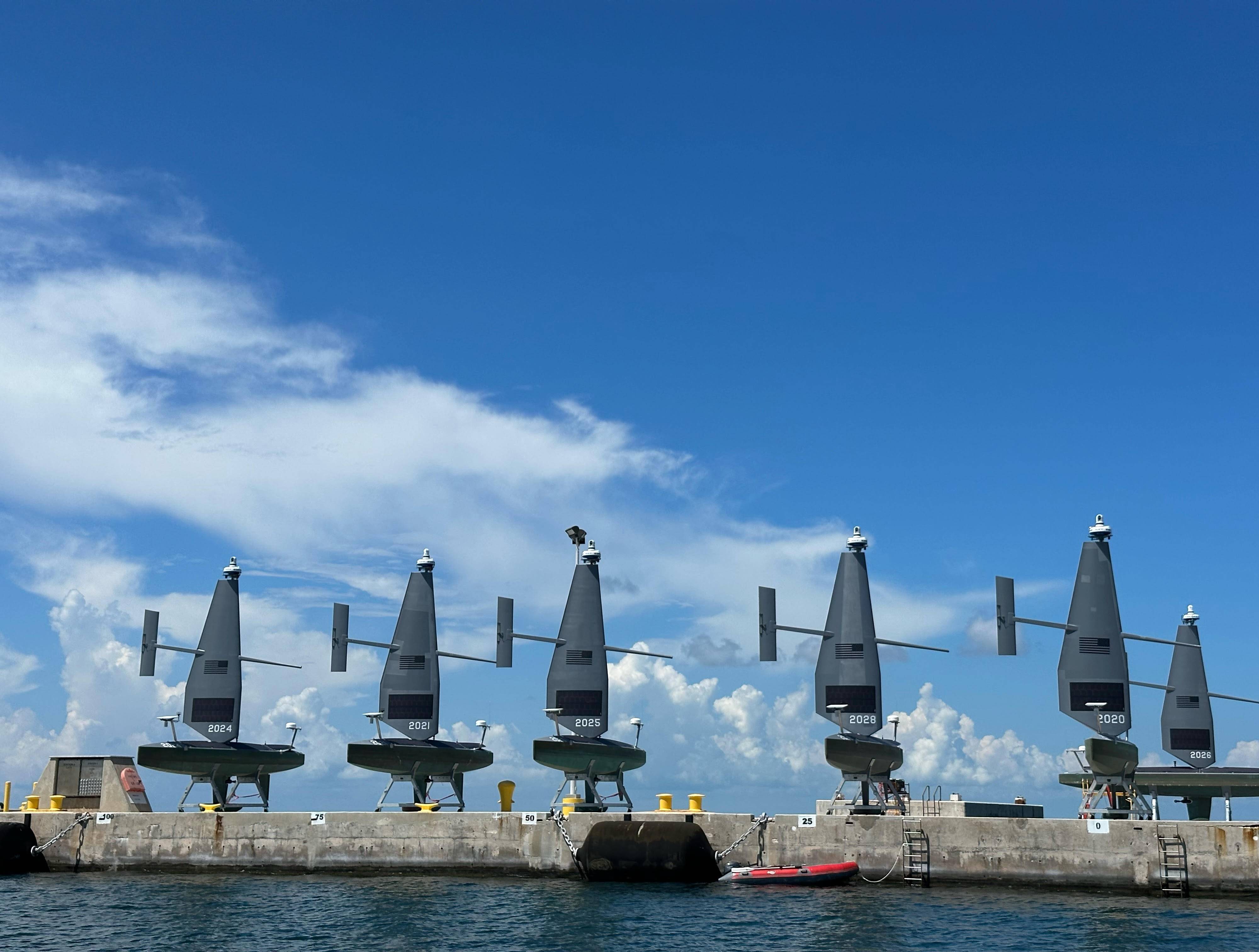
Commercial operators deploy Saildrone Voyager Unmanned Surface Vessels (USVs) out to sea in the initial steps of U.S. 4th Fleet’s Operation Windward Stack during a launch from Naval Air Station Key West’s Mole Pier and Truman Harbor, Sept. 13, 2023. (U.S. Navy photo by Danette Baso Silvers/Released)
“Follow the money" is a phrase popularly but incorrectly attributed to Deep Throat/Watergate. Broadening the coverage of the phrase to include the hot unmanned and autonomous surface and underwater vehicle segments allows us to understand what’s really going on in the market and the sums of money involved are significant.
The anatomy of unmanned systems
Firstly, let’s start by understanding the anatomy of an unmanned surface vehicle (USV) and an autonomous underwater vehicle (AUV). Autonomy has several levels, effectively split into manual teleoperation, remote supervised control (generally over the horizon/out of sight), and full autonomy. USVs and AUVs generally feature nine key elements. USV and AUV companies operate with varying degrees of vertical integration, although in the following sections, we will touch on some regional trends.
Anatomy of an unmanned vehicle
Element | Details |
Hull | USVs use monohull, catamaran, trimaran, or SWATH designs (aluminum, carbon fiber, composites); AUVs use cylindrical/torpedo pressure hulls (aluminum, titanium, composites) with hydrodynamic shells, ballast/trim systems, and flooded sections. |
Propulsion | Combustion engines, electric motors, sails, solar, or buoyancy engines (gliders) with battery storage for energy conversion. Propellers, water jets, or thrusters for propulsion. Rudders, fins and thrusters (plus elevators for AUVs) for vectoring. |
Navigation & guidance | USVs use GPS/GNSS, IMU, and DVL. AUVs lack underwater GPS, so rely on INS, DVL, depth sensors, acoustic positioning (USBL/LBL), and terrain-relative navigation. |
Sensors & perception | Radar, electro-optical and infrared cameras, LiDAR, sonar, and environmental sensors support obstacle detection, mapping, and monitoring. |
Command, control, & communication | Onboard autopilot computers, RF/satellite/cellular wireless links, and shore-based control stations. AUVs add acoustic modems for underwater comms. |
Autonomy software | Follows a sense-plan-act loop: perception (sensor fusion, object detection), localization (GNSS+IMU+DVL fusion), planning (path planning, COLREGs-compliant obstacle avoidance), control (actuator commands), and mission supervision (fault handling). Digital twins are commonly used for pre-deployment testing. |
Compute stack | GPU-class edge AI modules for perception, a CPU for mission/control logic, optional FPGAs for real-time signal processing, all packaged in rugged, low-power, redundant hardware. |
Payload systems | Mission-specific gear (sonar variants, cameras, environmental sensors, magnetometers, sub-bottom profilers, etc.) or defense payloads (surveillance, mine countermeasures, strike, etc.). |
Safety | Lights/AIS, fail-safe return-to-home logic, recovery hardware. AUVs add leak detection, watchdog-triggered surfacing, and emergency ballast release. |
Source: Intelatus Global Partners
The U.S. approach: primes, commercial yards and VCs
Four major private shipbuilders act as Navy primes: HII (leads in unmanned systems via ROMULUS USV and REMUS AUV programs under Odyssey autonomy software); General Dynamics (builds AUVs through Bluefin Robotics and develops USV C2 technology); Austal USA (builds Saildrone's Voyager USV); and Fincantieri Marine Group (will build Saildrone's Spectre USV). Boeing, a broader defense prime, builds the Orca XLUUV in California, with HII assisting hull assembly in Virginia.
Partnering with HII and Raytheon Technologies, major commercial shipbuilder Bollinger has supplied nine 12-meter semi-autonomous aluminum MCM USVs to the U.S. Navy and has a further 18 MCM USVs under contract, out of a total planned final inventory of 48 MCM USVs.
Several commercial shipyards have partnered with the growing number of venture-backed start-ups emerging in the U.S. While these companies ostensibly target both defense and commercial applications, many are scaling on the back of U.S. Navy programs, signaling a potential shift in naval procurement toward a “build first, buy later” model. Although procurement programs are now materializing, questions remain over the long-term financial sustainability of a sector requiring substantial capital investment ahead of revenues. We do not expect all start-ups to sustain this model. Some are likely to consolidate through M&A, while others may fail to progress beyond development. The investment approach of leading venture capital firms, often spreading capital across multiple companies in the sector, may reinforce this expectation.
Selected U.S. autonomous vehicle and technology start-ups

Source: Intelatus Global Partners
Other NATO and AUKUS markets: National champions, M&A and some VC activity
Kongsberg Gruppen (Oslo-listed, 50.1% Norwegian government-owned) is a key Nordic defense player with a broad maritime tech portfolio spanning navigation, seafloor mapping, sonar, and autonomous systems, including the Sounder USV and HUGIN AUV family for the defense and commercial segments. Kongsberg has developed much of its defense related technology with partners in the Norwegian defense and industrial space, and the acquisition of Hydroid, the U.S. manufacturer of shallow-to-medium depth REMUS AUVs (sold to HII in 2020).
July 2026 saw three major acquisitions consolidating unmanned maritime systems players:
- Canada’s Kraken Robotics ($615 million) acquired the UK's Covelya Group, including Sonardyne, EIVA, Forcys, Wavefront Systems, Voyis, and Chelsea Technologies, with technology offerings spanning underwater acoustics, sonar, navigation, imaging, and autonomous systems, significantly broadening Kraken's subsea portfolio.
- France’s Thales agreed to acquire the Gorgé family's 35.5% stake in compatriot Exail Technologies and launch a tender offer for remaining shares, valuing Exail at about €3.9 billion ($4.6 billion). The deal aims to create a global leader in autonomous maritime systems, underwater warfare, and inertial navigation, combining autonomous surface/underwater drones, mine countermeasures, ASW, sonars, photonics, and quantum sensing, strengthening GPS-independent navigation capabilities.
- Building on its acquisitions of WASS (2025) and Remazel (2024), Italy’s Fincantieri announced four acquisitions (Next Geosolutions, WSense, Graal Tech, Defcomm) for about €600 million ($687 million), building on earlier WASS (2025) and Remazel (2024) deals. This creates a vertically integrated underwater business across marine surveys, offshore services, autonomous drones, underwater communications, and the Internet of Underwater Things (IoUT), comprising eight specialized companies across Europe and the UAE, reinforcing Fincantieri's position in dual-use underwater technology and maritime infrastructure.
The UK’s Kraken Technology grew in under six years from a three-person startup to around 200 employees, delivering NATO USVs led by its 8.4m K3 Scout (200+ sold) and the USSOCOM-backed K4 Manta. Growth stems from an open, agnostic architecture (30+ modular payloads), NATO/UK government backing, and an automotive-style "boat-in-a-box" model producing a K3 daily from around 400 components, targeting four-country manufacturing through partnerships with U.S. Anduril, Canada’s Davie Defense, and Germany’s Rheinmetall. In July 2026, Kraken closed a $175 million Series B funding round at a $1 billion valuation to fund capability development and manufacturing expansion. UK facilities can scale to 1,000 units/year, with Germany matching that capacity.
The European commercial market
In oil & gas and offshore wind, USVs and AUVs increasingly conduct site surveys, construction surveys, and infrastructure inspection. Successful firms integrate vessels, sensors, C2 software, and data analytics, positioning themselves as data-as-a-service (DaaS) providers, since data delivery, not vessel supply, is the core offering. In this section, we discuss three successful DaaS players.
Netherlands-based listed company Fugro is a global leader in on/offshore mapping, modeling, and monitoring, generating around 30% of 2025 revenue from marine asset integrity supported by a USV fleet and remote operation centers. It partnered with SEA-KIT in 2020 (acquired 2023) for USV design/build, and currently operates one Blue Shadow, five Blue Essence (two more in construction), one Blue Eclipse, and one Blue Prism USV, targeting 5-10 geophysical and 5-10 inspection/monitoring USVs by 2027. Fugro's strategy emphasizes remote operations and USV differentiation to cut costs/emissions toward net zero by 2050. It also runs multiple Kongsberg HUGIN AUVs (3000, 4500, 6000, Edge, Superior) plus Echo Surveyor VII and Echo Mapper AUVs.
Founded in 2008, Reach Subsea offers IMR, construction support, and survey solutions. Its unmanned business, Reach Remote, provides DaaS and is now transitioning toward becoming a standalone listed company as it scales. Reach Remote operates two Exail Drix H-8 survey USVs (Orca 1 and Orca 2), and two Kongsberg 24-meter USVs (Reach Remote 1 & Reach Remote 2), with two more under construction for 2027 delivery, plus 14 tethered ROVs. The USVs run at IMO Degree 3 autonomy (uncrewed, ROC-controlled) for pipeline/subsea inspection, survey, seabed mapping, and light repair across oil & gas, offshore wind, cables, fish farming, mining, and environmental sectors, using hull-mounted sensors, an ROV survey system, and deployable UASs.
Founded 2017, XOCEAN is a privately-owned Irish marine tech company with more than €160 million ($185 million) raised, valued at about $270 million. It's a vertically integrated DaaS provider, designing/building USVs in-house, operating via its Irish ROC and CyberDeck C2 stack, and delivering multibeam echosounder, side-scan sonar, sub-bottom profiler, and magnetometer data across offshore wind, geophysical, environmental, asset integrity, bathymetry, and fisheries markets. XOCEAN operates around 30 XO-450 USVs (4.5m, solar/battery-powered, container-transportable) and several larger X-580 USVs (5.8m, MCA-compliant), with more X-580s under construction.
A pioneering global player
Founded in 2017 (HQ: Texas, USA and Southampton, UK), Ocean Infinity is a marine robotics company founded by Anthony Clake (majority shareholder/backer) and CEO Oliver Plunkett. Whilst developing into an ideal candidate for listing or M&A, Ocean Infinity remains privately held. It's a leading example of commercial global Maritime Autonomous Surface Ships (MASS), USV, and AUV DaaS company. Ocean Infinity provides seabed surveys, offshore monitoring, infrastructure support, search operations, and uncrewed vessel operations. It combines AI-driven data processing, satellite comms, and remote operation centers (ROCs) to shift the industry from crewed vessels to lean/unmanned fleets across offshore energy, defense, environmental monitoring, and deep-sea exploration.
Ocean Infinity’s fleet consists of multiple lean-crewed and unmanned platforms, controlled from ROCs in Southampton and Sweden, with further sites planned in Tasmania, Singapore, and Texas:
- USS Accession (3.5m-5m variants), acquired via Unmanned Survey Solutions (Jan 2026).
- L3Harris C-Worker 8USV for coastal/shallow-water surveys and inspections.
- Armada 21 (4 x 21m battery-hybrid USVs, built by Grovfjord in Norway, DNV-classed) for windfarm/cable surveys, delivered 2024–2025.
- Armada 36 (3 x 36m battery-hybrid USVs, built at Gdansk Shipyard/fitted in Southampton) under construction, part of a 5-vessel plan. UK MCA advancing uncrewed operation approval.
- Armada 78 (8 x 78m battery-hybrid dual-fuel MASS, built by VARD, Singapore-flagged) delivered 2022–2024, for geophysical/geotechnical work.
- Armada 86 (6 x 86m battery-hybrid MASS, VARD-built, moonpool-equipped for AUV/ROV/seabed tool deployment) delivered 2024–2025.
- NeedleFish (14m USVs) delivered to Kuwait Coast Guard with SRT Marine Systems.
- Kongsberg HUGIN AUVs, operating solo or in swarms via mother ships.
Hundreds of companies and concepts
In this article, we have reviewed some of the leading players in a fast-moving sector. Our proprietary database contains several hundred companies, from start-ups to established global players, who have collectively developed more than 900 individual MASS, USV and AUV models, many of which are in commercial production. Not all of these companies will succeed, but many will and many will require capital to sustain growth.
And as the MASS, USV, and AUV segments grow, so do the equipment and payload requirements, benefiting the wider maritime ecosystem.
For any queries, please contact Philip Lewis at <[email protected]>.




 August 2026