Echoview Launches New Version of Acoustic Data Software
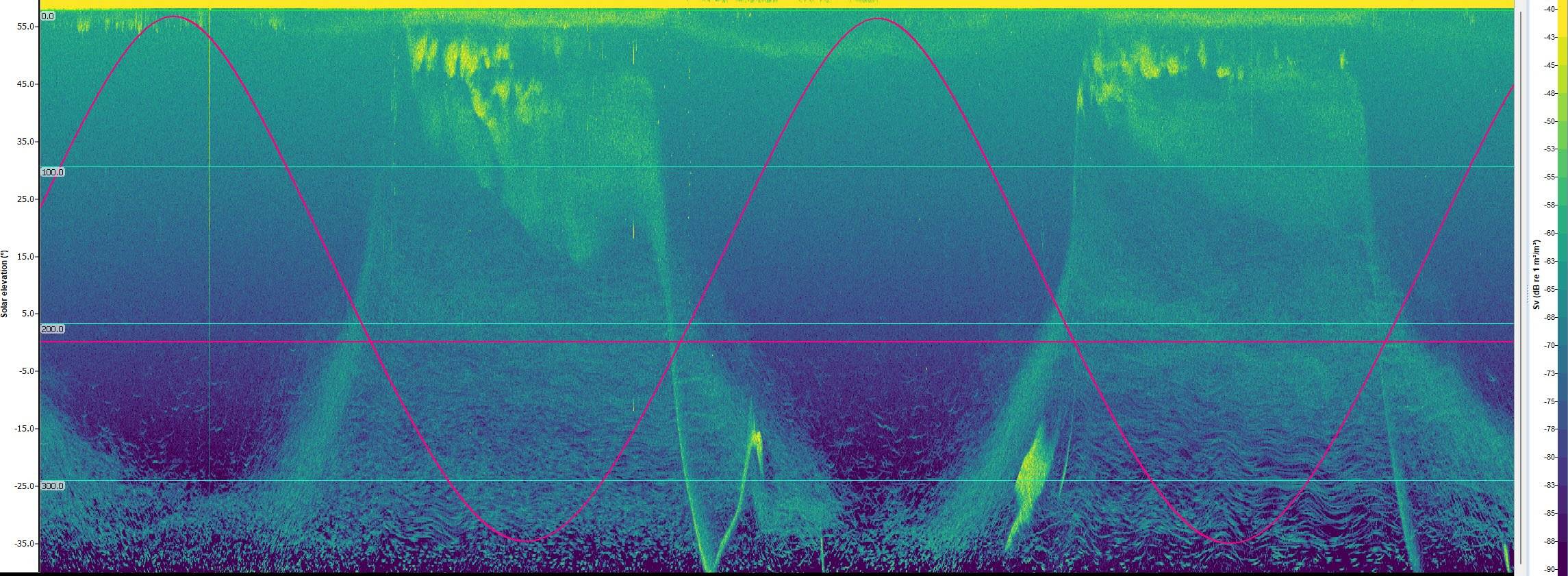
Solar elevation data (oscillating pink line) overlaid on Nortek Signature 100 data, providing context for diel vertical migration patterns in backscatter. The horizontal line marks 0° solar elevation, allowing day (above the line) and night (below the line) to be quickly confirmed. © Echoview Software
Echoview Software has launched Echoview 17, the latest release of its flagship software for processing, visualizing, and analyzing active acoustic data.
Echoview helps researchers, consultants, government agencies, industry, and environmental organizations process and interpret active acoustic data for water column research applications ranging from fisheries assessment and habitat mapping to ecosystem monitoring and behavioral studies.
Echoview 17, released in September 2026, expands compatibility with a broader range of data sources, while delivering enhancements to data processing, analysis, detection, automation, and workspace management. Together, these improvements help users work more efficiently and extract greater value from their data.
Key highlights of Echoview 17:
- Expanded support for Tritech Gemini and other formats
- Echoview 17 introduces support for Tritech Gemini (*.glf) files, adding another widely used imaging sonar format to Echoview's extensive range of supported technologies. Compatibility with other acoustic and ancillary data has also been extended, allowing researchers to bring more of their existing datasets into a consistent analysis workflow.
- For Kongsberg EK80 data, passive data can now be separated automatically from active pings recorded by the same transducer, while clearer variable names make different ping modes, data types, and sequencing configurations easier to identify and manage.
- Advanced time series capabilities
- Echoview 17 expands its Time series capabilities, helping researchers examine acoustic observations alongside environmental measurements, platform information, derived metrics, and other contextual data. Time series can be overlaid on echograms or compared in a single graph, making relationships between acoustic and supporting datasets easier to identify. New operators provide additional ways to generate and process Time series data.
- Improved Dataflow and workspace management
- Echoview 17 provides a more streamlined environment for building and managing processing workflows. An integrated Dataflow Toolbox, object grid snapping, and visual warnings make complex Dataflows easier to organize and troubleshoot. Enhanced window and layout controls help users configure their workspace for different projects and working styles.
- Multiple detection configurations
- Echoview 17 makes it easier to develop and compare alternative approaches to single beam and multibeam school and fish track detection. Users can create and manage multiple configurations in one place, helping them test different settings, compare their effects, and select an approach suited to their data and research objectives.
- More flexible analysis workflows
- Echoview 17 extends established analysis tools and exporters to a broader range of acoustic measurements, giving researchers more flexibility to work with different data types through familiar workflows. Interval Analysis operators can now work with additional data types, including power, TS, linear and unspecified dB, allowing analysis methods to be applied more broadly. Analysis exports can also include the ECS filename, making it easier to identify the calibration file used when reviewing and reporting results.



 August 2026