
Handy Helpers: Electric Underwater Tools and Manipulators
Credit: Reach Robotics
Underwater vehicles fill a crucial place in maritime operations, providing support across multiple industries, reaching remote locations despite extreme conditions and reducing risk to workers. They function as surrogate eyes and ears where we cannot be, and for periods of time longer than many humans could manage. However, underwater systems reach beyond observational abilities—literally. Tools and manipulators broaden the capabilities of vehicles, allowing them to perform a variety of subsea tasks.
Reaching new depths
“One of the most significant trends we are seeing is the growing expectation that inspection-class vehicles should also be capable of intervention,” explained Nigel Steven, head of commercial at Reach Robotics. “Operators are no longer satisfied with simply observing a problem. They want to recover objects, manipulate equipment, collect samples and complete tasks without deploying larger, more expensive systems.”
As such, there is growing demand across multiple sectors—ranging from defense and offshore energy to commercial inspection, research and environmental monitoring—for manipulators that are lightweight, straightforward to integrate and specific to a project's needs.
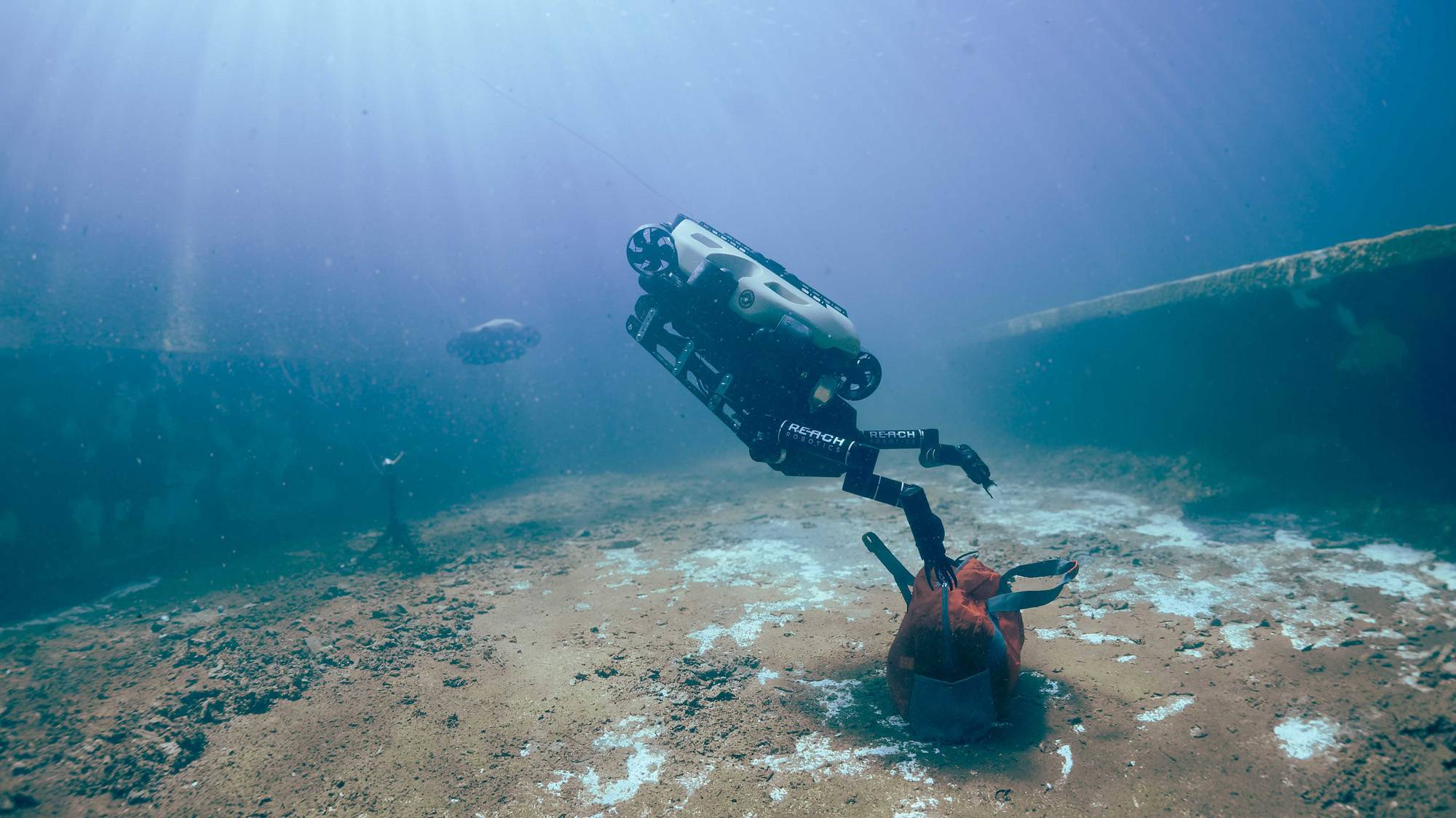
Reach Robotics develops electric manipulators for remotely operated vehicles (ROVs), enabling operators to perform precise underwater intervention tasks. The company’s product range spans compact systems for smaller inspection-class ROVs through to seven-function manipulators for more demanding subsea projects.
Steven recalled that during a recent inspection, maintenance and repair campaign, operators used a pair of Reach X five-function manipulators on an inspection-class ROV to move beyond visual inspection and conduct direct asset interaction. “The manipulators were used to place corrosion monitoring probes, clean marine growth to provide inspection access, and handle small subsea components, allowing condition assessment work to be completed without mobilizing a larger intervention system.
“For us, this project reflects a broader shift in the industry,” he added. “Operators are increasingly looking to perform practical intervention tasks from compact ROV platforms, reducing mobilization requirements while maintaining operational efficiency. It demonstrated how electric manipulation can expand the capability of inspection-class vehicles without the complexity traditionally associated with larger intervention systems.”
 Credit: Reach Robotics
 Credit: Reach Robotics
“I think we're at a real turning point for subsea manipulation,” added Rob Dewell, electric manipulator product manager at Saab UK, also recognizing the industry shift towards this capability.
“For a long time, people viewed electric systems as a compromise compared with hydraulics, but that's no longer the case,” he explained. “Advances in power density, control systems and system integration mean electric manipulators can now deliver the strength, precision and reliability needed for demanding intervention tasks, while also supporting the wider move towards all-electric and more autonomous subsea operations.”
Saab boasts the Seaeye eM1-7 Electric Manipulator (eM1-7), an electric manipulator arm designed for demanding underwater intervention tasks. It combines high lifting capability with precise control, offering up to 122kg lift capacity at a 2-meter reach and 454kg when retracted, while its six degrees of freedom provide the dexterity needed for complex operations. The system is also engineered for deepwater environments, with a depth rating of 4,000 meters.
 Saab’s Seaeye eM1-7 Electric Manipulator. Credit: Saab
 Saab’s Seaeye eM1-7 Electric Manipulator. Credit: Saab
Nauticus Robotics, Inc. also has an electric work-class subsea manipulator designed for ROV applications: the Olympic Arm. More recently, however, the company is integrating electric manipulators and autonomous operations with their first prototype built for autonomous underwater vehicles (AUVs) and robotic systems.
The initial prototype, described in a press release, features a modular three-joint configuration that serves as the foundation for planned five-joint and seven-joint variants capable of supporting increasingly complex subsea operations. Integrated with Nauticus Robotics’ ToolKITT software, the manipulator will autonomously recognize work sites, identify intervention points, compensate for changing underwater conditions, and execute tasks with reduced operator input.
Development teams have started functional and load testing, with Nauticus Robotics’ Aquanaut AUV serving as the initial integration vehicle for future field demonstrations.
An electric future
“What's particularly exciting is the role these technologies will play in reducing human intervention in hazardous environments,” Dewell enthused. “By combining advanced manipulation with greater automation and, ultimately, Al-enabled capabilities, we can improve safety, make operations more efficient and unlock new ways of working underwater that simply weren't possible before.”
Steven concurred, adding, “The subsea industry continues to evolve towards smaller, more agile robotic systems. As these platforms become increasingly capable, the role of electric, high-performance manipulation becomes even more important.”






 August 2026