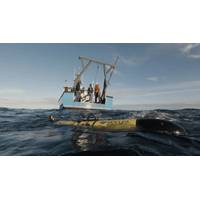
Redwing Glider Successfully Launched in Global Ocean Mission
(AUV) to circumnavigate the globe.Redwing’s journey will take it across the Gulf Stream towards Europe, then south to Gran Canaria, onward to Cape Town, across the Indian Ocean to Australia and New Zealand, through the Antarctic Circumpolar Current, and eventually back to the Atlantic via the Falkland Islands, Brazil, and the Caribbean.The mission is a collaboration between Teledyne Marine and Rutgers University. Engineers from Teledyne, alongside more than 50 students from Rutgers University - who have been instrumental in developing flight tools and navigation software - will work in unison to
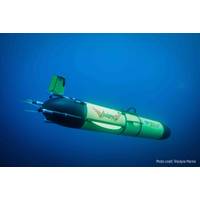
Underwater Autonomous Glider Departs to Circumnavigate the Globe
leg will take it to Cape town in South Africa, before crossing the Indian Ocean to stop at Perth in Western Australia, then on to Wellington, New Zealand. It will then navigate the Antarctic Circumpolar Current — the most powerful current on Earth — taking it on its longest leg to the Falkland Islands. From here there will be possible stops in Brazil and the Caribbean before heading back to Cape Cod in the U.S.Transmitting information via satellite when it surfaces every 8-12 hours, Redwing will share vital data on ocean temperature, salinity, currents, and ocean health via the National Oceanic
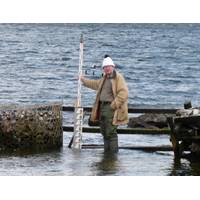
Obituary: Dr. David Thomas Pugh (1943-2022)
information on long-term sea level change. Such measurements are especially useful if they were made relative to geodetic benchmarks which survive to the present day, and which can also be used as a height reference for modern sea level measurements. David undertook such research in Tasmania and the Falkland Islands and at a number of locations around the UK and Ireland. His most recent publication on this subject (to do with sea levels at Cork) dates from 2021. He had a particular skill in tracking down important historical benchmarks that are located on old walls and buildings but are hidden beneath their
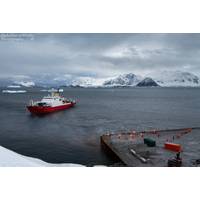
RRS James Clark Ross Makes Its Last Antarctic Call
was the RRS James Clark Ross’s final call of the ship’s five-and-a-half-month mission to deliver scientific and operational staff to Antarctica, and to resupply the U.K. stations in Antarctica for another year. Later this month the ship will make one final stop to her home port of the Falkland Islands to refuel before making the six-week journey back to the U.K.RRS James Clark Ross, named after the 19th Century British Royal Navy officer and polar explorer, was built by Swan Hunter Shipbuilders in Wallsend, U.K., and launched in 1990. For the past three decades the 99 meter, 5,372 GT ship has
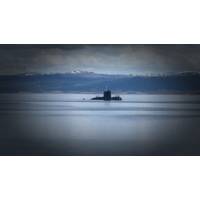
Argentine Submarine Found After Yearlong Search
of missing crew members blamed the government for underfunding the Navy.Argentina learned a harsh lesson of submarines' military value during the 1982 Falklands War, when a British sub sank the ARA General Belgrano cruiser. It was the only major ship Argentina lost in the war over the disputed Falkland Islands, which Argentina calls the Malvinas.(Additional reporting by Maximilian Heath, Scott Squires and Cassandra Garrison; Writing by Anthony Esposito, Hugh Bronstein and Scott Squires; Editing by Tom Hogue, Ros Russell and Bill Berkrot
Argentina Sticking with Submarine Program despite Disaster
adversary,” the Chilean navy says on its website. Argentina learned a harsh lesson of submarines’ military value during the 1982 Falklands War, when a British sub sank the ARA General Belgrano cruiser. It was the only major ship Argentina lost in the war over the disputed Falkland Islands, which Argentina calls the Malvinas. If anything, Argentina’s commitment to submarines is likely to grow in the years ahead, said Omar Lamrani, an analyst with Texas-based geopolitical consultancy Stratfor. “Since the military budget was cut after the Falklands
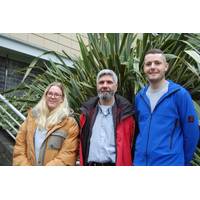
Researchers Set out to Study the Southern Ocean
Antarctic Survey (BAS). It is good for Newcastle University to be involved in this project at this stage. This is the first fieldwork season for ORCHESTRA and we hope that our involvement will continue throughout the whole research project.” Dr. Maqueda and his team flew to the Falkland Islands on November 15 where they joined the scientific research vessel, the RSS James Clark, to travel to the Antarctic to reach the BAS headquarters at Rothera. From the base they will use the RSS James Clark to deploy the Wave Glider in a 24 hour mission. The Wave Glider will then travel under the
RDS Wins Engineering and Design Contract for Sea Lion
FEED contract for the Sea Lion development and follows a concept study which was executed by an RDS team in Houston. The contract, which is expected to be carried out over the next 12 months, will see RDS deliver the design of drilling rig modules for a Tension Leg Platform (TLP), 200km north of the Falkland Islands. The overall project is being delivered from AMEC’s London design office, supported by KCA Deutag in London and Houston Offshore Engineering in Houston. Simon Drew, President of RDS said, “The Sea Lion field will be the first major development of oil and gas reserves

AGR to Drill Exploration Wells for RWE Dea in Titan Area
license 420 in 2010. AGR has enhanced previous experience working on the Leiv Eiriksson and recently delivered two wells in the Barents Sea using the rig. The company also managed the rig for 12 months while carrying out its multi-client, multi-well remote deepwater drilling campaign off the Falkland Islands in 2012. Recently AGR delivered a wildcat HPHT well for RWE Dea Norge in an environmentally sensitive area in the central region of the Norwegian Sea. Based on the available data, the well was recorded as the seventh deepest in the history of Norwegian oil and gas drilling and the second


 February 2026