Underwater Radiated Noise: What’s Missing for Design?
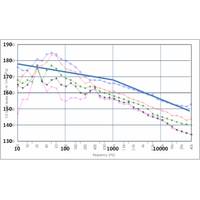
represented as an approximation using what is known as a “1/3 octave bandwidth spectral analysis”, which is a big name for the integration of total noise energy into frequency bands for a more easily communicated picture.Figure 1 – Typical 1/3 octave band URN spectrum. Image courtesy HydroCompThe curves with marker points are measured values at different ship speeds and the heavy blue line is the “DnV Silent E” notation, a contemporary noise threshold criterion. You’ll note that at all but the slowest speeds, the ship exceeds the criterion in the frequency range of
HydroComp Updates PropElements 2021
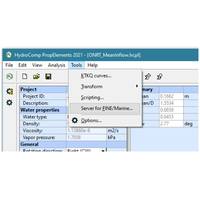
Development in 2021 for HydroComp PropElements offers new features across the range of applications, including improved wake-adapted propeller design and analysis.PropElements + FINE/Marine couplingUser testing is underway for the new coupling of HydroComp PropElements with NUMECA’s FINE/Marine CFD software. One of the challenges of full self-propulsion analysis with CFD is the computational load required to model the propeller within the 3D space. When coupled with FINE/Marine as a higher-order actuator disk replacement, PropElements calculates velocity fields and propeller body forces for the
Underwater Vehicle Propulsion Tech: Tail Shape and Vehicle-Propulsor Performance
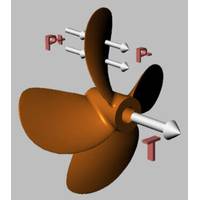
we want to identify during design – 1) the slope of flow into the propeller, 2) the curvature of the transition from the main cylindrical body to the propeller, 3) the distance between the propeller blade and the upstream body, and 4) the ratio of the propeller diameter to body diameter.Image: HydrocompSlope of flow into the propellerA propeller ideally wants inflow that is as axial as possible. The reasons for this are partly hydrodynamic and partly practical. There is a natural hydrodynamic compression and increase in velocity as water passes through a propeller. If the local environment further
Electric Motor Selection for Underwater Vehicles: Considerations of Partial Load Efficiency
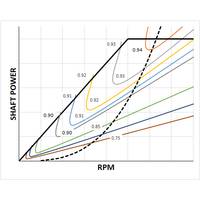
It is easy to appreciate why permanent magnet synchronous motors (PMSMs) are popular for use in underwater vehicles (UVs). They are compact and efficient with a high power density. More importantly, perhaps, they allow for effective operation across a broad RPM range which is beneficial for vehicles with multiple operating conditions. That said, we find vehicle product developers are often uncertain about a motor’s “efficiency”. This article offers a few comments from the perspective of a propeller designer, developing the components that puts the load on a UV’s motor.We first
Thruster Design for Submersible Developers
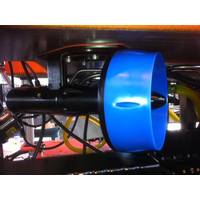
in vehicle and drive design, but will not be experienced in propulsor design. Nor would they be expected to have the specialized tools necessary for proficient thruster design, analysis, and optimization. This article will introduce submersible vehicle developers to the design practices used by HydroComp and other specialists to deliver thruster designs that are among the highest thrust-to-power ratio propulsors in service.PROPULSOR DESIGN OBJECTIVESThe ultimate objective of thruster design for vehicle development is typically a 3D CAD model of the propeller and nozzle that will support &ndash
Contemporary UUV Propulsor Design
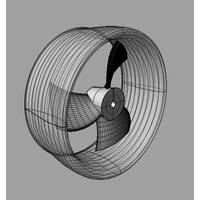
for the battery budget), maximum body diameter, minimum operational speed, consideration of shrouds or nozzles for hydrodynamic efficiency or safety from propeller contact, or reduction of noise to ensure quiet operation for data gathering. This is the setting for our UUV propulsor design work at HydroComp, and it starts with a client interview to glean the really important information for a successful design project. The Vessel-Propulsor-Drive model is a good framework for such discussions.VesselThe typical UUV is a body-of-revolution hull form (also called an axi-symmetric form) that has a nose
Engineering Better Propulsion
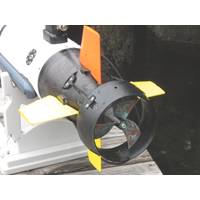
“Propeller design has often been considered kind of a black art,” said Donald MacPherson, technical director at HydroComp, Inc. But it’s an art that MacPherson has always had a knack for, and today his company is known as experts in the field of hydrodynamic performance.MacPherson co-founded HydroComp together with managing director Jill Aaron in 1984. The Durham, N.H. based firm’s maritime software and consultancy services have aided a wide range of hull and propeller analysis and design projects – from large commercial ships to unmanned underwater vehicles. For any
HydroComp Names Reps for Japan and China
HydroComp, Inc. has introduced FsTech, Inc. of Japan, and Nanjing Tianfu Software. Co., Ltd. (NJTF) of China as its newest representatives. FsTech was founded in 2009 by Zhang Ming and specializes in engineering simulation consulting service fields such as OpenFoam based CFD development, industrial design, CAE analysis and optimization. Zhang holds a PhD in Fluid Machinery and Engineering, and was a visiting professor of Kyushu Institute of Technology after founding FsTech. Zhang will be HydroComp’s liason and in charge of all sales and support activity for Japan. Nangin
New Submarine and SWATH Capabilities for HydroComp NavCad
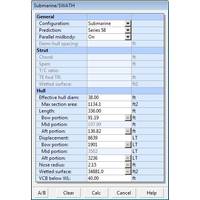
HydroComp NavCad is a software tool for the prediction and analysis of vessel speed and power performance. It also provides for the selection of suitable propulsion system components – engines, gears and propellers. A recent development effort has been undertaken to provide new submarine and SWATH performance analysis in NavCad. This includes new definitions for submerged hull form geometry, and the prediction of resistance and hull-propulsor interaction coefficients. Submerged hull form geometry The definition of the submerged hulls of submarines and SWATH vessels in NavCad is a new


 February 2026