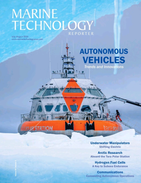
NORBIT Acquires Water Linked
NORBIT has acquired Trondheim-based Water Linked, a specialist in underwater navigation and imaging technologies for ROVs, AUVs and uncrewed surface vessels.Founded in 2013, Water Linked has developed a strong position in the subsea technology market with products including Doppler Velocity Logs (DVLs), 3D imaging sonars, acoustic positioning systems and underwater communication solutions. These technologies enable navigation, perception and autonomy in GPS-denied environments and are widely used in subsea inspection, offshore energy, marine research, defense and underwater infrastructure applications.
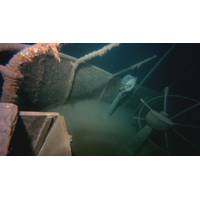
Imaging 100-Year-Old Shipwrecks Under 800 Feet of Water
Lakes. Eliason’s decades-long dedication and innovative use of technology have led to some of the region’s most significant underwater discoveries, including the Henry B. Smith and the record-breaking Scotiadoc wrecks.A critical enabler of Eliason’s work has been his use of specialized imaging tools tailored for extreme underwater environments. Chief among these is Theia Technologies’ MY125M ultra-wide no-distortion lens, which plays a central role in capturing clear, expansive visuals of deep-water wreck sites. Its ability to deliver wide-angle coverage without introducing geometric
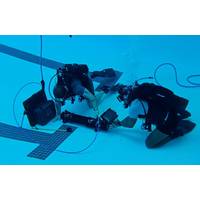
X-Ray Devise Boosts Underwater Inspection Safety
ORNL researchers developed a portable underwater X-ray imaging system that can immediately produce pictures of the interior of suspicious objects or check the integrity of infrastructure.“Until now, no practical underwater X-ray generator existed,” said ORNL’s Paul Groth. “Seeing inside submerged objects required a source of gamma radiation that posed safety risks for the diver and the marine environment,” and usually also caused delays for image processing on land.The innovation is being commercialized by industry partner The Sexton Corporation and won a 2025 R&D 100
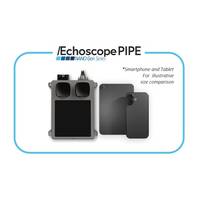
Coda Octopus Introduces Echoscope PIPE NANO Gen Series
Coda Octopus has announced the launch of the NANO Gen Series of sonars, the latest in ultra compact underwater imaging technology.The NANO Gen Series features an ultra-compact form factor, only slightly larger than a smartphone or tablet, making it ideal for integration with small underwater vehicles, diving platforms, and robotic systems.Built on the Echoscope PIPE technology, the NANO Gen Series delivers the same real-time 3D imaging performance, now extended to support advanced 4D, 5D, and 6D capabilities."With the increasing demand for smaller underwater vehicles that still require
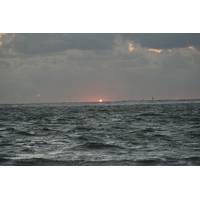
Scientists Discover Giant Sand Bodies Beneath the North Sea
Scientists have discovered hundreds of giant sand bodies beneath the North Sea that appear to defy fundamental geological principles and could have important implications for energy and carbon storage.Using high-resolution 3D seismic (sound wave) imaging, combined with data and rock samples from hundreds of wells, researchers from The University of Manchester in collaboration with industry, identified vast mounds of sand—some several kilometers wide—that appear to have sunk downward, displacing older, lighter and softer materials from beneath them.The result is stratigraphic inversion—
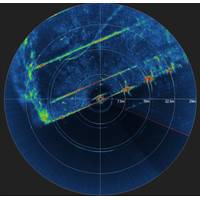
New Product: ISS360HD Sonar
which is fully used through CHIRP (Compressed High Intensity Radar Pulse) technology, designed to provide a resolution of 2.5mm when using the full bandwidth. A narrow acoustic beam, combined with a very short range resolution allows for high definition imagery.While designed to provide big imaging results, the form factor of the sonar has been kept compact, small enough the company claims for even the smallest of observation class ROVs.The ISS360HD also benefits from an inductively coupled transducer. This means there are no slip rings within the sonar – so there are no components


 August 2026