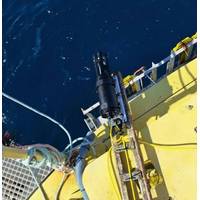
Vicinay Marine, Tecnalia Develop Remote Offshore Mooring Corrosion Sensor
Vicinay Marine and Spanish applied research center Tecnalia have jointly developed a sensor designed to remotely monitor corrosion on offshore mooring lines, aiming to improve the safety, reliability and service life of offshore systems.The companies said the sensor uses electrical resistance measurements to quantify section loss in mooring components in real time, model degradation trends and predict remaining service life.The technology is targeted at offshore wind farms and other floating offshore systems, where corrosion remains a key challenge affecting the integrity and durability of chains and
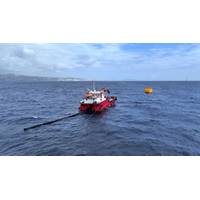
UK Firm Installs Floating OTEC Prototype in Atlantic Ocean
purpose-built offshore platform of its kind and is intended to address challenges in scaling the technology for island and coastal markets.OTEC has previously been demonstrated onshore at small scale, but its development has been constrained by the size and length of pipes needed to access seawater. Offshore systems reduce pipe length requirements and enable larger-scale deployment.The prototype was installed at the Oceanic Platform of the Canary Islands (PLOCAN), a marine test site off Spain, where engineers will assess system performance and environmental impact.The project included the deployment and
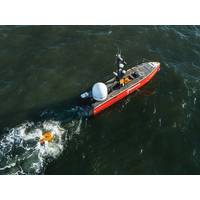
NOAA, Fugro Partner to Accelerate Deep Ocean Mapping and Characterization
workflows, the development of new sensor technologies, assessment of cloud-based data integration to support habitat mapping, the observation of critical minerals and other mission-critical objectives.Fugro's experience operating uncrewed vehicles, providing data services and remotely managing offshore systems and assets makes it a valuable partner for NOAA as they explore previously unexplored or poorly explored areas of the deep ocean. While Fugro and NOAA Ocean Exploration will develop specific projects together in the coming months, the CRADA lays the groundwork for ongoing collaboration and innovation
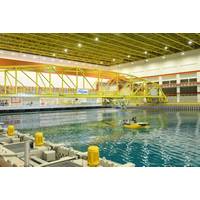
Ocean Tech Test Site Opens in Singapore
real-time data assimilation. These capabilities are developed and supported by a multi-disciplinary team of scientists and engineers with domain expertise in engineering, ocean sciences and naval architecture.Industry players are already working closely with TCOMS on projects that range from smart offshore systems, autonomous and remotely-operated vessels, marine robotics to nearshore infrastructure. These companies span Large Local Enterprises, Small and Medium Enterprises and Multi-National Corporations, including technology service providers and classification societies.“The TCOMS triple-helix
Royal IHC, Shanghai Salvage Ink Reel Lay System Deal
;We are very proud to have been selected by Shanghai Salvage as their partner for this innovative pipelay system due to our strong track record for sophisticated pipelay systems. IHC has been active in the Chinese market for over 30 years, delivering dredging vessels, dredging equipment and multiple offshore systems like pipelay systems and AHC deep water lowering systems. This new contract with Shanghai Salvage further strengthens our position in this important market for Royal IHC.”
Lloyd’s Register, TCOMS Partner on Technology Development
Lloyd’s Register (LR), an engineering, technical and business services organization, and the new Technology Center for Offshore and Marine, Singapore (TCOMS) have agreed to jointly develop technology, infrastructure and skills necessary for future marine and offshore systems, digital and data innovation, and robotic autonomous systems in a marine environment. TCOMS will allow industry partners, technology partners, incubators, regulators and the research community from Singapore and around the world to connect and collaborate through physical and digital modelling of marine and offshore
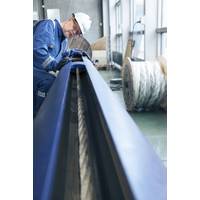
DNV GL Issues RP on Offshore Fiber Ropes
and because they can be easily customized. Their functionality is critical to ensuring successful offshore operations,” said Vidar Åhjem, principal engineer, DNV GL - Oil & Gas. “Performance-based selection of the mooring lines, lifting lines, slings and tethers, renders these offshore systems highly cost effective.” Lifting lines are used for the installation of subsea infrastructure, where the offshore fiber rope performs as an integral part of a lifting appliance and where no function can be seen in isolation. The integrated system behavior is also very important
Royal IHC acquires SAS Offshore
acquired SAS Offshore, which is based in Alphen aan den Rijn, The Netherlands. SAS Offshore is specialised in designing and manufacturing high quality deck equipment for the offshore oil and gas market. This acquisition enables IHC to further secure its position as a supplier of reliable integrated offshore systems and integrated vessels in this sector. SAS Offshore was originally founded in 1896 in Gouda and it has a long track record in delivering pipelaying systems and winches, including ancillary equipment and services. The company also holds a minority shareholding in the Norwegian engineering
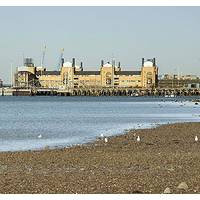
$31.7m AtlantOS Project to Enhance Ocean Observation
multidisciplinary project.” AtlantOS will improve the readiness of existing ocean observing networks and data systems, as well as strengthening Europe’s contribution to the Global Ocean Observing System. Within this project, NOC will be playing the integral role of linking coastal and offshore systems through sea level work and coastal biogeochemical projects, as well as coordinating field observations, creating products to aid weather prediction and leading the development of new observation technologies, techniques and systems to deliver data on all priority parameters. Dr. Matt
 February 2026