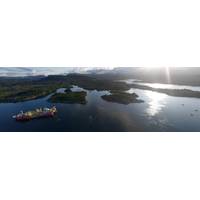
Nexans Completes Record-Depth Subsea Cable Project in Norway
Nexans and Statnett have completed a 420 kV subsea cable project across the Fensfjord in western Norway, strengthening power supply to Bergen and surrounding industrial areas.The project, awarded in 2022, included the engineering, manufacturing and installation of two high-voltage HVAC subsea cables spanning about 7.8 km between Haugsvær and Lindås, linking the Mongstad area to Iledalsvågen.The new connection doubles transmission capacity across the fjord and forms part of broader efforts to reinforce Norway’s high-voltage grid as energy demand rises.Nexans said the project
Application Note: Pressure Relief Valves and Purge Ports
vapor. So look for a system that can provide multiple purge cycles conveniently.Sea-going teams also know that loose items need to be tied down before leaving the dock. Global Ocean Design’s Deck Purge Box is a single integrated unit, easily secured to a bench top. It incorporates a universal power supply, so it readily adapts to foreign ships-of-opportunity. There are no hazmat components such as high-pressure bottles or biohazardous chemicals. It is CE compliant. It has been in production for over 15 years, and used on housings deployed at all latitudes and all depths, for short and long durations
Battery Power Management and Control
timer that outputs a 1.5v signal to a piezoelectric beeper. Bring the signal for the beeper to the gate of the NTE5455 instead to start a 10vdc source corroding a burnwire.SequencerPowering up multiple parallel circuits might be challenging due to initial in-rush currents. The TI LM3880 Simple Power Supply Sequencer is a device that controls power up and power down sequencing of three independent voltage rails. By staggering the startup sequence, the instantaneous battery loads are moderated. The robust part is qualified for automotive applications and features a low quiescent current of 25 &mu
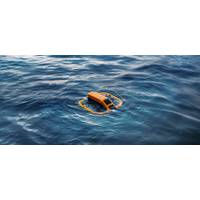
Hybrid Theory: Multi-Domain Unmanned Systems are Blurring Maritime Boundaries
approach to scalable, “disruptively affordable” autonomous maritime systems.SubSeaSail’s HERMES, meanwhile, is a scalable, self-righting, semi-submersible trimaran designed for long-duration surface and subsurface operations, and is envisioned as a cargo and expeditionary power supply platform. Like HORUS, HERMES can submerge to 100 meters to evade detection or ride out severe weather. With speeds of 5 to 15 knots, and large-volume payload space, it offers a high-speed, attritable platform for contested logistics.The HERMES. Credit: SubSeaSailAnother maritime innovator, Gulfport-bas
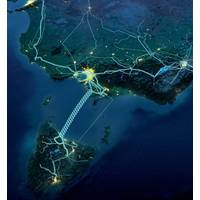
FID Made on Australia’s Marinus Link
cables, a communications station, and converter stations at each end.The project’s cables span 345 kilometers. This includes 255 kilometers of undersea cables across Bass Strait and 90 kilometers of underground cables in Gippsland, Victoria.Marinus Link’s 1,500MW capacity is equal to the power supply for 1.5 million Australian homes and approximately three times the capacity of the existing Tasmania to Victoria interconnector, Basslink.Marinus Link will be delivered in two stages. Initially as a 750MW project (Stage 1) with a second 750MW link to follow at a later date (Stage 2).The project
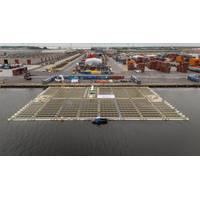
Offshore Solar Farm Set for Integration with Dutch Offshore Wind Project
farm has been completed at the Port of Amsterdam in a ‘world’s first’ project that will integrate the system with an offshore wind farm in the North Sea, offshore Netherlands.The system, supplied and built by Oceans of Energy, is larger than a football field and is set to integrate power supply at 759 MW Hollandse Kust Noord offshore wind farm in summer 2025.The wind farm, operated by Crosswind, a joint venture by Shell and Eneco, is located 18.5km offshore in the North Sea.The assembly of the offshore solar farm has been completed at the Port of Amsterdam, and the system is ready for
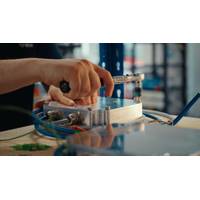
Synaptec Rolls Out Monitoring Tech to Tackle High-Voltage Cable Faults
power grids, it replaces manual inspection and reactive maintenance with a smarter, safer, and far more cost-effective approach to asset management.The system is based on Synaptec’s patented Distributed Electrical Sensing (DES) technology, which uses fully passive sensors that require no power supply, no data networks, and no ongoing maintenance.According to Synpatec, a single high-voltage cable fault in transmission networks and offshore wind developments can cost up to $1.3 million (£1million) per day in lost revenue.The vast majority of these failures, almost 70%, originate not in
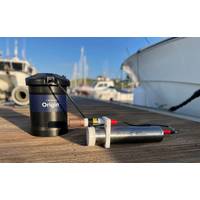
Sonardyne Integrates -4H-JENA Sensor into ADCP for Ocean Acidification Research
tools for understanding ocean acidification. The HydroC sensor integrates with Sonardyne's Origin 600 through either direct connection to the ADCP’s external sensor port or via the versatile Origin E-Mux multiplexer, which supports up to four external sensors simultaneously and extends power supply capability for longer deployments.In a recent deployment for a Sonardyne customer project, the integrated system demonstrated its effectiveness. The CONTROS HydroC sensor, preconfigured using dedicated -4H-JENA engineering software to produce measurements at defined intervals, was cabled directly
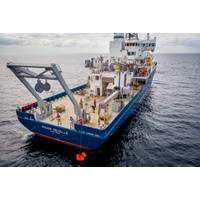
Research Vessels: A Conversation with Bruce Applegate of UNOLS
systems are increasingly being used to supplement traditional ship-based research. “With autonomy, we can deploy a swarm of sensors alongside ships, transforming data collection from a single track-line profile to a broad swath of information,” he said. However, challenges such as range, power supply, and system reliability mean that ships will remain indispensable as mobile command centers for these autonomous platforms.Students spent the day aboard the Robert Gordon Sproul as part of Fiamma Straneo’s Observational Physical Oceanography 176 class. The purpose of the cruise was to train

 February 2026