One Hull, Many Missions: How Modular USVs Are Changing Autonomous Marine Operations
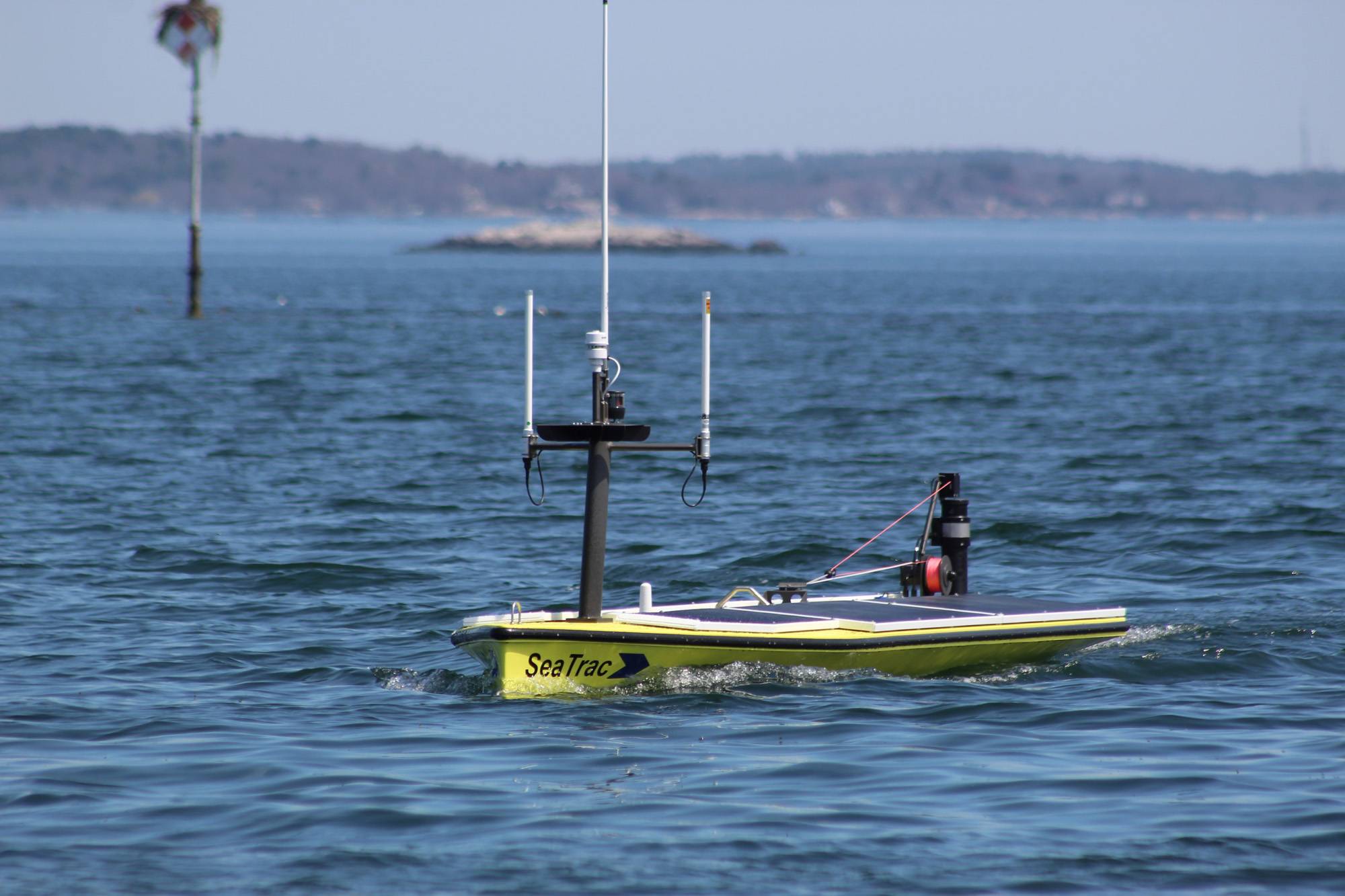
SeaTrac’s winch routinely supports profiling waters +200 meters deep, even in energetic seas where wave motion would otherwise complicate deployment. Credit: SeaTrac Systems
The rapid expansion of autonomous marine operations has created a challenge for research institutions, government agencies, and commercial operators alike. As missions become increasingly diverse, from environmental monitoring and hydrographic surveying to defense exercises and subsea positioning, maintaining dedicated vessels for every application presents difficulties both financially and operationally.
Instead, many organizations are prioritizing modular uncrewed surface vehicles (USVs) capable of supporting multiple mission profiles through rapid payload reconfiguration. Rather than purchasing a new platform for every sensor or application, a single vehicle can adapt to changing operational requirements while minimizing logistics, training, and maintenance costs.
The University of Southern Mississippi (USM) is among the many institutions putting this concept into practice. Through its Marine Research Center, USM has employed SeaTrac Systems’ SP-48 USV across an expanding range of scientific, defense, and industrial projects, demonstrating how a modular platform can serve as a force multiplier across different missions.
A Platform Designed for Adaptability
Unlike traditional, mission-specific vessels, the SP-48 is designed around a modular architecture. Payloads can be integrated using multiple mounting locations, including a moon pool, dry payload bay, mast, or keel, allowing operators to quickly configure the vehicle for different sensors without fundamentally changing the platform itself.
This flexibility eliminates the need to maintain separate vessels for every mission while allowing new technologies to be integrated as operational needs evolve.
The platform also incorporates over-the-horizon communications, multiple power options, and remote command-and-control capabilities that enable operators to supervise missions from shore. In many cases, a single operator can oversee multiple vehicles simultaneously, further increasing operational efficiency.
“USVs like ours offer researchers and project managers the opportunity to collect more marine data or surveil open waters with significantly reduced operational costs, risk to humans, and impact to the environment,” said SeaTrac’s Hobie Boeschenstein, director of business development. “Deploying USVs that are adaptable to nearly any marine environment, payload or sensor helps to ensure success across multiple mission profiles, further contributing to platform value. The use case opportunities in nearshore and offshore environments are endless.”
Expanding Environmental Data Collection
One of the clearest demonstrations of this flexibility has been USM's ongoing hypoxia mapping program in the Gulf of America.
Building on previous deployments, researchers expanded operations by deploying two SP-48 USVs simultaneously, each equipped with acoustic Doppler current profilers (Teledyne Workhorse Monitor ADCPs) and AML Oceanographic Endura 6 sondes to collect water quality measurements.
Operating multiple autonomous vessels allowed researchers to increase both spatial coverage and data density while reducing the personnel traditionally required for coastal surveys.
"SeaTrac's SP-48 and transom winch successfully reduced the on-site personnel needed for coastal hypoxia mapping despite unfavorable sea states and congested coastal corridors," said James Thompson, USM's hydrographic instrumentation specialist. "Even more impressive was the boat's connectedness. We look forward to incorporating SeaTrac technology into future research."
Rather than replacing researchers, the USVs extend their operational reach, enabling more persistent sampling with fewer people at risk on the water.
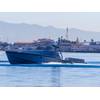
 Two SeaTrac USVs operated continuously in support of USM with minimal remote pilot intervention, held position for extended periods, and enabled re-sampling when required in the offshore waters of the Gulf of America. Credit: SeaTrac Systems
 USM remotely commands two USVs in a nearshore waterway via laptop computer. Credit: SeaTrac Systems/USM
Supporting Defense Training
The same platform has also been adapted for a vastly different mission: supporting U.S. Air Force pilot training.
Working alongside Parsons Corporation and the U.S. Air National Guard, USM configured the SP-48 to carry a TReX (Threat Representative Environment) emulator that simulated hostile air defense systems during flight training exercises.
Instead of collecting environmental data, the USV became a remotely positioned threat asset. Ultimately, the exercise targeted airborne systems and communicated with the command-and-control center via commercial and non-commercial communication mediums to develop skills in threat assessment and decision-making.
Because the USV was remotely deployed and repositioned as needed, it provided a flexible alternative to fixed infrastructure or manned support vessels.
"This innovative solution reduces logistical and personnel costs associated with manned missions while facilitating a high-fidelity simulation environment, ultimately elevating the U.S. Air Force's operational readiness," said Parsons’ Mike Kushin, president of defense and intelligence.
 SeaTrac Systems partnered with Parsons Corporation to support a threat environment demonstration for the U.S. Air Force. Credit: SeaTrac Systems
Advancing Acoustic Operations
In the area of domestic security, SeaTrac's SP-48 also supports acoustic research and intelligence, surveillance, and reconnaissance (ISR)-related activities.
In collaboration with Hyperion Technology Group and Blue IQ, USM researchers integrated Blue IQ hydrophones onto the vehicle for acoustic monitoring missions.
During stationary operations, the USV recorded acoustic signatures from surrounding marine traffic and aircraft, collecting valuable datasets without requiring personnel aboard the vessel.
The platform was also used to track autonomous underwater vehicles (AUVs) equipped with acoustic pingers. Using real-time hydrophone data, operators could detect, localize, and close in on underwater assets throughout testing.
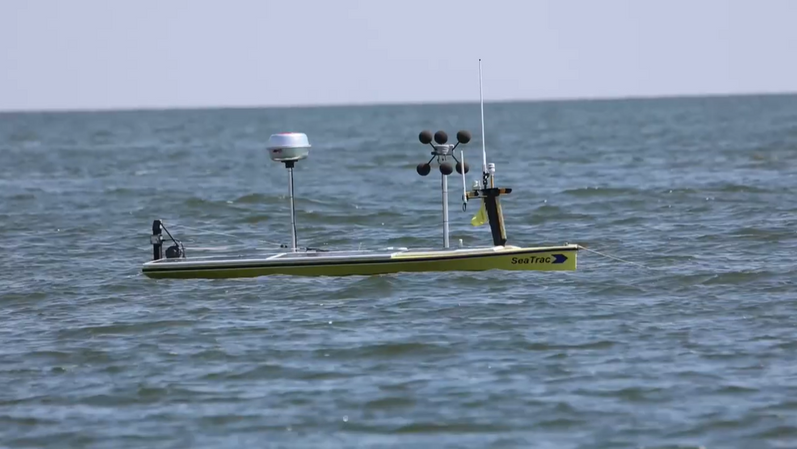 In 2026, USM hosted a collaborative acoustic demonstration on the Gulf Coast with the University of Mississippi (Ole Miss), SeaTrac, Hyperion Technology Group and BLUEiQ. Credit: SeaTrac Systems
Mapping Above and Below the Surface
Another recent application involved collaborative magnetic mapping using QuSpin magnetometers.
For this mission, the sensor was mounted beneath the hull on the SP-48's keel, allowing it to remain submerged throughout operations and collect high-fidelity magnetic measurements.
The integration illustrates how physical mounting options are just as important as sensor compatibility. Different missions often require different sensor orientations or environmental exposure, and the ability to mount payloads on the mast, within the moon pool, inside the payload bay, or beneath the hull expands the platform's operational envelope.
Preparing for What's Next
USM continues to broaden the SP-48's capabilities through additional payload integrations.
Upcoming missions include incorporating Sonardyne's Gyro USBL 5000 system to support precise underwater positioning, as well as a Kongsberg EM2040P multibeam echo sounder for high-resolution harbor and seafloor surveys.
"This demonstration is essential for rapidly identifying solutions to meet the mission-critical needs of our warfighters and federal agencies," said USM’s Dr. Brian Cuevas, associate vice president for research and innovation.
As remote-commanded marine operations continue to mature, versatility is becoming just as important as endurance or range.
Organizations increasingly require platforms that can move between environmental monitoring, defense, offshore energy, hydrography, and subsea operations without extensive reconfiguration or dedicated support vessels.
A single modular USV can support missions that once demanded multiple specialized platforms. And for operators facing expanding mission requirements and constrained budgets, that flexibility may prove to be one of autonomy's most valuable capabilities.




 August 2026