
Atlantic Canada: An East Coast Hub for Ocean Innovation
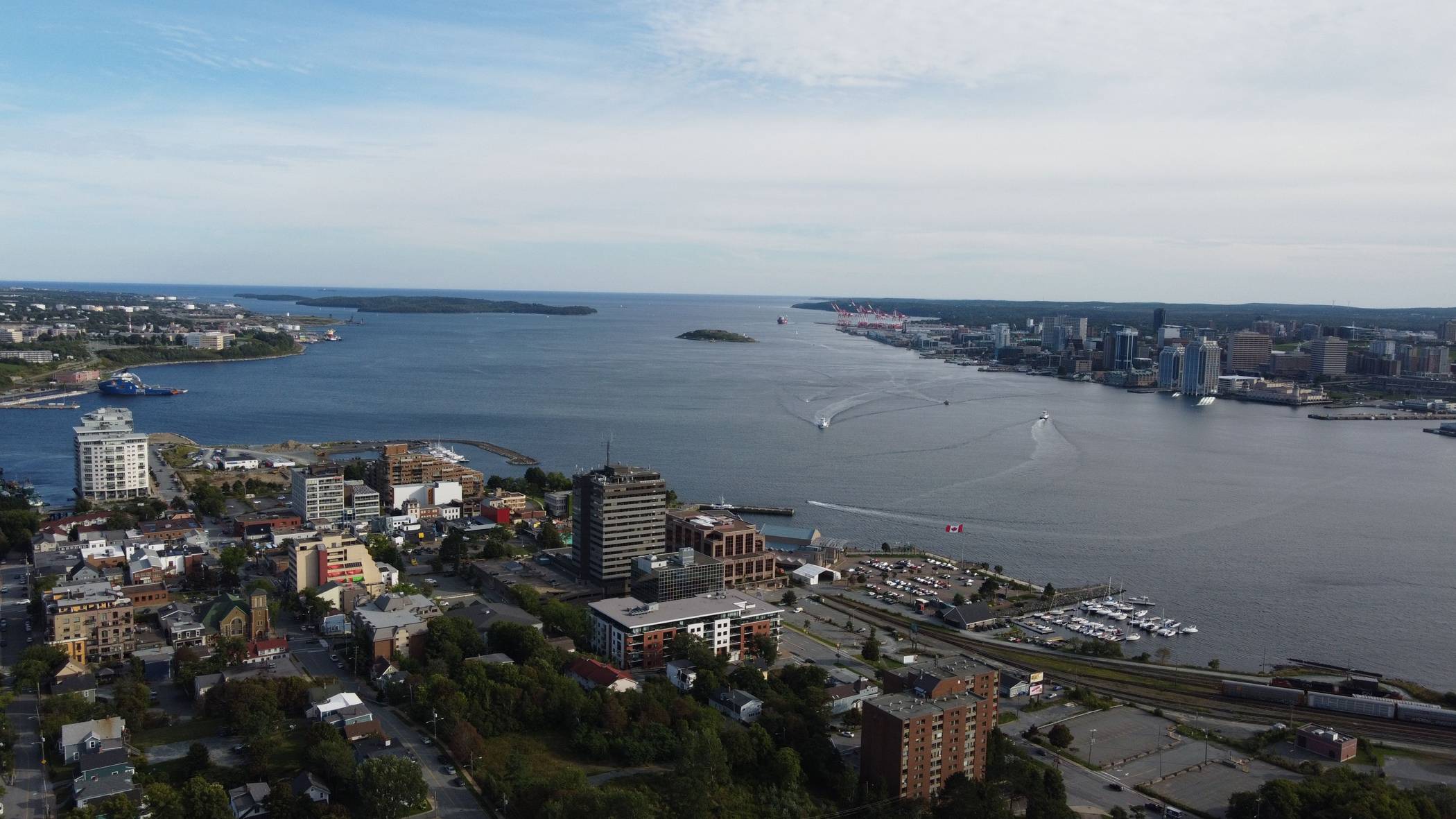
The Halifax Harbour, with Halifax on the right and Dartmouth, home to COVE, on the left. Credit: Adobe Stock/Dronescapes By Faubs/Wirestock Creators
Canada has long been an established leader in the maritime industry, complete with the longest coastline in the world (125, 567 miles) and in proximity to some of the harshest marine environments in the Arctic and North Atlantic Oceans. Leading maritime companies and organizations are scattered across the country, reaching from coast to coast to coast. Atlantic Canada, made up of New Brunswick (NB), Prince Edward Island (PEI), Nova Scotia (NS), and Newfoundland and Labrador (NL), has a long history rooted in marine activity, guiding their livelihoods and economies. The region remains a hub for maritime activity, innovating and growing across defense, autonomous solutions, academia, and ocean science.
 Atlantic Canada consist of New Brunswick, Prince Edward Island, Nova Scotia, and Newfoundland and Labrador. Credit: AdobeStock/lesniewski
Autonomy & Defense
Earlier this year, the University of New Brunswick (UNB) signed a memorandum of understanding (MoU) with South Korean shipbuilder Hanwha Ocean Co., Ltd. to advance marine and defense technology research. Hanwha Ocean is one of two qualified suppliers identified by the Government of Canada for the Canadian Patrol Submarine Project, with the goal of providing up to 12 new submarines deployable in the Arctic. UNB is home to the Canadian Institute for Cybersecurity, as well as the Marine Additive Manufacturing Centre of Excellence. The province is also home to Base Gagetown, one of the largest military bases in the nation. The MoU calls for collaborative research and innovation in AI, underwater acoustics and stealth solutions, Arctic-capable technologies, and intelligent and automated solutions for reduced crew.
The inaugural Canadian Autonomy Trials Series–Maritime (CATS-M) were held this spring at The Launch, an ocean innovation hub run by the Marine Institute at Memorial University of Newfoundland (MUN). With a focus on underwater domain awareness, the CATS-M trial series are part of an ongoing collaboration between COVE, an ocean technology partner based in Dartmouth, NS, and Defence Research and Development Canada to support maritime testing and validation of technologies with industry partners. COVE and The Launch also previously signed an MoU to further collaboration on testing, applied research, and commercialization of Canadian-developed technologies.
 The Launch innovation hub in Newfoundland. Credit: Adobe Stock/Dolores Harvey - stock.adobe.com
Cellula Robotics Ltd. and Industrias FERRI, S.A. have formed Nautical Reach Systems Ltd., an Atlantic Canadian joint venture that will design and manufacture marine motion, lift and handling systems for autonomous maritime operations. With Cellula Robotics headquartered in British Columbia and FERRI in Europe, Atlantic Canada strikes a happy medium, while also maintaining proximity to defense, academia, and industry communities that understand the operational demands of remote and harsh environments.
"Nautical Reach Systems will bring the vehicle and its handling equipment together at the design stage. Our longer-term goal is to enable surface and underwater vehicles to work together more effectively, including the deployment, recovery, refueling and handling of autonomous systems and payloads at sea," explained Neil Manning, CEO of Cellula Robotics. "This will help naval, coast guard and offshore operators use autonomous assets more reliably and with lower risk of damage or loss." Nautical Reach Systems will engineer its solutions around the mission, host vessel and operating environment, including remote, harsh and Arctic conditions.
Ocean Research
MUN's Marine Institute is also home to range of ocean research. In the summer of 2025, 285 concrete reef balls were installed in the Fox Harbour area of Placentia Bay to restore and enhance marine ecosystems affected by local vessel activity. Reef balls are concrete structures that create spaces for marine organisms to live, shelter and feed. This year, an underwater camera was installed so that researchers can track which species move in, observe habitat changes, and assess how marine life adapts to new surroundings. The camera and its light activate for two minutes every hour. The first 30 seconds of each recording are transmitted to MUN's Centre of Analytics, Informatics and Research.

 Scientists at MUN installed reef balls to provide habitats for marine organisms. Credit: Submitted Photo - Fisheries and Marine Institute, Memorial University
One province over in NS, pHathom is testing a method to capture carbon and store it back in the ocean by converting it into bicarbonate. The company's system revolves around rain—as drops fall, they absorb carbon dioxide from the atmosphere and become slightly acidic. When the water falls onto an alkaline rock (like limestone), a tiny part of the rock dissolves, reducing the rain's acidity and converting the carbon dioxide into bicarbonate. pHathom aims to mimic this process by exposing seawater to the exhaust of a biomass power plant, increasing the water’s acidity. This is mixed in a tank with small limestone particles, initiating the bicarbonate conversion. The pilot phase, which will be tested at the Huntsman Marine Science Centre in St. Andrews, NB, aims to capture 0.1 tons of carbon dioxide daily.
In PEI, a brief skip to the north, Canada's Ocean Supercluster (OSC) announced $1.1 million for the Accelerating the Development of MSX-Resistant Oyster Seed Project led by Atlantic Aqua Farms. Multinucleate Sphere Unknown (MSX) disease is a threat to shellfish aquaculture, reaching mortality rates exceeding 95% in parts of western PEI, a province where the oyster industry is valued at about $60 million annually. The project will develop MSX-resistant oysters, establish a disease model and identify key biological markers associated with oyster immune responses. Almost half of the funding is coming from OSC, with the rest contributed by a group of partners.
Regional Investment
With new technologies and solutions, the region is also witnessing increased investment in the maritime industry and innovation. AtlantiCan Growth Partners (AGP) launched earlier this year, an investment platform dedicated to scaling high-potential business across Atlantic Canada. While not ultimately exclusive to the maritime industry, AGP's first investment focus is in the blue economy, expanding the region's existing credibility and expertise in aquaculture, marine technology, fisheries, and ocean innovation.
Over the past five years, Atlantic Canada has attracted only 2-3% of national venture capital, despite being a region heavily connected to the ocean. AGP aims to fill this gap by helping Canadian companies scale in the region.
"Access to capital is a significant challenge for companies...we really need to see more capital, more access to customers, more access to markets. AGP is trying to tackle that capital piece, but also help with some of the broader scaling," explained Kendra Macdonald, CEO of OSC and a member of AGP's Board of Directors. "It's not just about the money. It's also about the strength of governance and broader investment support for these companies to be able to grow."
"We have one of the highest concentrations of researchers in ocean PhDs in ocean here," Macdonald added. "There's a really high concentration of researchers, talent, and capacity. It's also what we hear from our entrepreneurs—it's a very collaborative environment. You've got lots of support in the ecosystem that is really focused on helping these companies succeed. It is very unique in terms of the ecosystem that is built and the strength and connection to ocean opportunities."
AGP maintains a long-term vision of launching three dedicated funds, beginning with a $100-$150 million investment into the blue economy.
With constant innovation, a continued connection to the ocean, and new investment sources, Atlantic Canada is poised for meaningful growth in the blue economy. The four provinces are ones to keep an eye on, leveraging their coastal access, collaborative research, and longstanding maritime history.


 August 2026