SwRI Expands Deepsea Testing Capabilities with High-Pressure Vessel
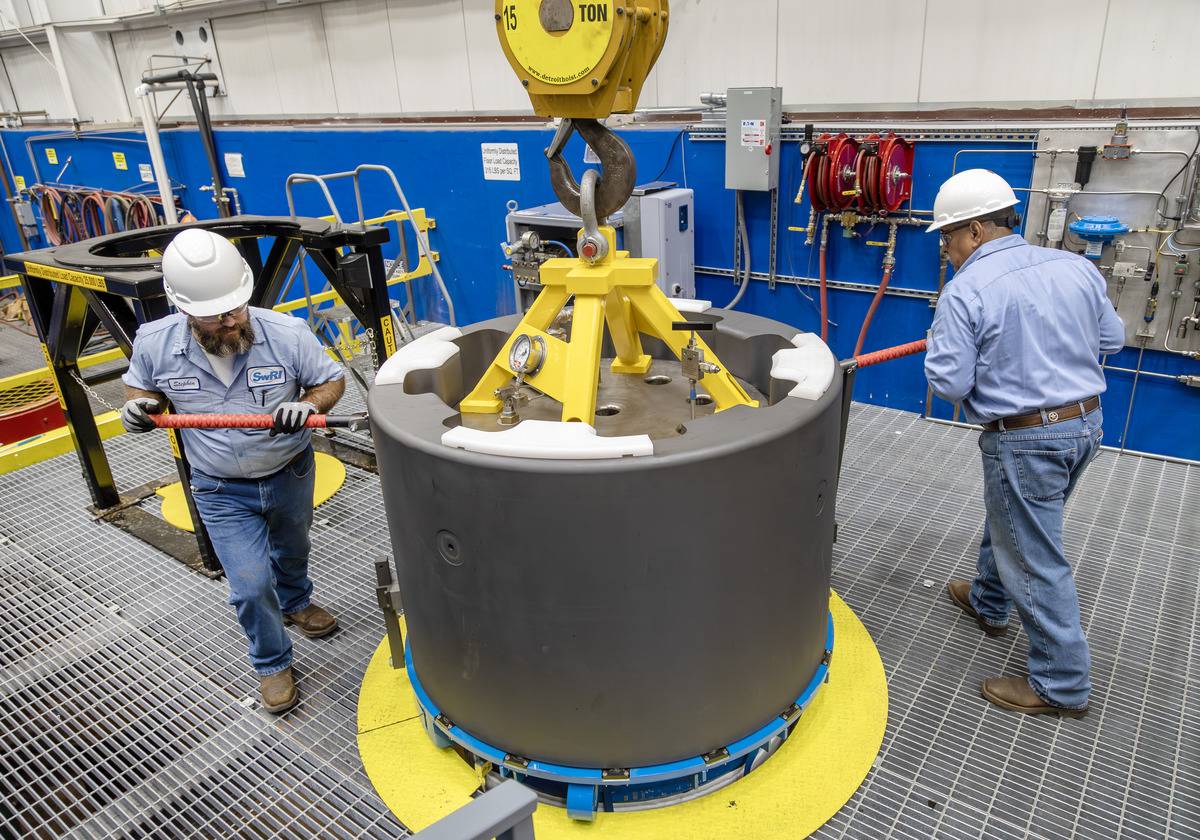
SwRI’s new 30-inch pressure vessel takes roughly two minutes to close. Similar vessels can take 30 to 45 minutes. The vessel accommodates testing at pressures of up to 16,500 psig, simulating the deepest ocean regions. (Credit: SwRI)
Southwest Research Institute (SwRI) has expanded its Ocean Simulation Laboratories with a new 30-inch-diameter pressure vessel designed to test larger equipment under conditions equivalent to those found at full ocean depth.
The new vessel can test equipment at pressures of up to 16,500 psig and is intended to simulate conditions encountered in the deepest parts of the ocean. SwRI said the addition enhances testing capabilities at its 18,000-square-foot Ocean Simulation Laboratories, which have supported offshore oil and gas and marine industries for more than 60 years.
The pressure vessel measures 30 inches in diameter and 15 feet in depth and incorporates a quick-acting closure developed by SwRI engineers.
“This pressure vessel offers several key advantages. While other chambers take 30 to 45 minutes to open or close, the new design slashes that time to roughly two minutes. This allows for a much quicker turnaround between tests,” said Paul Garza, who manages SwRI’s Ocean Simulation Laboratories.
SwRI said the closure system is designed to prevent misalignment and includes modular pass-throughs for electrical and other connections, simplifying reconfiguration and maintenance.
“We’ve seen quick-acting closures before but never for pressure vessels of this size that operate at such high pressures. The vessel design is intrinsically safe and durable. Our fatigue calculations show that it will be 20 years before it’s even necessary to inspect for cracks,” said SwRI’s Kyle Robinson, a principal engineer in the Institute’s Marine Structures Group who led the design of the vessel.
According to SwRI, the new vessel fills a gap in the industry by allowing testing of larger equipment at pressures representative of the deepest ocean environments.
The institute said the vessel will expand testing capabilities for subsea batteries used in unmanned underwater vehicles, particularly larger systems operating at higher pressures, while also increasing its ability to test larger and more complex offshore oil and gas equipment.
SwRI commissioned the vessel earlier this year and completed a proof hydrotest at pressures exceeding 26,000 psi before placing it into service. The vessel has since been used for client testing programs. Patents related to the design are pending.





 February 2026