Great Lakes Wildlife Film Project Includes Interactive Live Events
Source: Inspired Planet
Award-winning filmmakers Yvonne Drebert and Zach Melnick are setting out to reveal it in their most ambitious project yet: Hidden Below: The Great Lakes — a new TVO Original wildlife documentary exploring the Great Lakes watershed.
Production is already underway, with Drebert and Melnick deploying next-generation underwater drones capable of reaching the deepest depths of the lakes.
Over the next two years, the team’s cameras will capture a hidden world of survival and spectacle — deepwater sculpin guarding their nests hundreds of meters below the surface, rare lake trout with oversized fins gliding along the cliffs of unexplored submerged mountains, flocks of ducks plunging into dark waters for fish eggs, and vast schools of gizzard shad fleeing lethal cold in numbers rivalling the greatest wildlife migrations on Earth.
Hidden Below is being created in collaboration with a network of scientists, conservation organizations and community partners across the Great Lakes region. The Nature Conservancy of Canada is the project’s Lead Impact Partner, contributing scientific expertise and helping translate discovery into lasting freshwater conservation.
“Freshwater life is among the most threatened on Earth,” says Yvonne Drebert, Producer. “Yet our TV screens are filled with coral reefs and ocean giants, while the vibrant life of freshwater ecosystems remains largely unseen. Hidden Below is about changing that.”
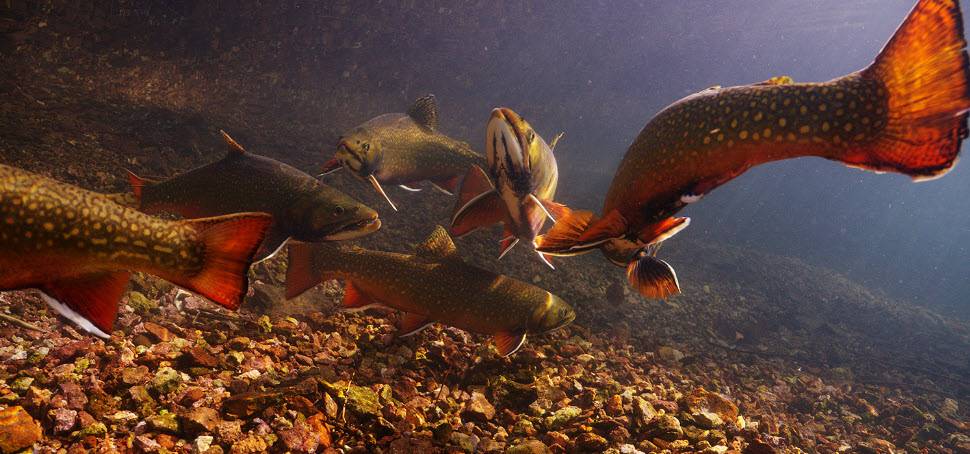
The team has already achieved an important early milestone. Last fall, working closely with Parks Canada staff in the Lake Superior National Marine Conservation Area, the filmmakers documented Coaster Brook Trout spawning near the epic outer islands of the protected area.
Coaster Brook Trout — found only in Lake Superior — are a brilliantly colored symbol of healthy freshwater ecosystems, that until recently were on the brink of extinction. While most Coaster spawning occurs in rivers, researchers and Indigenous knowledge holders have long suggested that some may also spawn amongst the remote islands.
Building on this understanding, the Hidden Below team captured what is believed to be the first footage documenting this island spawning behavior. The footage is not only scientifically valuable — it is visually extraordinary. In crystal-clear water, the trout excavate nests in the gravel to lay their eggs, and they contort into expressive, almost comical faces as they release eggs and milt.
Boxfish Robotics is providing advanced imaging to support the project. Boxfish technology was previously used for freshwater documentary filmmaking by Inspired Planet Productions, and for Hidden Below, the company is developing a dedicated underwater robotic platform, along with new visual capabilities designed to offer audiences a more immersive and dimensional experience of life beneath the surface.
“Hidden Below reflects exactly why Boxfish underwater robots are perfectly positioned to support science and enable stories that would otherwise remain unseen. Working with Inspired Planet Productions shows the impact of aligning technological innovation with research and filmmaking. Together, we are developing a new visual approach that will allow audiences to observe underwater ecosystems with an enhanced sense of depth and presence, revealing the hidden complexity of life below the surface,” said Craig Anderson, co-founder of Boxfish.
The Coaster Brook Trout documentation represents the first of what the team hopes will be many scientific contributions emerging from Hidden Below.
Hidden Below builds on the success of Drebert and Melnick’s previous TVO Original, All Too Clear, which captivated audiences as it ventured deep into the Great Lakes to reveal the historic impacts of invasive mussels.
Holding more than 20 percent of the world’s freshwater, the Great Lakes are one of the planet’s most significant natural systems and essential to life in Ontario.
While Hidden Below will premiere in 2028, audiences don’t have to wait to begin experiencing the underwater world of the Great Lakes. Building on their recent expansion into live, interactive exploration, Drebert and Melnick are inviting the public to join them in real time as they explore the depths with underwater drones on Hidden Below: LIVE.
Last September, the team livestreamed their first major expedition to Superior Shoal — the largest freshwater underwater mountain on Earth.
The next Hidden Below: LIVE event will take place at 10:00 am Eastern on Earth Day, April 22, broadcasting from one of the Great Lakes’ most visually mesmerizing and rarely seen locations: the waters surrounding the Bruce Power nuclear generating station on Lake Huron. Co-hosted by renowned fish biologist, Dr. Nicholas Mandrak, the livestream will provide extraordinary access to this “fish city,” where more than a dozen species, jockey for survival in crystal-clear waters shaped by human influence. The site stands as a vivid reminder that the Great Lakes are not untouched wilderness, but living ecosystems intricately intertwined with human activity.
Additional missions are planned throughout production — including a descent to the deepest point in the Great Lakes, known as “Superior Maximus,” more than 400 meters below the surface of Lake Superior. Each expedition will combine cinema-grade underwater robotics with live commentary from expert guests, as viewers explore alongside the team.






 August 2026