Schmidt Sciences Awards $33m for Global Freshwater Research
© Schmidt Sciences
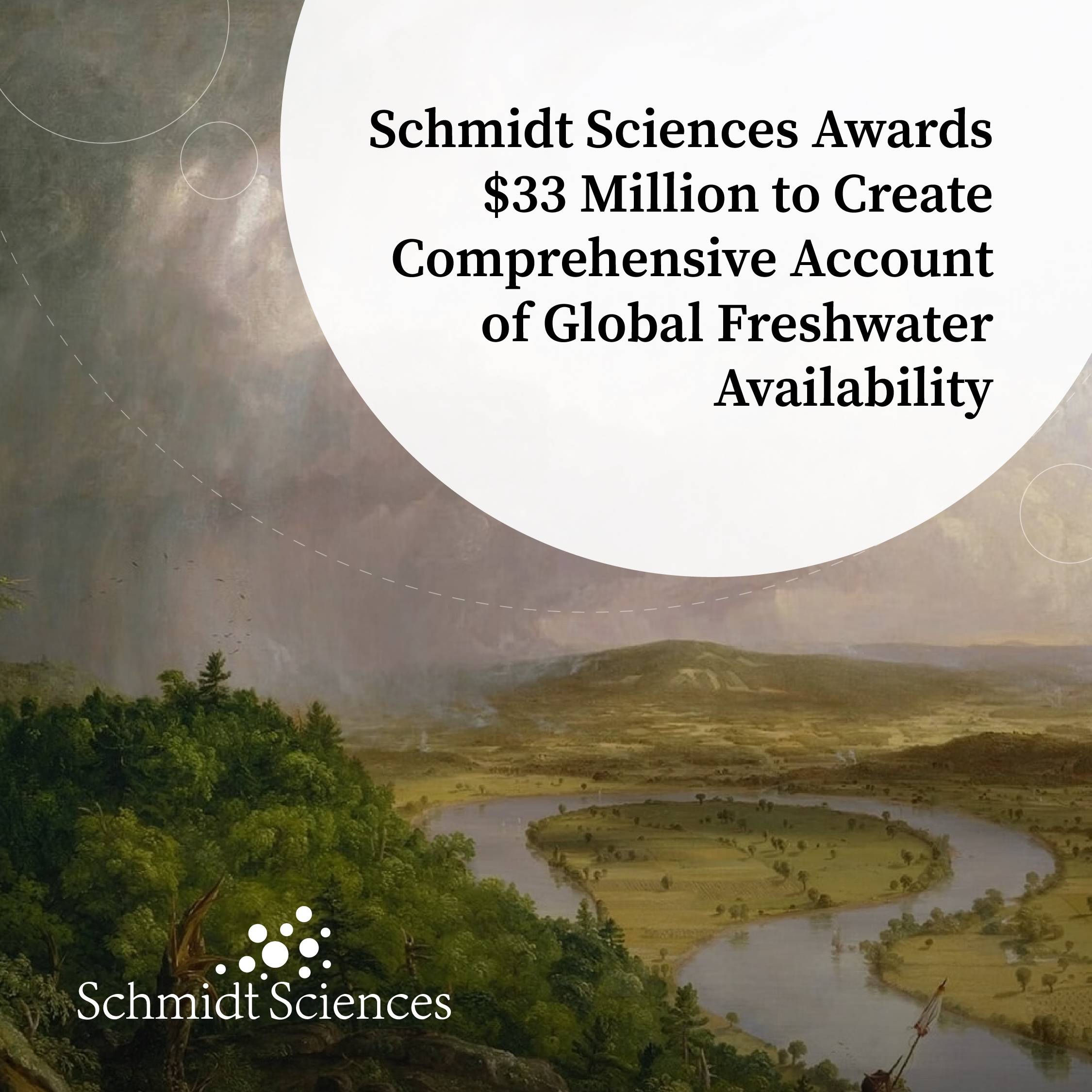
Four international teams of researchers will receive $33 million from Schmidt Sciences over five years to advance the global understanding of freshwater availability through the Virtual Institute for Earth’s Water (VIEW). Their research will leverage AI and high-resolution data to build a first-of-its-kind "global water ledger"—a definitive account of the world's freshwater resources to inform more effective, sustainable and equitable management.
While global temperatures are tracked with high precision, our understanding of the global water cycle remains fragmented. Freshwater researchers—spread across disciplines from extreme precipitation to groundwater—have largely worked in isolation from one another, and from the energy and agriculture sectors whose futures depend on water. Data are often scattered, inconsistent, and difficult to access, while the models scientists use to understand water availability have struggled to capture the full complexity of the water cycle. The result is a critical gap between what we know and what we need to know to manage freshwater sustainably.
The four inaugural projects include pioneering research into 60 years of global water history, the evolution of riverine ecosystems under human influence, assessing the state of mountain glaciers, snowpacks, and downstream water, and the integration of local science and knowledge into global models.
The teams will work together to integrate water data that captures both physical and societal processes that govern the water cycle—enabling new insights into the freshwater cycle and informing critical decisions surrounding the future of global water availability. Following the selection of its inaugural cohort of projects, Schmidt Sciences is opening a second round of Expressions of Intent, inviting researchers worldwide to submit proposals in two critical areas of the global water cycle: the balance between precipitation, evaporation and plant uptake; and the feedback loops and tipping points in the freshwater cycle.
VIEW Projects
- RAWS (Re-Analysis of Water for Society)
- Led by Marc F.P. Bierkens, Utrecht University, Netherlands; Landon Marston, Virginia Tech, U.S.
- RAWS will produce the first high-resolution global picture of how the world's freshwater resources have changed over the past 60 years. By leveraging global water models and AI, the team will map multiple components of the water system, including groundwater, crop growth, human use and infrastructure to pinpoint where and why water scarcity and competition emerge across water, food, energy and ecosystems.
- DARE (The Dynamic Atlas of Riverine Ecosystems and Infrastructure)
- Led by Stefano Galleli, Cornell University, U.S.
- DARE will create the first global dataset tracking how river systems around the world have evolved under human influence since 1950. By reconstructing the history of rivers and water infrastructure, the project will track how rivers have responded to hydraulic infrastructure, including dams, wells, and streamflow diversions. Their comprehensive study will include discharge, sediment transport, and biodiversity, with a focus on quantifying uncertainty, especially in under-observed river basins.
- MountAInWater: Water from the Mountains — Global Reanalysis and Future TippingPoints
- Led by Francesca Pellicciotti, Institute of Science and Technology Austria (ISTA)
- MountAInWater will deliver the first comprehensive global assessment of mountain water resources from 2000 to the present, evaluating the health of glaciers, snowpack, and downstream water supplies. The team will use AI to accelerate complex simulations and conduct fieldwork at hard-to-access high-elevation sites in the Himalayas, Pamir, CanadianRockies and Andes. They will collect meteorological, snow and water data to understand how mountain water supplies are changing and what complex system interactions could impact society.
- Unlocking Local Knowledge Production for Global Water Reanalysis
- Led by Wouter Buytaert, Imperial College London; Seifu Tilahun, International Water Management Institute – Ghana
- This project will develop new methods for incorporating community-collected data and local knowledge into global water models. In collaboration with local partners across data-scarce regions, including the Andes, Ghana, Ethiopia, Laos and India, the team will deploy low-cost sensors to measure precipitation, river water levels and discharge and groundwater depth.




 August 2026