

Evolving Strategies for Subsea Cable Security
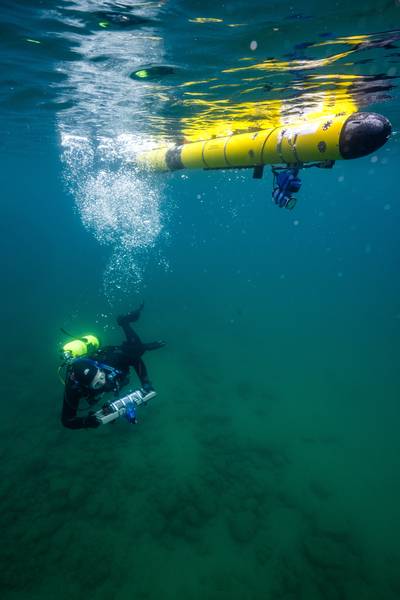
Image courtesy of Tim Briggs, Lincoln Laboratory MIT
Last week, the British military exposed a covert Russian submarine operation in and around UK waters. The operation was considered part of a Russian bluff while other specialist vessels conducted nefarious activities near critical underwater infrastructure.
Incidents like these continue to spark industry comment, and this week Iain Grainger, Chief Executive of the International Marine Contractors Association (IMCA), said: “What we are seeing reflects a broader trend: subsea infrastructure is becoming more exposed and more strategically important. These are the systems that support communications, energy supply, and financial markets. When they are disrupted, the effects are immediate and can extend well beyond national borders.”
While much of the focus is on monitoring and detection, industry experience highlights that the greater challenge lies in response. Repairing subsea infrastructure is a complex offshore operation requiring specialist vessels, advanced equipment, and highly trained personnel. Depending on location, water depth, weather conditions, and permitting requirements, repairs can take days or longer. In practice, response time is often determined by how quickly the right vessels, equipment, and crews can be mobilized.
“Monitoring activity is only one part of the picture,” Grainger continued. “The real test is how quickly we can respond when disruption occurs. That depends on having the right vessels available, the right skills in place, and regulatory frameworks that allow rapid mobilization across borders.”
IMCA notes that growing demand for offshore energy infrastructure, including wind and field interconnection, is placing additional pressure on the availability of specialized vessels and skilled personnel required for installation and repair.
“This is not just about the immediate incident,” Grainger added. “As energy security rises up the agenda, subsea resilience needs to be treated as a strategic priority.”
This week, cable design, installation, and lifecycle services company Nexans highlighted the shift in expectations, from reactive repair models to structured, anticipatory IMR strategies embedded into infrastructure planning. “For Europe, the challenge goes beyond technology. It is about aligning capabilities, coordination, and long-term investment with the scale of ambition,” said the company in a blog post.
If subsea cable failures remain relatively rare, when they occur, their consequences are immediate. With limited redundancy in power transmission systems, outages can disrupt electricity flows, impact markets, and delay renewable integration. Repair operations are complex and costly, depending on location and conditions.
“At the same time, the ecosystem required to respond, such as specialized vessels, skilled personnel, and available equipment, remains constrained. What are the results? A growing imbalance: more infrastructure, higher exposure, and limited ability to recover quickly.”
Also this week, MIT described how a team led by Madeline Miller is working on AUV support for divers repairing critical infrastructure. Miller says to find the break in an underwater power cable a ship’s crew may pull up the entire line or deploy ROVs to traverse the line. Instead, her team is developing the technology that enables an AUV to map the line and pinpoint the location of the fault for a diver to then fix.
"Divers and AUVs generally don't team at all underwater," says Miller. "Underwater missions requiring humans typically do so because they involve some sort of manipulation a robot can't do, like repairing infrastructure or deactivating a mine. Even ROVs are challenging to work with underwater in very skilled manipulation tasks because the manipulators themselves aren't agile enough."
Beyond their superior dexterity, humans excel at recognizing objects underwater. But humans working underwater can't perform complex computations or move very quickly, especially if they are carrying heavy equipment; robots have an edge over humans in processing power, high-speed mobility, and endurance. To combine these strengths, Miller and her team are developing hardware and algorithms for underwater navigation and perception — two key capabilities for effective human-robot teaming.
As Miller explains, divers may only have a compass and fin-kick counts to guide them. With few landmarks and potentially murky conditions caused by a lack of light at depth or the presence of biological matter in the water column, they can easily become disoriented and lost.
For robots to help divers navigate, they need to perceive their environment. However, in the presence of darkness and turbidity, cameras cannot generate images, while sonar generates images that lack color and only show the shapes and shadows of objects at the scene.
With the internally funded research program to overcome these issues coming to an end, Miller's team is now seeking external sponsorship to refine and transition the technology to military or commercial partners.
"The undersea domain is becoming increasingly contested as more nations develop and advance the capabilities of autonomous maritime systems. Maintaining global economic security and U.S. strategic advantage in the undersea domain will require leveraging and combining the best of AI and human capabilities," Miller says.


 August 2026