
Australian Quantum Technology to Support National Defence Strategy
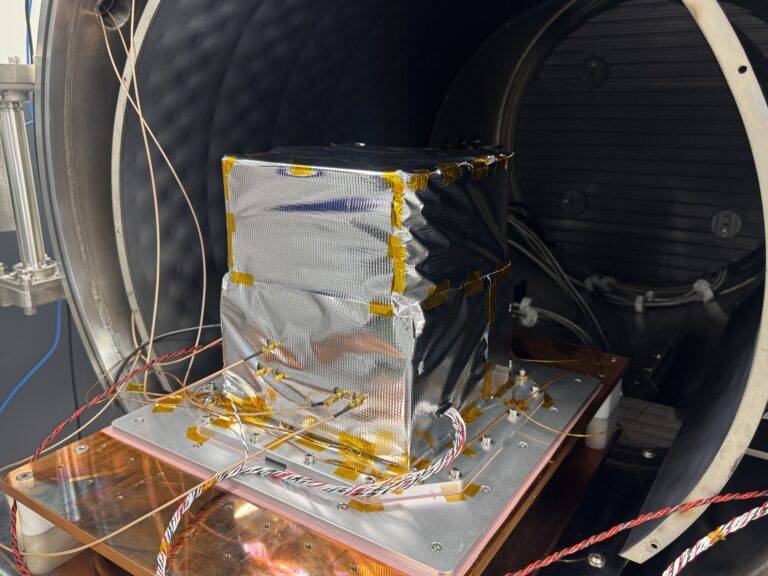
TEMPO (source: QuantX Labs)
A new quantum clock technology developed in Australia has now been deployed in space.
Developed by QuantX Labs, TEMPO delivers up to 10 times the performance of current GNSS-based timing systems. In space, that translates to more resilient communications, more accurate navigation and harder-to-disrupt synchronization between satellites and ground systems – capabilities that matter when GPS is jammed, spoofed or unavailable.
The development comes as the Australian Government released the 2026 National Defence Strategy and Integrated Investment Program last month, committing A$425 billion over the next decade. The strategy ranks undersea warfare and resilient multi-orbit satellite communications as its first and seventh priorities respectively.
The Integrated Investment Program commits A$9-$12 billion to enhanced space capabilities, with a rescoped focus on a resilient, multi-orbit Australian defense satellite communications capability. Precision atomic clocks like TEMPO are foundational to keeping satellite constellations synchronized and communications secure under electronic attack.
QuantX Labs is also developing SENTIO, an extremely sensitive quantum magnetometer capable of detecting objects underwater and underground. Quantum magnetometry is one of the most promising emerging technologies that can detect submerged targets in GPS-denied environments without relying on traditional acoustic signatures.
The technologies built by QuantX Labs have been developed in partnership with Adelaide University.
Professor Nigel Spooner and Dr Erik Shartner from the university, through their industry partner TeraGlo, are developing quantum sensors for seabed mining. Their sensors allow for real-time material identification and quantification enabling interactive material targeting and process control.
They are also developing sensors for mud logging - the creation of a detailed record (well log) of a borehole by examining the cuttings of rock brought to the surface. Their sensors enable the near real-time examination of these cuttings and the reduction in the amount of conventional analysis required such as x-ray diffraction and optical microscopy.
Quantum sensing exploits the most counterintuitive properties of quantum systems, explains the Australian Nuclear Science and Technology Organisation (ANSTO). A quantum sensor uses the central weakness of quantum systems—their strong sensitivity to external disturbances.
Quantum sensors can detect extremely tiny changes, such as an increase in energy caused by a single proton, and they often give more precise readings than their classical counterparts because quantum properties are known very accurately.
Quantum sensors can also be self-calibrating and deliver more consistent results than conventional instruments. For example, classical devices such as pressure sensors need to be calibrated at the factory and recalibrated periodically.
Devices that use the properties of atoms never need to be calibrated, because all atoms of a given type are identical and their properties never change. A quantum quantity, such as the wavelength of the red light used in a laser, is known very precisely from calculations and experiment.
A third advantage of quantum sensors is their small size. The entire sensor can often be miniaturized.
Some of the most promising applications for quantum sensors in defense include support enhanced positioning (quantum accelerometers, magnetometers, spectrometers, radar, gyroscopes and clocks); enhanced navigation and timing; enhanced situational awareness; enhanced human-machine interfacing and enhanced defense science and industry (quantum microscopes, spectrometers and nanosensors).





 August 2026