
CSignum Releases Solution for Through-Ground Wireless Communications
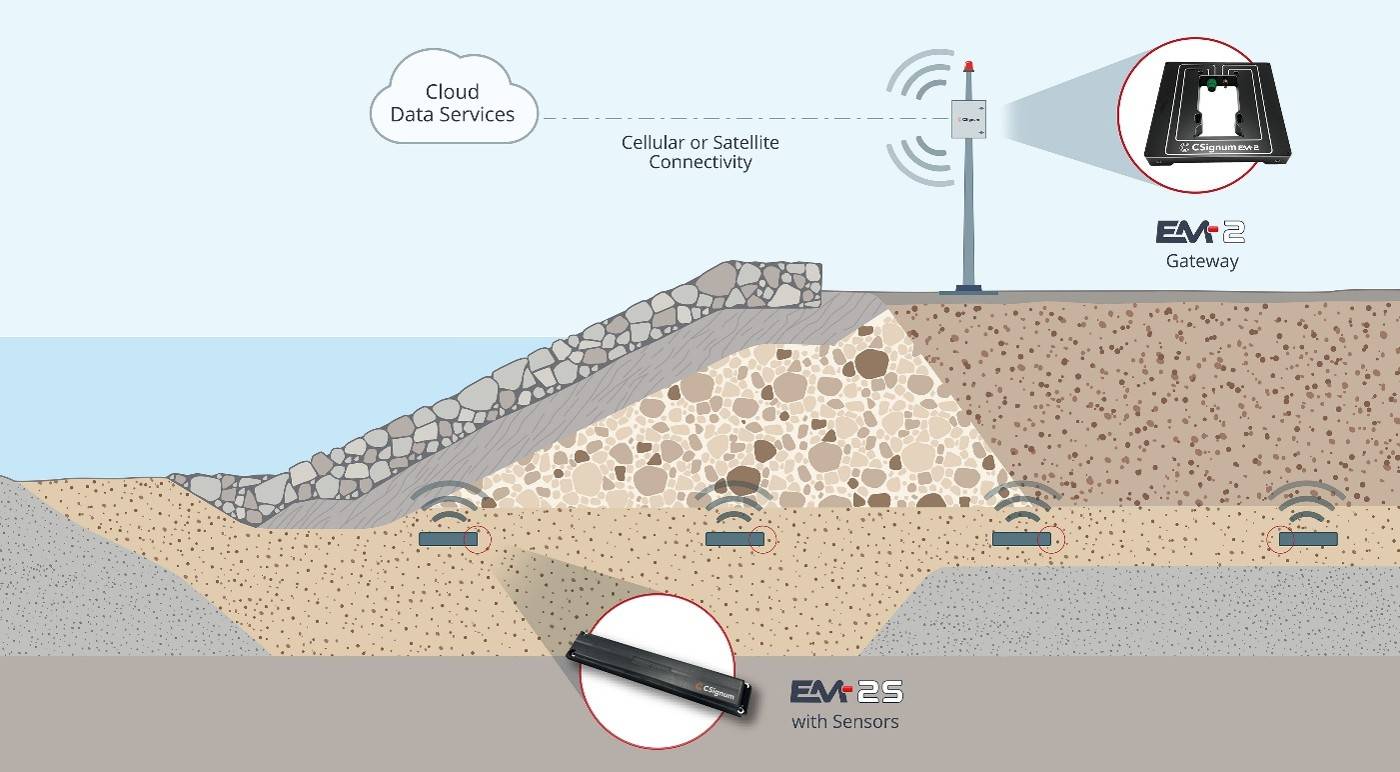
CSignum EM-2S bidirectional wireless data communications through subsurface infrastructure environments. © CSignum
CSignum announced its EM-2S through-ground wireless communications solution, extending the company’s electromagnetic field signaling (EMFS) technology to geotechnical, structural, and infrastructure monitoring applications.
EM-2S enables bidirectional data communications through soil, rock, concrete, water, and mixed-media environments, providing access to measurements from buried and embedded instrumentation where conventional radio-based communications are constrained.
Designed to work with a broad range of established geotechnical, structural, and environmental monitoring instruments, EM-2S connects subsurface sensors with above-ground monitoring systems. Engineers and asset operators can retrieve measurements and, where supported by the connected instrumentation, remotely manage monitoring operations without requiring a continuous communications cable to the surface.
Monitoring instruments installed underground or embedded in structures traditionally rely on physical cabling to reach accessible data acquisition equipment. Installation, excavation, pile driving, ground settlement, and long-term operation can damage these connections or complicate routing and maintenance. Conventional radio-frequency wireless technologies also experience substantial attenuation through soil, rock, and concrete. EMFS provides a different communications approach by transmitting data wirelessly through these challenging materials rather than depending on an unobstructed radio path.
EM-2S supports bidirectional communications over distances of up to 100 meters, subject to site conditions and material properties. Available mesh networking enables compatible buried nodes to relay data and extend monitoring coverage. The system can therefore support distributed sensor installations across structures and subsurface environments while reducing reliance on vulnerable surface communication cabling.
Field experience provides examples of EMFS performance in challenging environments. CSignum reports communications trials between tunnels in a clay mine, including links of up to 100 meters through rock depending on its composition, and a separate canal-tunnel trial demonstrating communication through water and surrounding rock to a hillside receiver.
Measurements pass wirelessly from EM-2S nodes to an above-ground EM-2 gateway, which forwards data over cellular or satellite networks to cloud services and remote monitoring platforms. CSignum’s cloud offering and integration interfaces can support visualization, analysis, dashboards, and incorporation into customers’ existing monitoring and asset-management systems. This end-to-end architecture connects otherwise difficult-to-access instruments with the systems engineers use to evaluate conditions and make decisions.
EM-2S is designed to interface with compatible geotechnical, structural, and environmental instruments through established interfaces and signals, including RS232, RS485, Modbus, and 4–20 mA. Depending on instrument configuration and interface compatibility, multiple sensors may be connected to a single node. The system can power compatible connected sensors during scheduled measurements, helping manage energy consumption. This approach allows engineers and instrumentation providers to retain proven sensor technologies while incorporating through-ground wireless communications.
Applications span geotechnical, infrastructure, and environmental monitoring, including:
- Ground movement and deformation monitoring: Integration with inclinometers, tiltmeters, extensometers, settlement sensors, and crack meters to monitor lateral displacement, settlement, foundation movement, structural rotation, and deformation.
- Groundwater and pore pressure monitoring: Wireless data from piezometers, groundwater level sensors, and subsurface instrumentation tracking pore water pressure and hydrological conditions affecting foundations, embankments, and soil stability.
- Structural stress, strain, and load monitoring: Communications with strain gauges, earth pressure cells, and load cells used to measure structural loading and deformation in foundations, retaining walls, ground anchors, and tunnels.
- Tunneling, excavation, and slope stability: Support for monitoring networks tracking tunnel convergence, retaining wall deflection, ground displacement, groundwater pressure, and changing soil or rock conditions.
- Vibration and ground motion monitoring: Integration with geophones, accelerometers, and vibration instruments for monitoring construction-related and transportation-related ground motion, subject to instrument data-rate requirements.
- Buried and mixed-media infrastructure: Wireless monitoring of equipment beneath roads, airport runways, dams, embankments, and buried pipelines, including installations spanning soil, rock, concrete, and water.
EM-2S combines wireless communications, data logging, edge processing, and an internal battery in a compact, resin-filled enclosure intended for demanding buried and embedded installations. Its three-dimensional antenna arrangement is designed to support communications across varying device orientations, including those encountered during installation and ground movement.
Unlike one-way telemetry, EM-2S provides bidirectional communications for retrieving measurements and remotely managing compatible monitoring equipment. Depending on the instrumentation, operators may adjust measurement schedules, change operating parameters, or initiate readings without physical access. Multiple monitoring locations can communicate with a surface gateway, and available mesh networking supports relay between buried nodes.
Low-power operating modes and an internal battery system support long-term deployments, with operational lifetimes of up to 20 years depending on measurement frequency, connected sensors, communications activity, and environmental conditions. Measurement intervals can be controlled from the surface, allowing frequent measurement during construction and early settling phases, reverting to less frequent long-term monitoring to manage the internal battery life over many years.


 August 2026