
Global Governance Failing on Ocean Acidification and Food Security
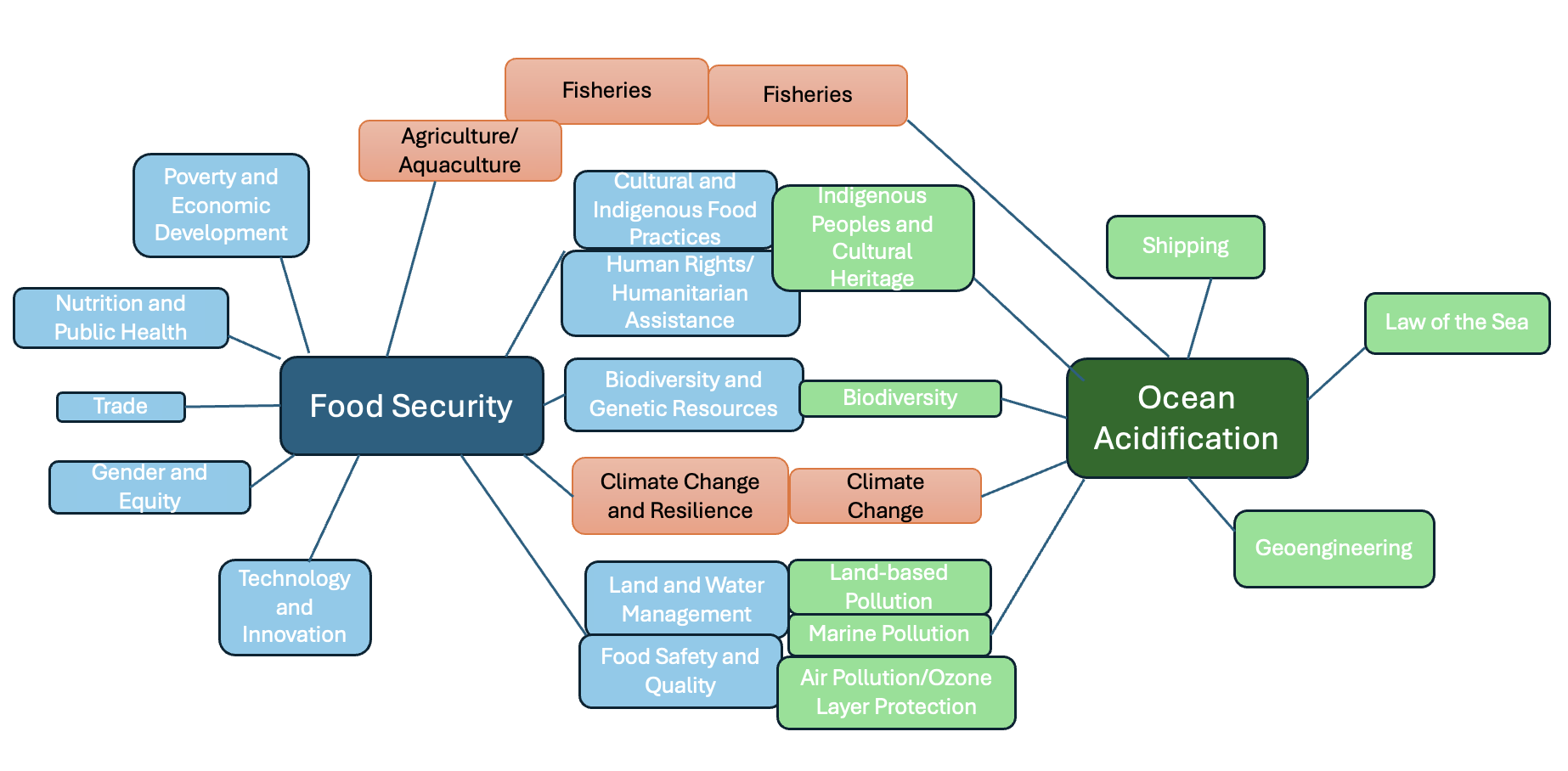
The thematic nodes represent issue areas related to blue food security (blue) and ocean acidification (green). The nodes in the centre are those that apply to both blue food security and ocean acidification, and issues that were identified as critical governance areas at the OA-blue food nexus. (Source: UCL)
A new study, launched during Our Oceans Conference being held in Mombasa, finds that international governance frameworks are poorly equipped to address the combined threat of ocean acidification (OA) and blue food insecurity.
The research, published in Environmental Research: Food Systems, maps the international governance landscape for both issues and finds that, while the two policy domains overlap significantly, they are rarely addressed together.
Annika Frosch, lead author and Research Fellow at the UCL Energy Institute Shipping and Oceans Research Group, said: “Without coordinated action across climate and food systems, the growing impacts of ocean acidification will continue to undermine fisheries and aquaculture that underpin global nutrition and livelihoods.”
Blue foods - fish, shellfish, and algae sourced from marine and freshwater environments - provide essential nutrients to millions of people worldwide, and global consumption has grown more than fivefold over the past 60 years.
At the same time, ocean acidification, driven primarily by rising CO₂ emissions, is already harming shellfish aquaculture and fisheries, degrading coral reef ecosystems, and altering the nutritional quality and safety of seafood.
Communities in the Global South, which rely most heavily on blue foods for daily protein, face the greatest risks - yet also receive the least research attention and policy support.
The study finds that most international actors and instruments treat the two issues in isolation. A detailed examination of two central institutions - the Food and Agriculture Organization (FAO) and the UN Framework Convention on Climate Change (UNFCCC) - illustrates the problem clearly:
• The FAO lacks an explicit mandate to govern ocean acidification. When OA is mentioned in FAO instruments, it typically appears as one item in a longer list of climate stressors, rather than being treated as a distinct and direct threat to food security.
• The UNFCCC addresses ocean acidification only indirectly, through its broader CO₂ mitigation goals. Neither the UNFCCC nor the Paris Agreement explicitly names OA, and it does not feature as a core governance priority. Food security is referenced in UNFCCC objectives but is not linked to OA even in documents that mention both.
The study also highlights that blue food security tends to receive legal and political recognition, while ocean acidification remains largely confined to scientific discussion - making coordinated policy action harder to achieve.
Keiko Nomura, co-author and Postdoctoral Researcher at the University of Colorado Boulder, said “Our findings suggest that ocean acidification remains more visible in scientific discussions than in international policy frameworks. Bridging this science-policy divide could help improve governance of climate risks to blue food systems.”
The paper makes recommendations for policy makers to bridge these governance gaps, including:
• Strengthening FAO instruments to treat OA as a distinct climate-related stressor to fisheries and aquaculture, including through binding policies, vulnerability thresholds for key species, and the promotion of socioeconomic strategies.
• Developing a dedicated OA workstream or technical body under the UNFCCC
• Incentivising countries to include OA monitoring and adaptation measures in their Nationally Determined Contributions (NDCs)
• Creating formal institutional links and coordination between climate bodies and marine science and fisheries organisations modelled on the Joint Capacity-building Programme of the three ‘Rio Conventions’, adapted for the OA–blue food security nexus.
The researchers note that some Pacific Island nations - including Fiji and the Solomon Islands - are already leading the way by integrating ocean acidification into their national climate strategies and fisheries management plans, demonstrating what more coherent governance could look like.
The study accompanies Dr Frosch’s new book ‘Navigating the Souring Seas: The Global Experimentalist Governance of Ocean Acidification’ which explores how OA is being addressed at the global stage. Bridging science, law, and international policy, this interdisciplinary book provides a clear overview of the scientific background of OA and maps the international governance landscape, identifying it as a regime complex. Through detailed interview-based case studies of the Ocean Acidification Alliance and the International Maritime Organization, the book evaluates real-world efforts to govern OA and highlights how flexibility, learning, and multilevel collaboration, can enhance their effectiveness.






 August 2026