The Rise of the Aquanaut
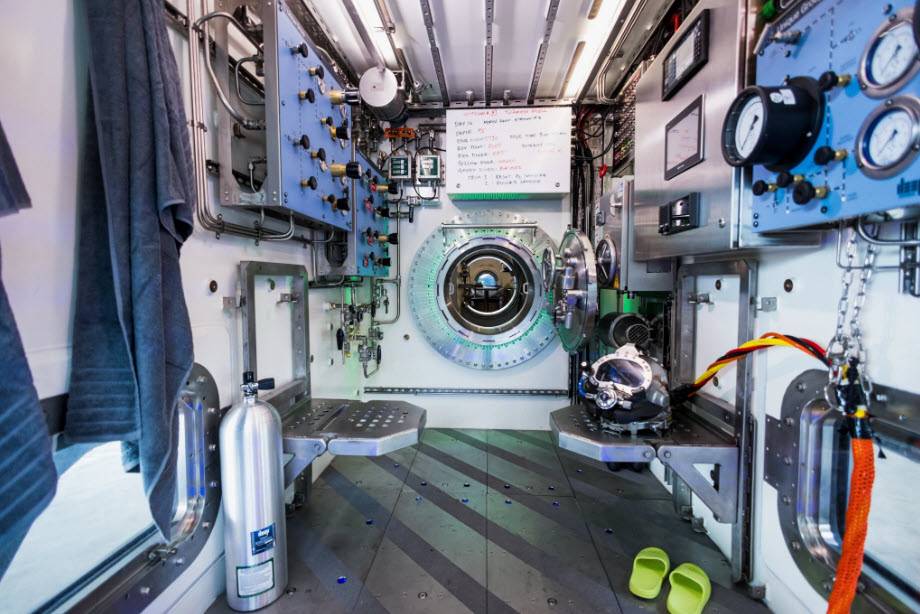
Vanguard (source: DEEP)
The feeling of awe and planetary connection experienced by astronauts observing Earth from low space orbit is known as the “overview effect,” a term coined by Frank White, the author of numerous books on space exploration and science. Now researchers from Northeastern University have documented a similar cognitive shift among aquanauts, people who live and work under the sea. They call it the “underview effect.”
Sharing that sense of wonder and kinship with nature with the public could be key to helping understand and conserve the ocean environment, according to the research published in Environment & Behavior.
“We’re at this juncture where we’re realizing that a business-as-usual approach to how we interact with nature and especially the ocean is just not going to cut it,” said Brian Helmuth, professor at Northeastern and one of the authors of the study.
Lead author Kristen Kilgallen, a Ph.D. student at Northeastern, interviewed 14 aquanauts — one of whom is also an astronaut — about the psychological, behavioral and cognitive changes they experienced living underwater for extended periods of time.
Normally, scuba divers can only descend to a depth of 60 feet for 45 minutes before they have to resurface to avoid decompression sickness. Saturation divers, on the other hand, pack their decompression into 24 hours at the end of their underwater stay.
Helmuth compares it to Jane Goodall being able to live in the forest and study chimpanzees compared to being dropped in by helicopter for 30 minutes at a time.
Even short trips underwater can induce feelings of awe and transcendence. Being underwater for extended periods amplifies that effect manyfold, Kilgallen said. “A major shift occurred that was very similar to what astronauts experience,” she said.
The aquanauts reported that living underwater led to heightened perceptions and an amplification of the sense of commitment and connectedness to the natural world, Kilgallen said. Of the respondents, 70% reported heightened awe and gratitude and 64% heightened engagement with their surroundings due to the challenge of living under the seas.
Aquanauts number about 100 living members, said Helmuth, whereas NASA says there are hundreds of astronauts, including those active and retired. Would-be aquanauts currently face a lack of opportunity to live underwater — although Helmuth hopes that will change soon.
Subsea habitats are not a new invention. Jacques Cousteau built the first in 1962, although it was only about the size of an elevator.
The only currently operating underwater station for research during saturation diving that Helmuth knows of is the Aquarius Reef Base operated off the Florida Keys by Florida International University. “There are other underwater facilities,” he said, “but they are shallower than saturation depth, for example, Jules Verne Lodge.”
In 2014, a team of aquanauts lived in Aqaurius for 31 days under the leadership of Fabien Cousteau. He used the occasion to mark the 50th anniversary of his famed grandfather Jacques Cousteau’s 30-day underwater mission, Conshelf II, by going one day longer and twice as deep.
Helmuth now serves as a chief scientist for Fabien Cousteau’s latest endeavor, Proteus, which calls for a series of large underwater stations to be built.
“We have a builder. We have designs,” but are still in the fundraising stage, Helmuth said.
Meanwhile, the first new subsea human habitat of its kind to be built in the U.S. in almost 40 years, Vanguard, was unveiled last year by DEEP in Miami. Vanguard will provide a comfortable living environment for ocean scientists, conservationists, and explorers. By allowing teams to remain submerged for extended periods, the habitat will enable more comprehensive research and real-time observation of marine ecosystems.
Vanguard is currently undergoing final outfitting, subsystem testing, integrated end-to-end acceptance testing.
The project also marks a milestone in safety and innovation, as Vanguard will be the first underwater habitat to be classed by DNV. Vanguard uses a tethered connection that pipes fresh air and water down to the habitat. It also hosts a diesel generator to power an internet connection and a tank to hold wastewater.
Ultimately, Vanguard represents the beginning of a larger vision – a global network of underwater habitats that could give humans a permanent presence in the ocean. DEEP is already planning its successor, an advanced modular habitat called Sentinel. Sentinel modules will be six meters wide, twice the diameter of Vanguard.
A small deployment might have a crew of eight, about the same as the International Space Station. A big Sentinel system could house 50, up to 225 meters deep. DEEP says Sentinel will be launched in 2027.
Ultimately, according to its mission statement, DEEP seeks to “make humans aquatic.”




 August 2026