

The Coldest Place in the Universe
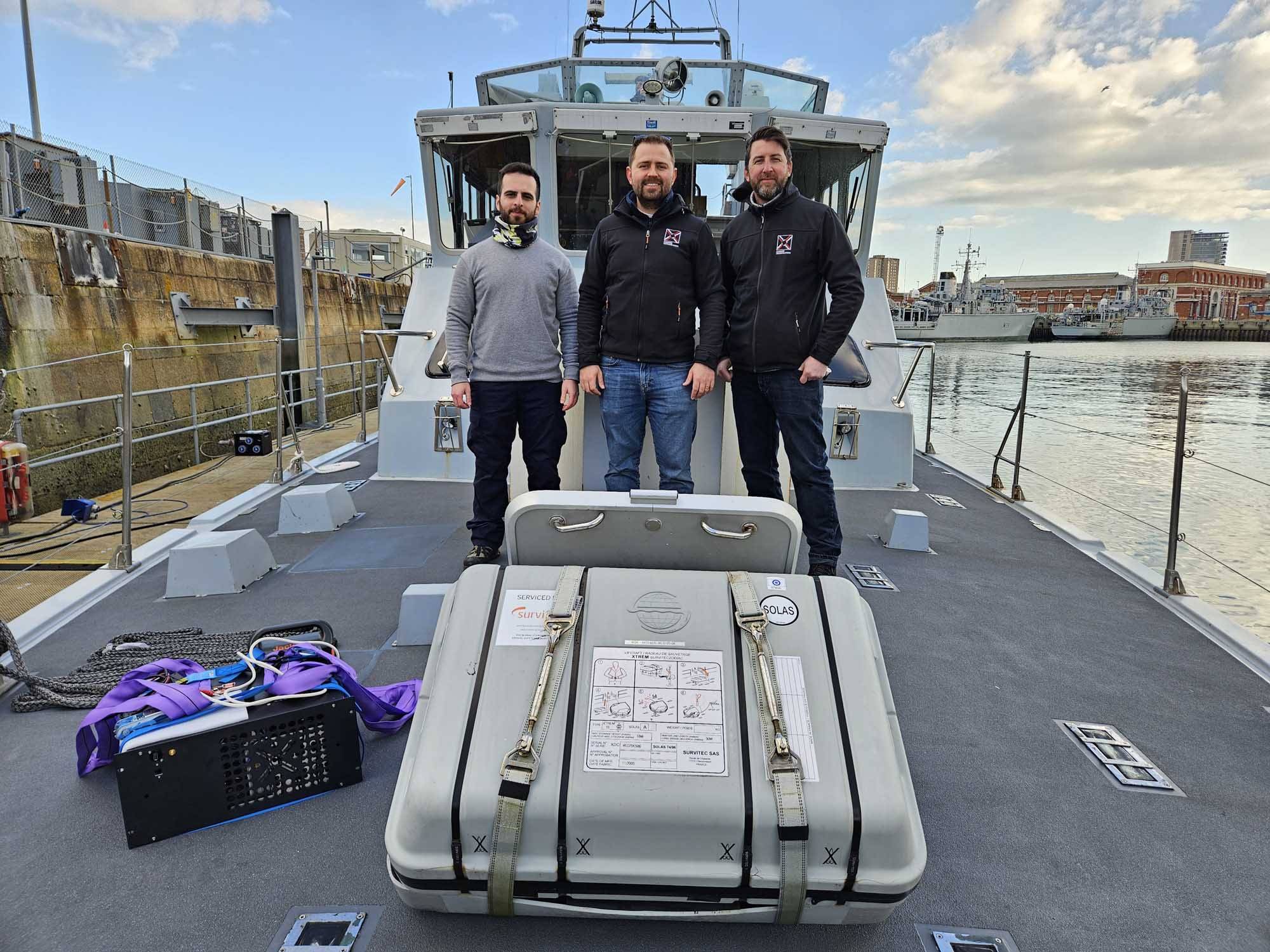
The Aquark team on board the HMS Pursuer. Credit: Aquark
A UK company has reached a temperature of minus 273.149996°C in the quantum technology it uses in its atomic clock, effectively creating the coldest place in the universe. It’s a high-tech solution for an age-old problem: accurate navigation at sea without the support of satellite systems.
Alexander Jantzen, Co-founder & Chief Operating Officer at Aquark Technologies, explains: “At the beginning of the 18th century, knowing your latitude when navigating was long understood by observing the position of known distant stars above the horizon, however the longitude was a dangerous mystery. The longitude problem comes from the fact that our planet rotates, and we have no fixed point of reference to compare with when out at sea.”
The solution to this problem came in 1735 when John Harrison developed the first practical marine chronometer.
“The solution to navigation accuracy was – and still is – precise timing,” says Jantzen. “Harrison solved the longitude problem, showing how accurate positioning was possible with the chronometer (the most reliable timekeeper in its day). He compared the time from a known location – such as where the ship set sail from – with the time of day where the ship was located. Knowing the difference in time of when noon occurred allowed the ship to precisely know its longitudinal position.”
By the 1980s, satellite navigation systems in the Global Navigation Satellite System (including GPS) rendered chronometers largely obsolete for practical navigation, because the time signals needed for accurate navigation mostly then came from atomic clocks on GNSS satellites.
If GNSS is disrupted, atomic clocks provide reliable holdover, delivering a stable timing signal until GNSS access is restored, because they provide a highly precise, reliable and continuous ticking that cannot be interfered with.
“Out at sea, spoofing detection is only as good as your timing reference. Bridge systems need something ‘ticking’ with accuracy as a reference source. When all is well, a vessel’s bridge position, navigation and timing (PNT) systems will have the same ‘ticks’ as an atomic clock. But when a GNSS receiver is spoofed, its timing speeds up in relation to the reference ‘tick’ which can result in unreliable positioning data and dangerous navigation errors if the spoofing is undetected,” says Jantzen.
“PNT resilience can be achieved when the system detects a gap between the ticks of the atomic clock and the GNSS. The system can switch to the atomic clock’s time signal during spoofing and will revert to GNSS when the timekeeping gap closes.”
“The best precision timing systems today measure the natural and stable frequency properties of atoms as defined by quantum mechanics and use them to correct drifts from an expected point, typically a 10 MHz oscillator,” says Jantzen. “To generate the highest accuracy, you must access the atom undisturbed for as long as possible to remove noise and average out random variations. At Aquark, we do this by laser cooling the atoms close to absolute zero.”
At the extreme temperature achieved by Aquark, the atom’s natural quantum “tick” can be measured for longer periods, as the natural movement of the atoms is slowed by a factor of almost 10,000 from 290 m/s to 34 mm/s. The frequency of the clock is continuously checked against the atomic frequency and automatically corrected if needed, reducing its long-term drift without requiring any correction from the timing signal usually provided by GNSS.
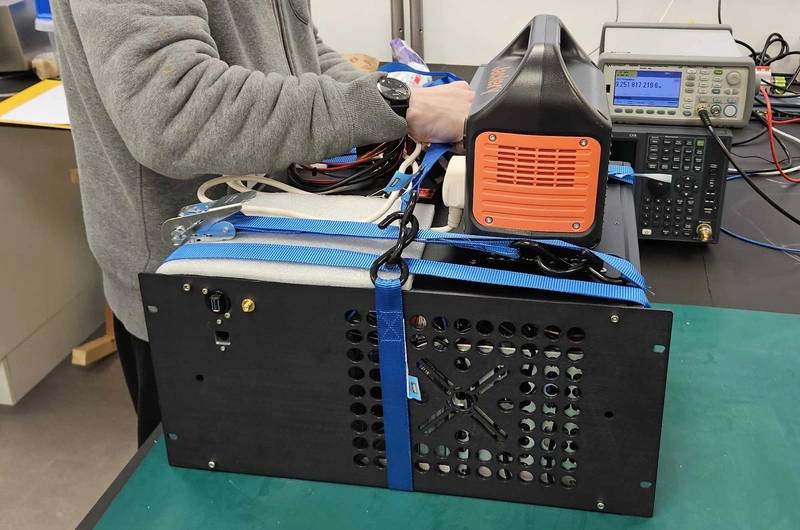 The AQlock is the first commercially available atomic clock built in the UK. Credit: Aquark
In June 2025, Aquark partnered with the Royal Navy to deploy AQlock aboard HMS Pursuer for a three-day sea trial. The trial was the first of its kind, testing the stability of the AQlock when operated in open sea conditions. During the trials, the cold-atom clock operated continuously, providing precise timing without a correction from GNSS, despite being exposed to continuous pitch and roll of the vessel.
 Aquark has conducted the first underwater test of its AQuest cold atom trap onboard the National Oceanography Centre Autosub Long Range autonomous underwater vehicle. Credit: Aquark
Aquark also conducted the first underwater test of its AQuest cold atom trap, a key component of AQlock, in dynamic conditions onboard the National Oceanography Centre Autosub Long Range autonomous underwater vehicle. The collected data provided performance metrics about the system’s behavior and robustness at different temperatures and pressures.
“What makes the trial remarkable is that laser cooling atoms has historically only been possible when a system is carefully isolated from most external disturbances, which is a big engineering challenge in itself on dry land. So it was an achievement to see our core technology - the Super-Molasses Trap - function underwater to form ultra-cold atom clouds.”
Discovered in 2019 at the University of Southampton, the Super-Molasses Trap used by AQlock reduces the tried and tested recipe for making cold atoms to a much simpler setup that only needs the right geometry of laser light and ultra-high vacuum (pressure equal to outer space). What makes it unique is that it does not need a supporting magnetic field.
It is hard to overstate the significance of this in engineering terms as it removes about 50% of system complexities, Jantzen says. It fundamentally changes how the atoms are used and paves the way for an alternative path to that which has led the entire field for almost four decades.
“The Super-Molasses Trap allows us to reduce the size, weight, cost, and power consumption of quantum sensing systems.”
That has been the main challenge for atomic clocks to date. The more precise they are, the bigger they become. High performance and conventional cold-atom systems, such as magneto-optical traps, remain bulky, expensive, and impractical outside laboratory environments.
Aquark is now closing in on its goal to reduce global reliance on GNSS for operations, infrastructure, telecommunications, finance, transportation, and many other sectors. “Cold matter technology is at the heart of what we do – and timing is just one application for it. With future demand and innovation, Aquark will be in a good position to develop cold matter devices that can address the full spectrum of potential applications. These might include gravity sensors for advanced navigation, underwater exploration, and environmental monitoring as well as new capabilities in radio frequency and inertial force sensing.
“There are clear demands for resilience today, however we believe that the greatest use of the technology is in the applications yet to be realized.”
 “The solution to navigation accuracy was – and still is – precise timing.” Credit: Aquark





 August 2026