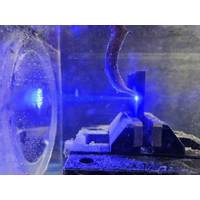
Bright Prospect: Blue Lasers for the Deep Sea
attractive. Contact-free processing underwater significantly reduces wear on tools and components, lowers energy requirements, and minimizes the release of potentially harmful particles or substances. Contact-free processing underwater significantly reduces wear on tools and components, lowers energy consumption, and minimizes the release of potentially harmful particles or substances. In terms of environmental protection and resource conservation, the diode-laser-based process clearly outperforms conventional mechanical or chemical methods—which often cause environmental damage and material

New Technologies Boost Wave Power Potential
for wave energy is already high. As Kadri says: “Ocean waves have long been seen as having huge potential as a source of renewable energy. Waves produce an estimated 50 trillion to 80 trillion watts of power worldwide – nearly two to three times the world’s current annual energy consumption.&rdquo
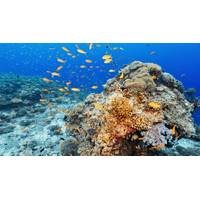
SYRENE: An Underwater Embedded Artificial Intelligence Camera for Invasive Fauna Monitoring
creation of this dataset was a crucial step in ensuring the relevance and performance of the model. By choosing to target a single species exclusively, we significantly reduced the risk of false positives (detection errors with other species), while optimizing inference time and, indirectly, the energy consumption of the device.Detector testThe prototype was tested in March 2021 under near-real conditions, with budget in mind: submerged in a tank containing lionfish belonging to the Océanopolis marine center, with a return via the mobile telephone network enabling detection alerts and snapshots
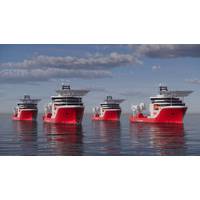
Kongsberg Maritime Secures LARS Contract with Sea1 Offshore
even in challenging sea states. The systems are designed with a compact and modular approach, making them easy to integrate on different vessel types while maintaining high durability and minimizing downtime.The inclusion of hydraulic power units with frequency control reduces emissions and energy consumption. Advanced control systems provide precise and responsive handling, enabling safe and accurate operations for complex subsea tasks
AI is Boosting Operational Autonomy
greater integration of AI with bio-inspired algorithms such as those that mimic the adaptive decision-making observed in marine animals.Researchers at Australia’s Queensland University of Technology are already working on both these challenges, employing bio-inspired algorithms to reduce energy consumption. They highlight that robotic vision systems alone can use up to a third of the energy onboard a robot because of modern robotic vision’s reliance on AI.They have developed a system that uses a brain-inspired technology called neuromorphic computing. This takes principles from neuroscience
Lander Lab: Chilean Ocean Lander Data Acquisition and Control System
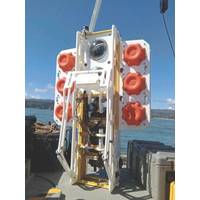
16 GB microSD. As tested in this project, the SD Card requires less than 10 mA during writing and up to 100 mA in short periods when it is initialized.Wiring diagram of the main processor based on Atmega Mega2560-Core, and expansion boards. The system components have been selected for efficient energy consumption, from the microcontroller with an active mode consumption of 59 and 0.6 mW in sleep mode. (Image by Victor Villagrán, UdeC)Electric schematic of the main power unit includes power drivers and voltage regulators to support the requirements of the system. Components, such as low quiescent
Kongsberg Maritime Unveils Range of T&I Solutions for Floating Wind
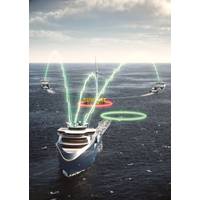
winch system capable of tensioning and proof-loading up to three mooring lines simultaneously with significant reduction in bollard pull requirements. This vessel can pull up to 900 tonnes in a single fall configuration, ensuring efficient and safe anchor handling, with reduced energy consumption.The subsea construction vessel design concept, (UT 7600 FWIV Subsea), is equipped with advanced systems for handling, storing, and deploying mooring elements, making it ideal for high-volume floating wind installations, according to Kongsberg Maritime.Tow Assist System to Enhance Towing OperationsTo
Flocean Aim to Transform Desalination with Subsea Technology
risks.Flocean’s technology addresses traditional desalination challenges by implementing deep water reverse osmosis (RO) systems 400-600 meters under the ocean. Taking advantage of the already pressurized and predictably clean deep sea water, the company claims that its approach reduces energy consumption by up to 50% and eliminates toxic brine discharge. This reduces land use by up to 95% compared to current methods and enhances ocean health."Flocean's subsea approach represents a leap forward in sustainable desalination, aligning perfectly with our commitment to climate-positive solutions
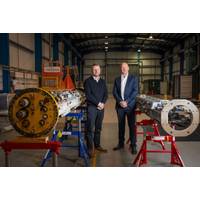
Proserv and Verlume Team Up for Subsea Power Efficiency Boost
market.Under the terms of the MoU, Proserv and Verlume will integrate Proserv’s subsea control and communications systems with Verlume’s energy management and battery technology to improve the efficiency of subsea power delivery.This enhanced level of system integration will reduce energy consumption by as much as 50% and significantly improve operational flexibility, reliability and reduce costs, according to the companies.By utilizing an integrated approach, a unique market offering will be created which aims to provide reliable power to remote, subsea assets.Together, the companies will
 February 2026