Integrated, Multi-Domain Port Security
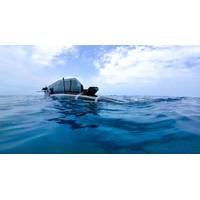
multi-domain situational awareness and response.Wavefront Systems, MARSS and Forcys recently provided a week-long demonstration of their combined underwater and multi-domain security systems, hosted at Portland Port, UK. Observers were able to watch the threat unfold in real time as Wavefront’s Sentinel Intruder Detection Sonar (IDS) and MARSS’ NiDAR Command and Control platform worked in tandem to detect, track, classify and respond to a range of hostile events from underwater and the air. NiDAR is a sensor-agnostic, multi-domain surveillance and security platform
Intruder Alert: Ports Face a Range of Underwater Threats
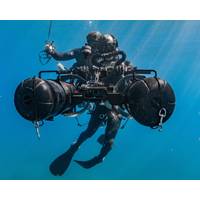
provide the means to detect and track intrusions beneath the surface. The most widely deployed technology for this purpose is the intruder detection system (IDS), which uses high-frequency active sonar to detect the presence of divers, SDVs, and increasingly small UUVs. Products such as the Forcys Sentinel, AquaShield from DSIT Solutions, and Norbit’s GuardPoint offer integrated solutions that combine sonar sensors, signal processing software, command-and-control interfaces, and even underwater loudhailers.These systems are typically arranged as networks of sonar nodes positioned along harbor
Teledyne Marine Wins UK Royal Navy Contract for AUVs and Floats
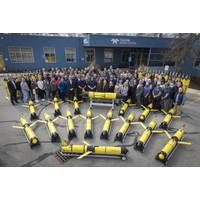
of the Royal Navy’s Future Maritime Data Gathering (FMDG) - Persistent Oceanographic Data Collect, strengthening the Royal Navy’s oceanographic and environmental data collection capabilities.Under this contract, Teledyne will supply numerous autonomous ocean observing systems, including Sentinel and Slocum gliders, APEX floats, and associated services, enabling the Royal Navy to expand its fleet of advanced unmanned technologies to collect high-quality oceanographic data in support of operational planning, maritime safety, and defense activities, directly supporting Atlantic Bastion.Under
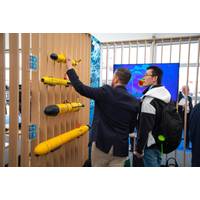
Teledyne Marine Will Debut New Technologies at Oceanology International 2026
industry colleagues to mark five decades of innovation in marine acoustics.Visitors to the stand will be able to explore a range of proven survey and autonomous platforms, including a Gavia AUV equipped with integrated SeaBat T20 multibeam sonar and Compact Navigator, alongside the long-endurance Slocum Sentinel glider. Teledyne’s Sentinel glider ‘Redwing’ is currently on a mission around the world and attendees can learn more.Teledyne Marine will also present its new SeaBat T51 integrated dual head multibeam systems, delivering greater swath coverage, improved along-track density and
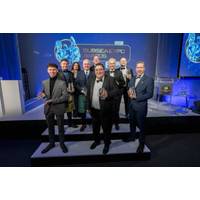
Wins For Companies Across UK at Annual Subsea Expo Awards in Aberdeen
;s reach right across the UK, companies from Aberdeen, Bristol, Hampshire, Hertfordshire and Newcastle collected awards at the event, which was hosted by television personality and comedian Cally Beaton.The Technology Development Award, sponsored by Viper Innovations, was won by Aberdeen-based Sentinel Subsea, acknowledging development of its well integrity monitoring technology WellSentinel. Electrical monitoring and asset integrity provider Viper Innovations, which is headquartered in Portishead, near Bristol, and has an office in Aberdeen, secured the Cross Sector Innovation Award for its spread
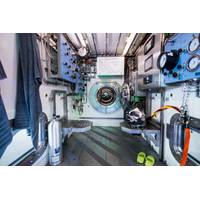
The Rise of the Aquanaut
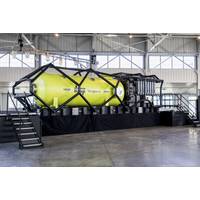
power an internet connection and a tank to hold wastewater.Ultimately, Vanguard represents the beginning of a larger vision – a global network of underwater habitats that could give humans a permanent presence in the ocean. DEEP is already planning its successor, an advanced modular habitat called Sentinel. Sentinel modules will be six meters wide, twice the diameter of Vanguard.A small deployment might have a crew of eight, about the same as the International Space Station. A big Sentinel system could house 50, up to 225 meters deep. DEEP says Sentinel will be launched in 2027.Ultimately, according
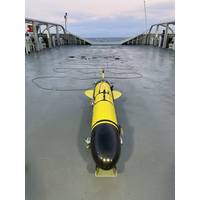
Teledyne Demonstrates Autonomous Systems for Anti-Submarine Warfare in the North Atlantic
Teledyne Technologies Incorporated announced that, from January 17 through January 22, it conducted an Anti-Submarine Warfare (ASW) demonstration in Icelandic waters using its autonomous underwater vehicles, including the Slocum Sentinel Glider with a 60-meter-long passive acoustic towed array, the Slocum G3 Glider with integrated Teledyne Benthos acoustic communications, and two Advanced Profiling Explorer (APEX) floats fitted with ambient noise Passive Acoustic MonitoringSeveral NATO members were in attendance to witness the trials which were conducted from the Teledyne Gavia facility located in
New Study Reveals How Greenland’s Seaweed Stores Carbon in the Deep Ocean
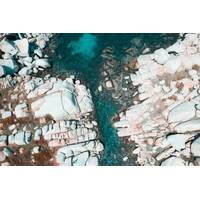
ocean currents, and numerical simulation models showed that the ocean currents can carry buoyant macroalgae from coastal zones into deeper waters on ecological timescales (averaging 12–64 days), often before structural breakdown occurs.Those findings were supported by analysis of more than 1,300 Sentinel-2 satellite high-resolution, multi-spectral images, via a service run by the EU’s Copernicus program. These images revealed nearly 8,000 floating macroalgae patches across the Greenland shelf sea and the adjacent Labrador Sea, confirming widespread offshore presence of macroalgae.[A] Locations
DEEP Partners with Unique Group to Deliver Subsea Human Habitat
;s pioneering subsea human habitat program. Unique Group is responsible for the design, engineering, and project management of several critical systems vital to the deployment of the pilot habitat, Vanguard.DEEP’s mission is to Make Humans Aquatic and their long-term roadmap includes building Sentinel, a larger subsea habitat system that enables researchers and scientists to live and operate underwater at depths of up to 200 meters for up to 7 days or more at a time. The first pilot habitat, Vanguard, is being built right now in Sebastian, Florida, and will be followed by the Sentinel habitat

 February 2026