SeaBot Maritime, GRi Simulations and Frontier Robotics Feature Human-AI Autonomous Maritime Training Platform
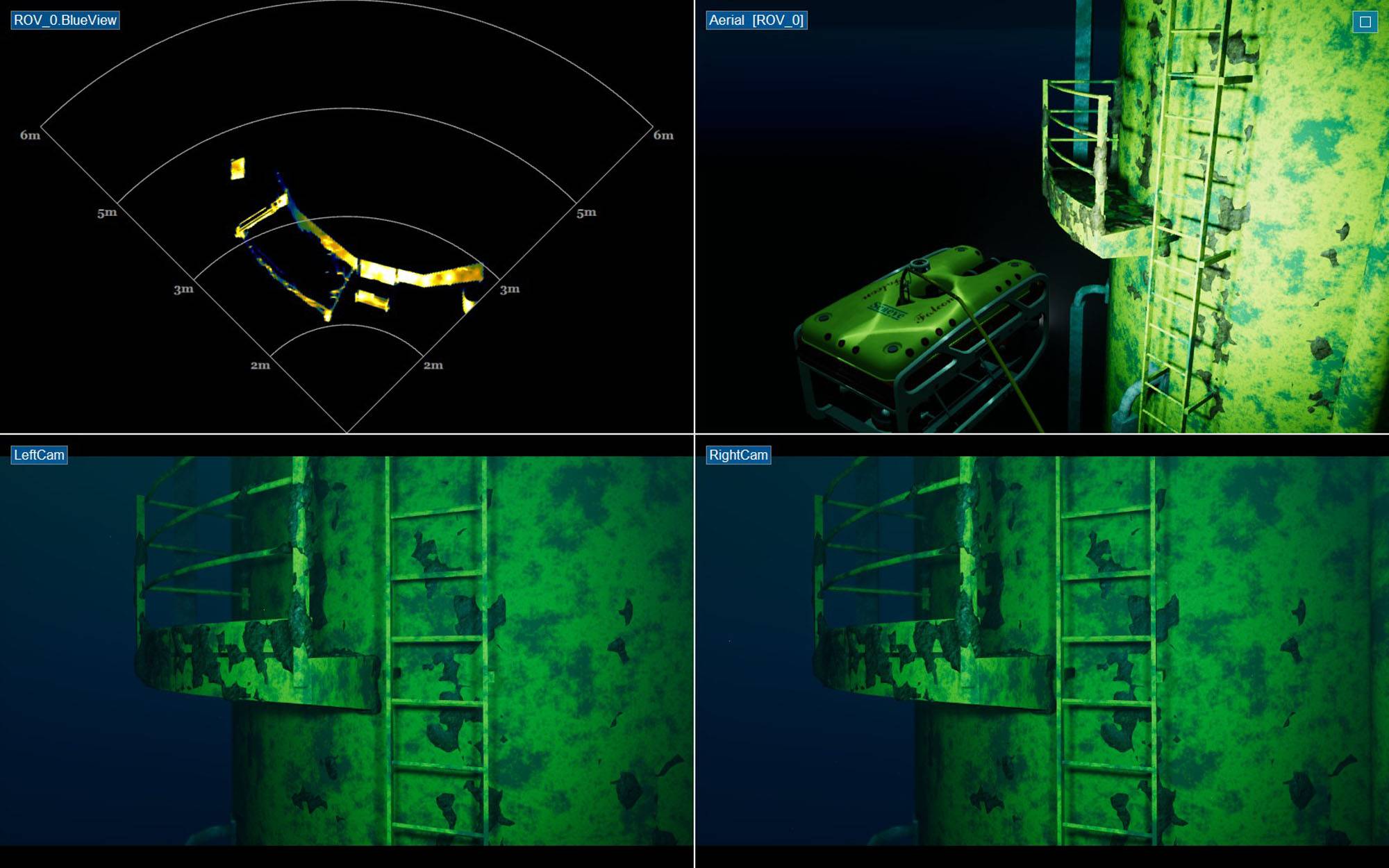
Screenshot of GRi Simulations’ VROV marine operations simulator configured to model offshore ROV inspection missions and support testing of AI-enabled subsea autonomy systems. Credit: GRi Simulations Inc.
Across offshore energy, commercial maritime and defense, deploying people and equipment into subsea environments remains complex, specialist and high-risk work, with individual campaigns often exceeding $130,000 per mission. As autonomous systems become central to maritime operations, SeaBot Maritime, GRi Simulations Inc. and Frontier Robotics have delivered a new simulation platform that enables operators to safely train and validate AI-enabled systems before deployment at sea.
Developed as part of a UK government-funded initiative awarded by the AI Security Institute, the platform allows autonomous subsea systems to be tested within a realistic digital offshore environment prior to live deployment. The project, titled “Evolving Human-AI Competencies: Workforce Development for Building Systemically Safe Cyber-Physical Systems,” was led academically by King’s College London, with SeaBot Maritime directing operational and training design to ensure real-world maritime relevance.
The initiative strengthens how offshore operations are prepared and delivered, pairing advanced simulation with highly trained operators to enhance safety, readiness and operational resilience.
VROV
At the core of the platform is GRi Simulation’s VROV (Virtual Remotely Operated Vehicle) system, a real-time marine operations simulator used globally for subsea training. For the project, GRi configured VROV to create a digital twin of an offshore wind farm inspection using a Saab Seaeye Falcon ROV. Monopile structures were populated with randomized inspection faults including corrosion, marine growth, anode damage and subsea cable defects, ensuring no two simulated missions are identical. Environmental variables such as sea state, current, turbidity and sonar noise can be adjusted to reflect real offshore conditions, with dynamic tether modelling and collision detection adding further operational realism.
VROV supports live integration of external autonomy control systems, creating both a sophisticated training environment and an autonomy validation test bed. During the project, Frontier Robotics integrated its autonomous navigation software into the simulator, moving from small-scale physical tank testing to expansive virtual ocean environments. The integration enabled testing of autopilot-assisted navigation, multiway point mission planning, SLAM-based localization, obstacle avoidance and both semi-autonomous and fully autonomous inspection workflows within a realistic offshore setting.
The platform also allows deliberate introduction of failure states, including autopilot degradation, camera malfunction and environmental disturbances. Operators can rehearse emergency intervention scenarios and assess how humans and autonomous systems perform together under pressure, without the cost or risk of offshore deployment.
GRi Simulation’s proprietary physics engine (GRiP) delivers high-fidelity dynamics and behavioral realism, including dynamic tether modelling, collision detection and interaction, and configurable environmental conditions.
SeaBot Maritime is now leading the commercial translation of the platform into structured training and competency pathways for offshore operators.
An Intelligent Future
“We’ve demonstrated, for the first time, that one operator can safely and effectively oversee multiple ROVs across complex subsea environments,” said Gordon Meadow, CEO of SeaBot Maritime. “The future is about empowering highly trained onshore operators to lead intelligent, connected systems rather than continuing to scale offshore crews.”
“Interfacing Frontier’s autonomous control system with GRi’s VROV simulation platform, created a realistic testbed for advancing safe, AI-supported offshore inspections. This demonstrates how simulation can be used to accelerate development while reducing cost,” added Russ Pelley, President of GRi Simulations.
While the funded case study focused on subsea inspection operations, the underlying architecture supports wider maritime autonomy applications. GRi’s VROV platform has demonstrated integration capability with autonomous surface vessel control systems, including the GuardianAI control system developed by Marine AI, highlighting its adaptability across both subsea and surface domains.
As AI adoption accelerates across offshore energy, defense and critical infrastructure inspection, the safe integration of autonomous systems is becoming one of the sector’s defining challenges.



 August 2026