Sonardyne's Fetch Positioning Technology to Support Deepsea Neutrino Detector
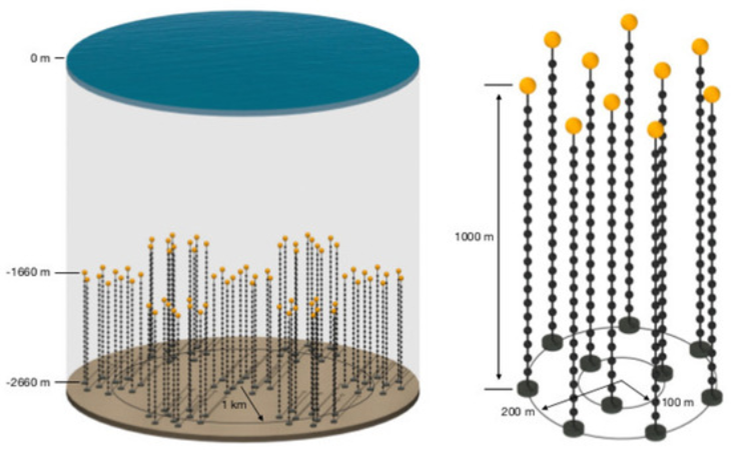
Illustration of the P-ONE configuration: As shown on the left, seven clusters will constitute a one cubic kilometre detector. A single cluster with ten mooring lines is depicted on the right. (Picture: K. Holzapfel/Technical University of Munich)
A new deep-sea neutrino detector being built to transform our understanding of the universe will use precise positioning from underwater technology company Sonardyne.
An array of Sonardyne's Fetch instruments will provide the precise and stable underwater positioning the 3,000 m deep Pacific Ocean Neutrino Experiment (P-ONE) needs to accurately detect and analyze high-energy neutrinos.
P-ONE, a multi-national, multi-institute scientific collaborative project, will help scientists to unlock insights into extreme cosmic phenomena like black holes and supernovae. The cosmic neutrino telescope will be built off the coast of British Columbia, Canada, leveraging Ocean Network's Canada's existing world-class advanced deep-sea infrastructure.
Alongside exploring the universe, P-ONE will also deliver vital data for oceanography, climate science and tectonic research, advancing both astrophysics and marine technology.
Professor Matthias Danninger, principal investigator at Simon Fraser University (SFU), says, "The P-ONE collaboration’s goal is to create a unique observational facility, as part of a global effort to improve our understanding of high-energy and ultra-high-energy cosmic neutrinos, their sources and their role in astro and particle physics."
The P-ONE detector will involve the anchoring of a three-dimensional array of thousands of advanced optical sensors creating a vast detection grid. These will detect the faint light (Cherenkov radiation) created when high-energy neutrinos interact with water molecules.
The P-One collaboration’s goal is to build a full detector array that would cover multiple square kilometers. The initial pilot array, and a potential future full array, will be connected into ONC's existing cabled infrastructure, which spans thousands of kilometers in the Cascadia Basin.
Designed as a long-life autonomous seabed node, Sonardyne's Fetch can operate for up to 10 years, making it ideal for extended deep-sea monitoring campaigns. Its adaptable design allows for a range of sensors to be integrated, supporting everything from seabed deformation studies to broader ocean science.




 August 2026