
New Zealand Weighs Seabed Mining’s Environmental Impact
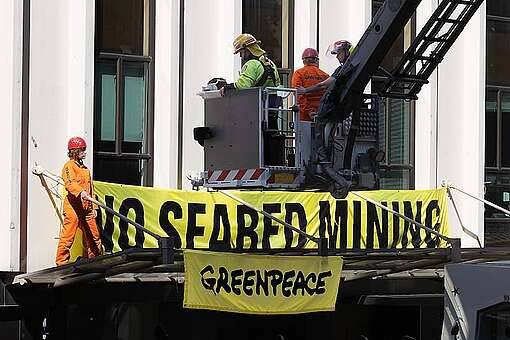
Source: Greenpeace
This week, the US BOEM released its critical mineral sales and bidder qualifications.
“We are pleased to share important news about potential upcoming opportunities to lease areas of the U.S. Outer Continental Shelf for the potential future development of critical and strategic mineral resources vital to America’s security, technological leadership, and economic strength.”
The move comes after New Zealand’s Fast Track expert panel declined an Australian company’s application to mine the seabed in the South Taranaki Bight, finding in a draft decision that it would likely cause material harm to marine ecosystems and threatened species like pygmy blue whales and penguins. It concluded the Trans-Tasman Resources mining project could not be safely managed, even with conditions attached.
Trans-Tasman Resources had applied under the Fast-track Approvals Act 2024 (FTAA) for approvals for its Taranaki project which involves, in each year for 20 years, extraction of up to approximately 50 million tonnes of seabed material, recovery of up to approximately five million tonnes of vanadium-rich titanomagnetite concentrate, and the return of approximately 45 million tonnes of de-ored sediment to the seabed.
Some of Fast Track’s findings when rejecting the application are:
Extent of benefits: the Panel considers that the project has significant regional benefits and some national benefits. These benefits relate to diversification of the economy, royalties, tax contributions, gross domestic product contributions, employment, household income increases, establishment of a Community Trust, workforce skills development and indirect climate related benefits. The Panel finds that the project’s contribution to regional gross domestic product and employment are its most significant benefits.
Sediment plume and deposited sediment scale and extent: the Panel finds that there is uncertainty as to the scale and extent of the sediment plume and deposited sediment resulting from the project, in circumstances where those matters are critical to assessing the project’s effects on the environment and on existing interests. The Panel is not satisfied that conditions could control the sediment plume in a way that would avoid material harm to sensitive species and habitats.
Underwater noise: the Panel finds that there is uncertainty regarding the underwater noise that would be generated by the project. An assessment restricted to the integrated mining vessel and crawler as modelled sources of underwater noise does not represent a realistic worst case for total project noise, in circumstances where those matters are critical to assessing the project’s effects on the environment and existing interests. The Panel is not satisfied that conditions could control noise levels to avoid material harm to sensitive species.
Effects on the environment: the Panel finds that granting the approvals would result in material harm to benthic primary productivity, and benthic ecosystems; that material harm is likely to Māui dolphins; and that there is a credible risk of material harm to other marine mammal species, kororā/little penguin and fairy prion. The Panel also finds that the geomorphological changes associated with tailings backfill (flow liquefaction and related runout) carry a risk of material harm to benthic ecosystems and that the project presents a credible risk of adverse local effects on fish distribution and habitat function.
Effects on natural character: The project would affect the level of natural character within the project area and in parts of the coastal marine area, including some of the identified areas of outstanding natural character. A notable impact on the existing level of natural character occurs as a consequence of what would be a notable adverse visual amenity effect on water clarity, particularly at locations for recreation and which are deemed to be ecologically and culturally important. The geomorphological impacts of the project, with changes to seabed morphology from pits and mounds, and ongoing movement of sediment possible through liquefaction would be notable and adverse and is projected to persist for decades to centuries. The consequence of such effects is a notable reduction in the natural character of the project area and beyond for at least the period of the mining, and in some respects (such as geomorphology and suspended sediments) well beyond the period of proposed mining. The Panel finds that the project would significantly affect the level of natural character within the project area and in parts of the coastal marine area.
Effects on existing interests: The Panel’s finding on existing interests are these:
a. Tikanga-based relationships with the moana and its resources would be adversely affected by the project, including effects on mauri, disruption of customary supply systems, and constraints on the practical exercise of kaitiakitanga.
b. Māori commercial and customary fishing existing interests would be adversely affected by localised displacement, operational exclusion, and loss of practical access and certainty arising from project activities (including the mining, sediment plume and underwater noise footprints). The Panel does not accept that these fishing activities could be readily transferred to alternative locations without loss of value or practical function.
c. The project would adversely affect commercial fishing interests through localised exclusion, displacement of fishing effort, increased operating costs and risk, and uncertainty that would materially alter fishing behaviour and market participation.
d. There would be effects on recreational use of the STB, particularly recreational diving where key dive sites would be significantly adversely affected by reduced water clarity for much longer periods than currently occurs.
e. The risks to the Kupe Well Head Platform from potential collision by project vessels could be managed through conditions and the existing safety exclusion zones applied by applicable regulations. However, the Panel has concerns regarding the long-term instability of mining tailings and the uncertainty this creates for potential effects on Kupe infrastructure.
f. Impacts on aquaculture interests could be effectively managed through a combination of compliance with other relevant marine management regimes and conditions.
g. Impacts on navigation and maritime safety could be effectively managed through a combination of compliance with other relevant marine management regimes and conditions.
Best available information: the EEZ Act requires decisions to be based on the best available information but the Panel finds that, for certain key matters, the information before it does not meet that standard. For the marine consent, the Panel has considered whether an adaptive management approach could address those uncertainties, as required by s 61(3) EEZ Act. We are not satisfied that adaptive management would be effective in this case.
Conclusion: The Panel finds that the adverse impacts of the project are sufficiently significant to be out of proportion to its regional and national benefits, even after taking into account the potential use of conditions. In the exercise of our discretion under s 85(3) FTAA, we consider the application should be declined.





 August 2026