Canada’s Ocean Supercluster Announces Three Ocean Innovation Projects Valued at $15m
Canada’s Ocean Supercluster has announced three new ocean innovation projects valued at USD$15.8 million (CAD$22.1 million). This includes the USD$2.57 million (CAD$3.6 million) Marsupial Flying Robots Project led by Avestec, the USD$2.15 million (CAD$3 million) Lilypad: Electric Charge Barge Project led by Mostar Labs, and the USD$11.08 million (CAD$15.5 million) Enabling Scalable Seaweed Restoration & Cultivation Project led by Canadian Pacifico Seaweeds.
Marsupial Flying Robots Project
This project is advancing robotics through the development of Marsupial Flying Robots – an integrated system designed for complex inspection and maintenance tasks, such as those involving rope access, scaffolding, and diver-based inspections in offshore and marine environments. The project enhances safety, reduces downtime, and lowers costs by minimizing human exposure to hazardous conditions.
The project is led by Burnaby, BC-based Avestec, in partnership with Nanaimo, BC-based Reach Systems Inc, and Coquitlam, BC-based Anarampower Ltd.
Avestec’s Marsupial Flying Robot Project will deliver a dual-robot system functioning as a collaborative robotic mechanism to conduct complex inspections in offshore and challenging environments. By driving the commercialization of advanced robotic inspection solutions, the initiative is set to generate revenue growth and market expansion for Canadian SMEs, strengthen supply chains, and foster innovation-driven economic development.
Lilypad: Electric Charge Barge Project
This project introduces Lilypad, a mobile floating charging station designed to accelerate maritime electrification. The solution provides a flexible, cost-effective charging infrastructure for electric vessels, reducing reliance on permanent installations, and supporting clean marine transportation. The mobile solution operates like a floating gas station for electric boats in coastal waters.
The project is led by Victoria, BC-based Mostar Labs, in partnership with St. John’s, NL-based Engage Creative Technologies.
By integrating smart grid technology and emergency power capabilities, Lilypad enhances coastal community resilience, while also building a skilled workforce for clean maritime technology through advancing digital adoption in marine transportation. The project carries significant potential for international application, positioning Canada as a global leader in sustainable marine infrastructure. In regions like the Mediterranean, North America, and Australia where boat numbers are high and sustainability mandates are rising, the path to electrification is accelerating. Adopting Lilypad allows marinas to capture this market early at low risk.
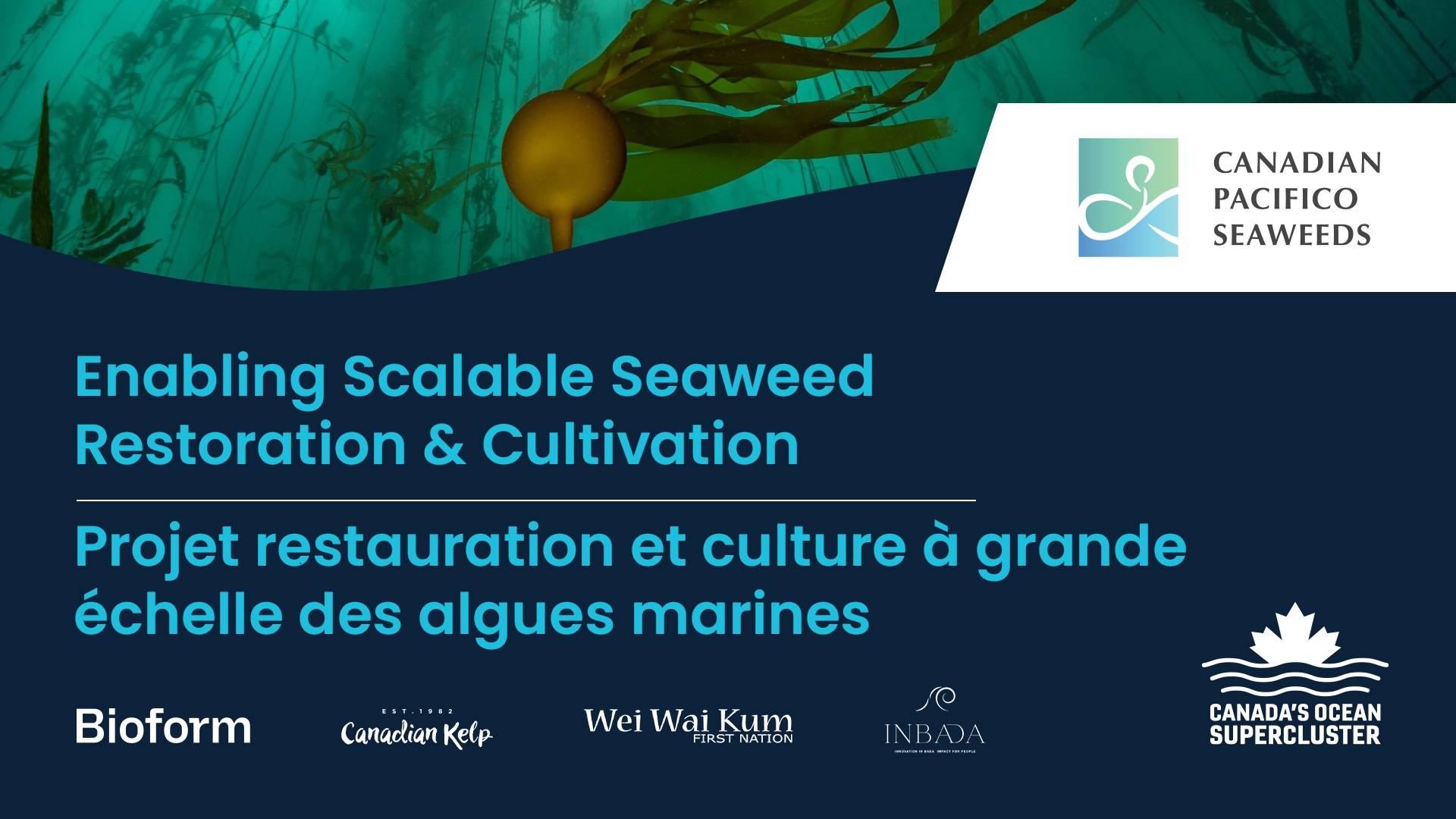
Enabling Scalable Seaweed Restoration & Cultivation Project
This project aims to revolutionize seaweed seeding technology through the development and commercialization of KelpSpat. This breakthrough adhesive and automation system improves kelp seed survival rates by up to 400 per cent, enabling large-scale sustainable cultivation and seaforestation.
The project is led by Richmond, BC-based Canadian Pacifico Seaweeds, with 13 partners and collaborators across aquaculture, Indigenous communities, non-profits, and academia. Partners include Bamfield, BC-based Canadian Kelp Resources Ltd, Vancouver, BC-based Bioform Technologies Inc, Campbell River, BC-based Wei Wai Kum First Nation, and Vancouver, BC-based Inbada Holdings.
The project includes trials at Indigenous-stewarded farms and explores commercialization pathways for food-grade seaweed, functional foods, performance ingredients, bioplastics feedstock, and regenerative ocean conservation. It supports rural communities, strengthens aquaculture, and contributes to global ocean health, while positioning Canada as a global leader in cold-water seaweed cultivation and exports. It also provides the opportunity to tap into the USD$930 million (CAD$1.3 billion) global edible dried seaweed market, as well as related food system markets such as plant health and animal nutrition through agricultural programs – leveraging Canada’s cold-water advantage and growing expertise in sustainable seaweed farming. With projections that the global seaweed industry alone will reach USD$20.02 billion (CAD$28 billion) annually by 2050, there is substantial room for growth in this sector.




 August 2026