
Hybrid Theory: Multi-Domain Unmanned Systems are Blurring Maritime Boundaries

The HoverAir Aqua. Credit: HOVERAir
[2031: Somewhere in the Luzon Strait]
Under cover of darkness, an elite team of Navy SEALs reaches an uninhabited island and moves inland. Fifty km out to sea, a flotilla of autonomous underwater and surface vehicles (AUSVs) shifts between the surface and the safety of the deep, keeping a stealthy, unblinking eye on enemy fleet movements and transmitting near-real-time intelligence to USINDOPACOM and the embarked SEALs. From behind the beach, a small amphibious quadcopter takes to the sky, traveling ten km offshore where it descends, lands on the water’s surface, and submerges, its onboard acoustic modem broadcasting a single high-frequency message to an object resting quietly on the seabed - NOW. As the drone reemerges and climbs back into the sky, a prepositioned cargo trimaran rises slowly through the water column, breaks the surface, and begins its wind-driven journey toward shore. On reaching the surf zone, SEALs slip from behind the rocks to haul the vessel onto the beach and recover its payload of provisions and power modules before dismantling and concealing it among the weathered landscape. Meanwhile, a flotilla of autonomous low-profile vessels (ALPVs) is inbound from Guam, loaded down with four-ton payloads comprised of modular autonomous air, underwater, and surface vehicles for detecting, tracking, and striking enemy warships.
This scenario may read like a passage from a speculative techno-thriller, but these platforms and capabilities already exist, and are coming to contested waterways around the world. The lines between warfare domains are blurring as a generation of innovative hybrids enters the battlespace. Whether rising from the depths to take flight or diving below the surface to evade detection, these systems are poised to redefine maritime mission sets.
Air to Surface: Where the Sky Meets the Sea
The emergence of unmanned air systems (UAS) with amphibious and submersible capabilities represents a potentially transformative development in maritime defense. Among the most mature of these cross-domain systems is the Naviator, developed at Rutgers University and now marketed by SubUAS LLC. First demonstrated in 2017, the Naviator is a quadcopter drone that can transition from the air to water depths of up to 1000 feet. Its four rotors serve double duty: providing lift and maneuvering in the air, and functioning as propellers underwater. The vehicle has demonstrated missions ranging from bridge inspection to harbor access reconnaissance, and shows potential for mine hunting, hull inspection, and search and rescue. With the ability to dive, maneuver, and return to flight, the Naviator represents perhaps the most battlespace-ready realization of an aerial-aquatic hybrid to date.
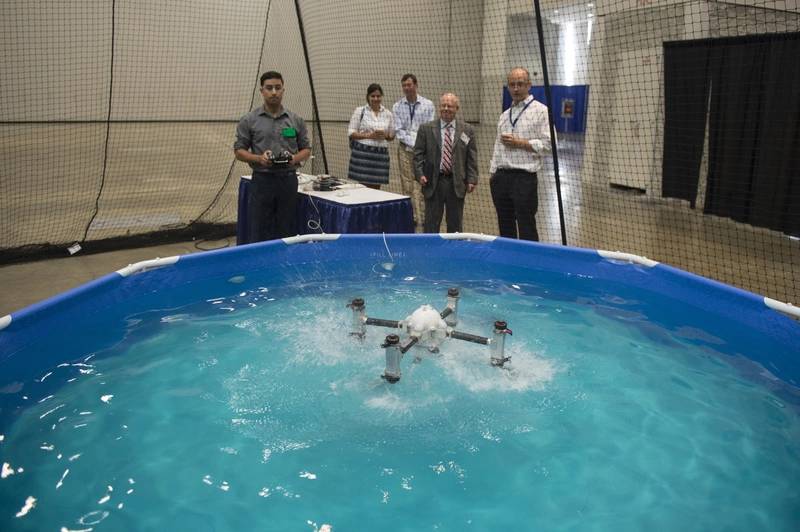 The Naviator drone. Credit: U.S. Navy photo by John F. Williams/Released
Another contender is from Vancouver-based Seahawk Robotics. With its ruggedized, waterproof airframe, the F4 is designed to land, float, and operate on open water for extended periods. Rather than fully submerging, it uses the water’s surface as a base for deploying and retrieving sensors using an onboard winch. For navies and commercial operators alike, the F4 can provide a rapidly deployable, targeted sensing or communication capability at dramatically reduced cost and logistical overhead.
Some intriguing recreational COTS systems also offer defense potential. Chinese manufacturer SwellPro has carved out a niche with its SplashDrone 4, a self-righting, ruggedized, fully waterproof quadcopter that can fly, land, float on water, and take off again. And then there’s the HOVERAir Aqua, a pocket-sized, IP67-rated drone by Zero Zero Robotics, makers of the popular HOVERAir self-flying camera drone. The Aqua can float, stabilize, and even film below the ocean surface in “Snorkel Mode” using its tilting 4K camera. While neither vehicle dives fully beneath the waves, they demonstrate how quickly amphibious UAS are maturing in the commercial space, and could readily be adapted for maritime drone operations.
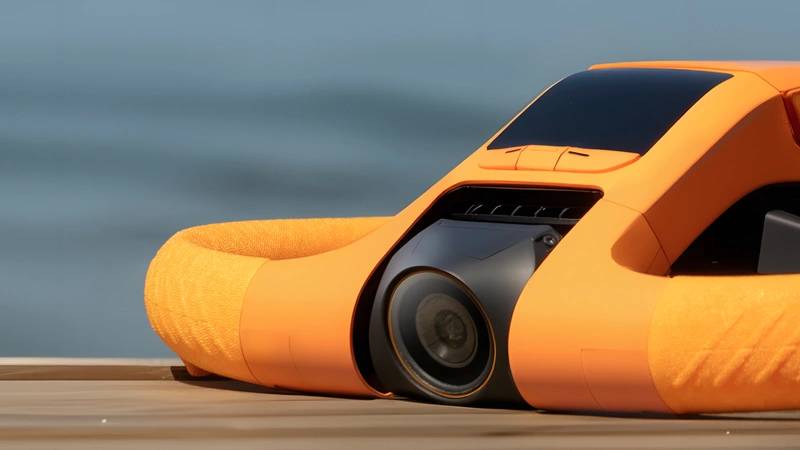 The HOVERAirAQUA. Credit: HOVERAir
Surface to Undersea: Piercing the Interface
Imagine an autonomous vehicle that can operate both above and below the ocean surface, combining the persistence and communication advantages of a USV with the stealth capabilities of a UUV. Now imagine it is powered exclusively by wind and solar energy, and can be organized into distributed, high-endurance, attritable fleets for full-spectrum maritime surveillance.
San Diego-based SubSeaSail has spent nearly a decade perfecting just such a vehicle. HORUS is a compact, lightweight, monohull AUSV designed for persistent maritime operations and data collection. A patented, transparent wingsail enables low-signature operations at sea for months without fuel or maintenance, while its ability to submerge to depths of 100 meters allows it to evade detection or adverse weather conditions. Measuring approximately 1.6 meters in length and weighing around 32 kilograms in its base configuration, HORUS can achieve sailing speeds of 0.5 to 2.5 knots under wind power and up to 4 knots using its electric thruster for station-keeping or low-wind transit. With the Defense Innovation Unit supporting the vehicle’s transition to contract manufacturing, HORUS represents a next-generation approach to scalable, “disruptively affordable” autonomous maritime systems.
SubSeaSail’s HERMES, meanwhile, is a scalable, self-righting, semi-submersible trimaran designed for long-duration surface and subsurface operations, and is envisioned as a cargo and expeditionary power supply platform. Like HORUS, HERMES can submerge to 100 meters to evade detection or ride out severe weather. With speeds of 5 to 15 knots, and large-volume payload space, it offers a high-speed, attritable platform for contested logistics.
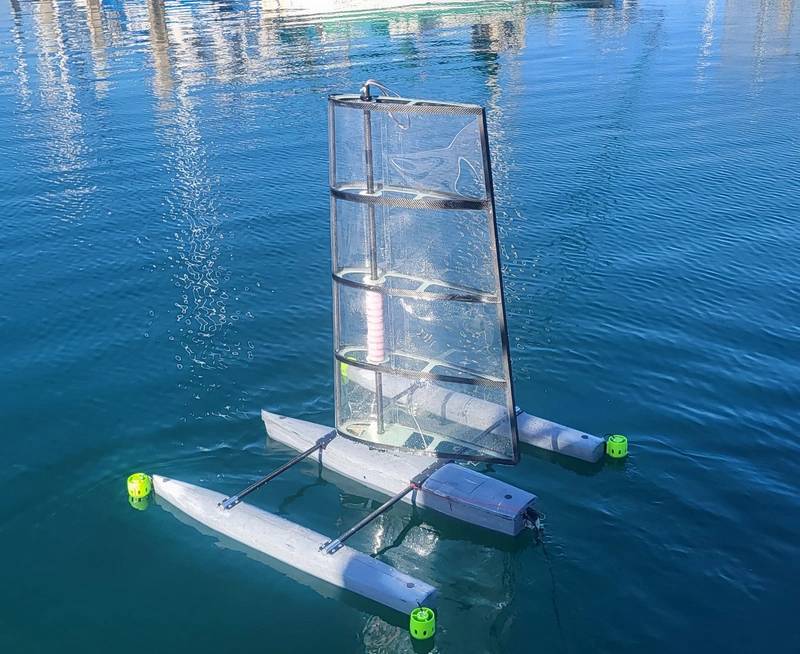 The HERMES. Credit: SubSeaSail
Another maritime innovator, Gulfport-based Ocean Aero, has developed a first-of-its-kind hybrid autonomous platform, the Triton. Measuring approximately 4.5 meters in length and weighing 350 kilograms, its folding rigid sail, integrated solar panels, and electric drive enable months-long surface operations or dives to 200 meters for up to five days. In addition to surface surveillance, the Triton’s body payload capacity of 23 kilograms (with additional space in the wing and keel) enables underwater survey and intelligence operations, making it well suited for missions such as anti-submarine warfare (ASW), mine countermeasures (MCM), and critical infrastructure protection. The vehicle is designed for one or two-person launch/recovery from ship or shore, and a small logistics footprint allows it to be easily transported and deployed in remote or contested regions.
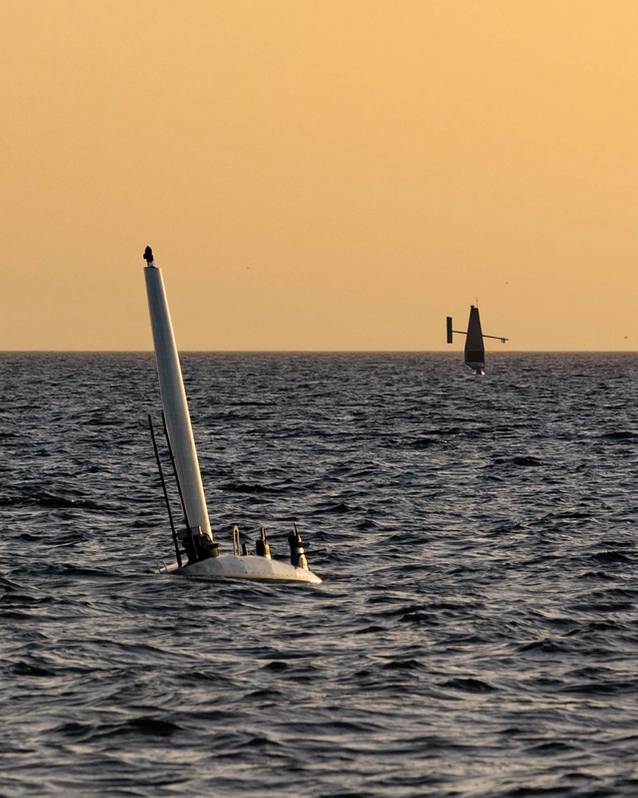 An Ocean Aero Triton unmanned surface vessel (USV), left, operates in the Arabian Gulf with a Saildrone Explorer USV during a bilateral exercise between the U.S. Navy and United Arab Emirates Navy, Feb. 16, 2023. Credit: U.S. Navy photo by Lt. Jay Faylo
On the higher displacement end of the spectrum, the Leidos Sea Specter is an autonomous low-profile vessel (ALPV) developed for the U.S. Marine Corps to support distributed operations and contested logistics. Inspired by semi-submersible “narco-boats,” the 65-foot diesel-powered craft rides low in the water to minimize visual, radar, and infrared signatures. Designed to carry up to five tons of cargo at speeds of eight knots and ranges exceeding 2,000 nautical miles, it offers a stealthy, attritable platform for clandestine supply chains. A prototype is already undergoing field testing in Okinawa, where Marine Corps Combat Logistics Battalion 31 and the 12th Littoral Logistics Battalion are putting the vessel through its paces.
A Vanishing Divide
The ocean surface is increasingly a flexible membrane through which platforms can transit at will, and as autonomy continues to advance, the distinctions among air, surface, and underwater domains may blur. Future strike groups may be accompanied not only by fleets of heterogenous drones, but an array of clever and capable hybrids - vehicles that can fly, sail, dive, and relay information seamlessly across domains. The erosion of fixed maritime boundaries is underway, and could usher in a more fluid, adaptive, and interconnected battlespace.



 August 2026