
Retiring the R/V Endeavor: Celebrating a Lifetime of Accomplishments and Memories
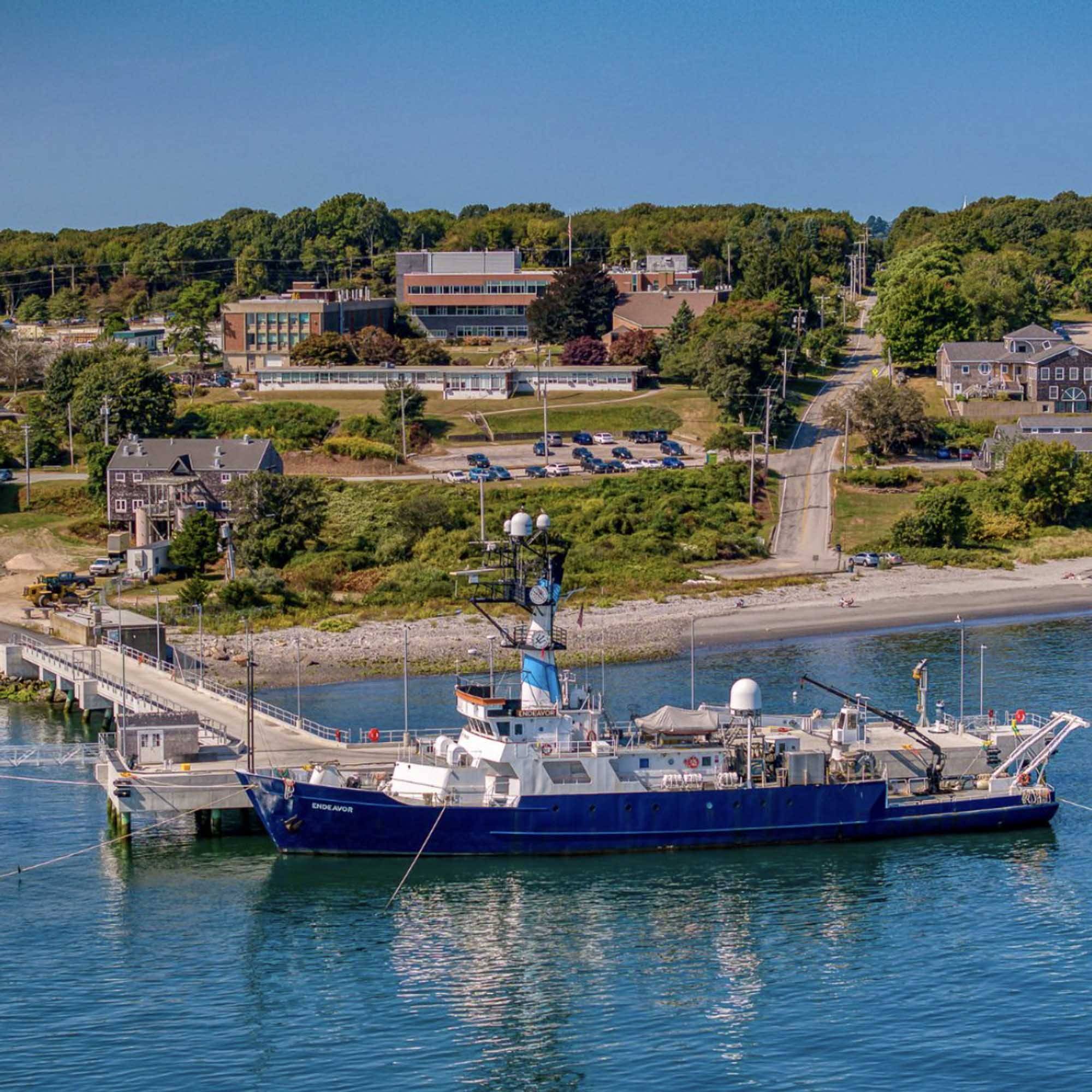
R/V Endeavor. Credit: URI Photo
In September 2025, R/V Endeavor, the University of Rhode Island's (URI) research vessel, sailed on her 736th and final voyage, bringing 50 years of service to a close. Rhonda Moniz, host of the DEEP DIVE podcast, sat down with Endeavor's Port Captain Brendan Thornton and Scientific Service Manager Erich Gruebel to celebrate the vessel's accomplishments and talk about what's next.
Built and rebuilt to serve
Endeavor joined URI's Graduate School of Oceanography (GSO) in 1976 as one of the first purpose-built research vessels in the University-National Oceanographic Laboratory System (UNOLS) fleet. She succeeded URI's previous research vessel, Trident, which was a converted 1945-era Army freighter. Endeavor served on various environmental studies around the world until 1993, when she was refit in her original shipyard in Sturgeon Bay, Wisconsin, continuing her work until this past fall. Endeavor has been as far west as Hawai'i, as far south as Brazil, up to Norway, and out to the Black Sea.
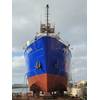
 R/V Endeavor was built in 1976 by Peterson Builders, Inc., in Sturgeon Bay, Wisconsin. Credit: URI Photo
 The Ram Band at Endeavor’s christening on December 11, 1976. Credit: URI Photo
R/V Endeavor’s specifications:
Built in 1976 with a major mid-life refit in 1993
Length overall: 185’
Draft: 18’6” aft, 12’6” forward
Cruising speed: 10 knots
Max speed: 14 knots
Range: 8000 nautical miles @ 12 knots
Endurance: 30 days
Complement: 12 crew, 17 scientists, 1 Marine technician
On her 736 cruises, Endeavor served as a platform for scientists from around the globe and for cutting-edge technologies. "It's been a privilege to take out scientists from different disciplines and to be able to work with many different institutions from all over the world—not just URI—to further environmental research and ensure that the measurements are taken for a better planet," stated Thornton. "It's also been very rewarding to work with a lot of new technology and equipment that is going to further shape the oceanographic community and sampling in the future."
 A map of R/V Endeavor's historical ship tracks over the last 49 years. Credit: Bonny Clarke
Endeavor also played a significant role in times of need. "Some of the highlights are rapid response to things like the Haiti earthquake and the BP oil spill," said Gruebel. Primarily, however, she delivered as a general research vessel. "Oceanography is a body of research—it's not just individual discoveries. The amount that this single ship has contributed over the years is what makes me proud," he added.
 On December 15, the tanker Argo Merchant ran aground off Nantucket Island during a storm, carrying more than 7.7 million gallons of fuel oil and thrusting Endeavor into service. The vessel broke apart over the following week, unleashing one of the largest oil spills in U.S. history.
During the half-century Endeavor spent at URI, she saw many technological updates, including through the mid-life refit. "If you look at different pictures, you can see that the lines of the ship have drastically changed. They added another deck in 1993, different systems, winches—to adapt to a lot of the new technologies that have come aboard and other research ships...We like to joke, there's a good mix of museum pieces and new technology on board," Thornton said.
"Technology and scientific capability wise, if you stepped on Endeavor today, after 50 years of service, you would never know that it's a 50-year-old ship. We worked very hard to keep it up to date. We're constantly installing new equipment. In the last five or six years, there's been huge advances in satellite communications and cybersecurity, and we're a leader in that regard," Gruebel added.
New era, new Dawn
As Endeavor heads into retirement, URI is planning for its new vessel, R/V Narragansett Dawn, which at time of writing is under construction in Houma, Louisiana, and will be delivered in March 2026. By design, this latest vessel will feature new capabilities and technologies.
"From the operational side, one of the biggest requests that a lot of the scientists seem to have in the fleet is for dynamic positioning systems," said Thornton. "That allows the vessel to stay put in one place based on coordinates that we can plug into the system. That'll be very useful for ROV and AUV operations—things that require the ship to stay in one spot. Right now, we have one propeller, one rudder and a bow thruster. So, it requires a lot of ship handling and we can get the job done, but the precision is something the scientific community can look forward to."
"One of the primary reasons for replacing the Endeavor, despite the advanced age of the ship, is that there's a lot of modern oceanographic work that the vessel can't do and that requires dynamic positioning and a lot of the advanced sonars," Gruebel added. "Endeavor's hull—the physical shape of the hull—just can't support things like multi-beam and sub-bottom profilers."
Thornton and Gruebel admit that a new vessel and onboard technology will create staffing implications too. "I think one of the biggest challenges we're going to face is, in the last several years, there's been a shortage of both maritime professionals and marine technicians who are able to care for this equipment. It's highly skilled labor and requires a willingness to spend time at sea. And these new ships are just so advanced—they're unlike anything out there. I think that's going to be the biggest challenge we face, is supporting a vessel that has all this modern equipment," Gruebel said.
One for the ages
Endeavor's record is one of versatility and perseverance. "It's impressive to have over 730 successful science missions. It's a real testament to the crew, technicians and scientists on board because 50 years of success is almost unheard of. It's the longest running oceanographic vessel in the fleet," Thornton said. "It's a testament to the National Science Foundation (NSF) and the ship's operators for being able to successfully run a vessel that long. There was a lot of care, a lot of thought, a lot of planning and good people that went into making sure she had successful operation for this number of years.
Gruebel also feels that Endeavor's success is a reminder of the importance of research vessels. "I don't think the general public has a very good idea of how important the ocean is to your daily life and getting the message out that the field of oceanography—it's not just whales and dolphins and being able to train scientists, technologists and maritime crew, because you will always need ships to be at sea, despite advances in robotics and automation and satellite imagery. There'll always be a need for research vessels. They're complicated and expensive to operate, but it's just like space exploration. It's part of the pursuit of humanity."
Since Endeavor's retirement, the GSO and NSF have been in talks to determine the vessel's next phase, either continuing to serve in a new role or as a source of parts donated to other institutions. Regardless of the outcome, Endeavor's legacy has been established over a 50-year career across academia, marine research, global emergency response and in the lives of countless scientists, students, professors, technologists and beyond. Her impact at URI and in the greater scientific community will be long-lasting and meaningful, leaving R/V Narragansett Dawn with a legacy to continue.
 In September 2015, the R/V Endeavor served as the base for a five-day mission to explore two World War II shipwrecks off the Rhode Island coast: the German U-853 submarine and the SS Black Point, the last U.S. merchant ship sunk in the Atlantic. Scientists used remotely operated vehicles to survey the wrecks, streaming dives live online and on Rhode Island PBS. Credit: URI Photo
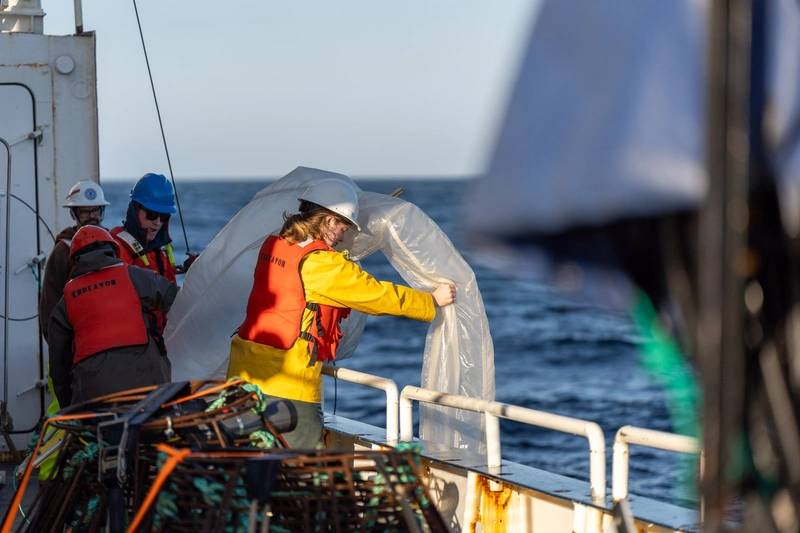
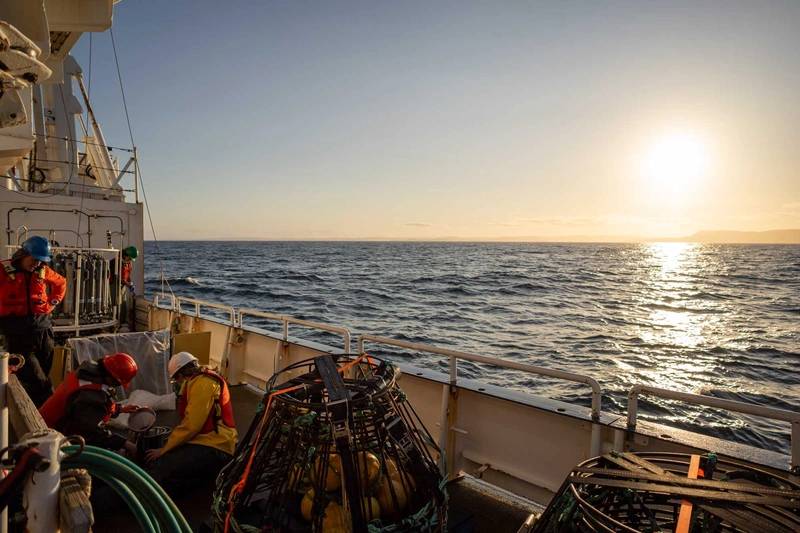 For R/V Endeavor's final cruise, the ship traveled to Nova Scotia and the northeastern coast of Newfoundland, where the science team assessed the ecological impacts of oil and gas activities using CTDs, manta nets, and a multicorer. Credit: URI Photo
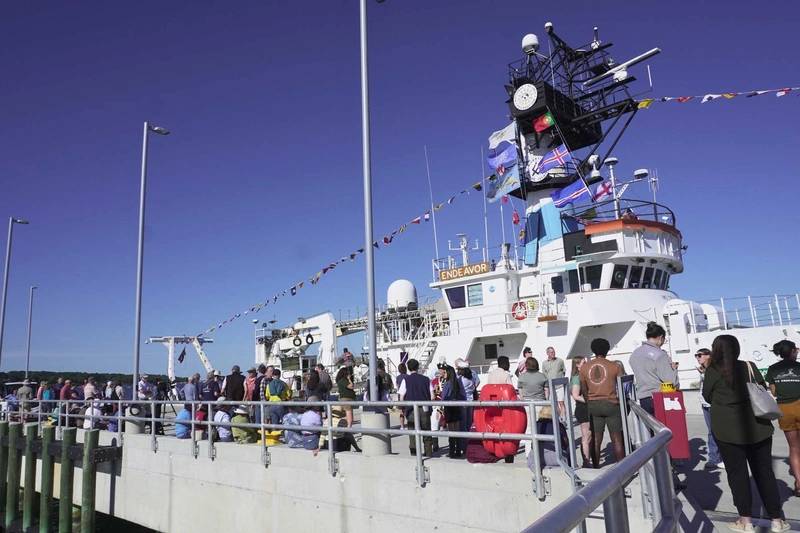 The ship returned from its final cruise to the Bay Campus on September 20, 2025. Credit: URI Photo
Learn more about R/V Endeavor on the most recent episode of the Deep Dive Podcast with Rhonda Moniz.


 August 2026