
New Study Reveals How Greenland’s Seaweed Stores Carbon in the Deep Ocean
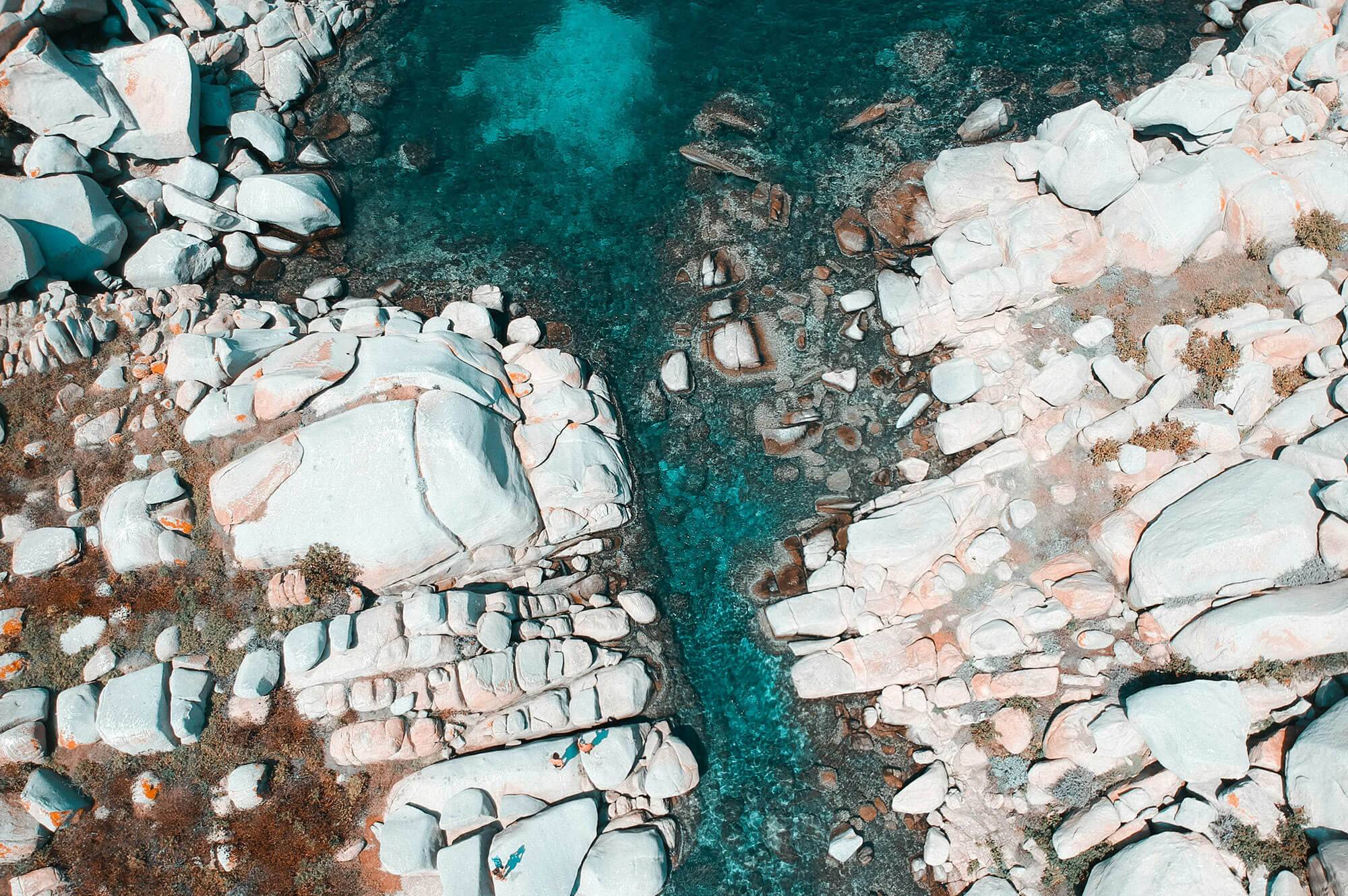
Greenland’s rocky shore. Mathilde Cureau | Unsplash
An interdisciplinary study confirms, for the first time, the oceanographic pathways that transport floating macroalgae from the coastal waters of Southwest Greenland to deep-sea carbon reservoirs, potentially playing a previously underappreciated role in global carbon storage.
Macroalgae, or seaweeds (including kelp), are highly productive coastal habitats capable of absorbing significant quantities of atmospheric carbon (CO₂). Previous studies have estimated that globally, 4–44 teragrams (1Tg = one million metric tons) per year of macroalgal-derived carbon may reach depths of 200m, where it may be sequestered for at least 100 years.
However, macroalgae’s contribution to long-term carbon storage has been challenging to quantify with any certainty due to issues including: the wide range of macroalgae properties that need to be considered; the complexity of interactions with physical oceanographic transport processes, and a lack of scientific evidence about the travels and transformations of detached macroalgae after leaving coastal rocky shores.
To address this knowledge gap, the study team, co-led by the Leibniz Institute for Baltic Sea Research Warnemünde and Helmholtz-Zentrum Hereon in Germany and involving scientists from Plymouth Marine Laboratory, University of Exeter, Portugal, Saudi Arabia and Denmark, used a combination of satellite imagery, ocean drifter tracking, numerical modelling and advanced turbulence analyses to demonstrate that extensive mats of macroalgae can travel hundreds of kilometres offshore. Eventually these mats may sink to great depths where their organic carbon may be stored long-term.
Data from 305 oceanographic monitoring devices, which float on the surface to help investigate ocean currents, and numerical simulation models showed that the ocean currents can carry buoyant macroalgae from coastal zones into deeper waters on ecological timescales (averaging 12–64 days), often before structural breakdown occurs.
Those findings were supported by analysis of more than 1,300 Sentinel-2 satellite high-resolution, multi-spectral images, via a service run by the EU’s Copernicus program. These images revealed nearly 8,000 floating macroalgae patches across the Greenland shelf sea and the adjacent Labrador Sea, confirming widespread offshore presence of macroalgae.
 [A] Locations of floating mats of macroalgae color-coded by month. Also shown are the combined footprints of the Sentinel-2 tiles and the 1000m isobath (dashed black line). Floating algae index [B] and true color [C] Sentinel-2 image from 19 August 2020 showing the largest individual mat of floating macroalgae detected with an area of 221,900m2. The inset in [B] shows the location of the mat. © PML
Highly detailed three-dimensional ocean models using Large Eddy Simulation techniques further revealed that winter-time deep oceanic convection, whereby vigorous vertical mixing is driven by cooling surface waters, can submerge floating macroalgae far below the surface. Under the high pressure found in these deeper oceanic waters, buoyancy structures within the seaweed collapse, causing them to sink and carry carbon into the depths of the ocean.
 © PML
© PML
Southwest Greenland was selected as the case study area as it provides an ideal location to test the assumptions underlying estimates of macroalgal export from coastal areas to the deep sea. The area has abundant macroalgae on its rocky coastline, the dominant species of brown algae float when detached, and other studies have confirmed that sediment eDNA identified macroalgae in sediment extending from shallow nearshore areas to 1460m depth and 350 km offshore. The prevalence of macroalgae in Greenland and Arctic shelf, slope and deep-sea sediments, with a dominance of brown algae, has been maintained for millennia, documenting that macroalgae export from Greenland contribute to long-term carbon burial in the Arctic.
For future studies the team recommends a large-scale interdisciplinary study to observe the three primary processes that result in export of floating macroalgae from coastal sources to potential sinks in the Labrador Sea: 1) detachment; 2) offshore export by surface currents; 3) vertical export.
To achieve this, observations of floating longevities and rising velocities of the dominant floating macroalgae species must be determined experimentally, as well as their sinking velocities after the buoyancy structures collapse. Similarly, the depth at which the buoyancy structures collapse occurs must be determined to develop reliable parameterizations for vertical export.



 August 2026