
SUBCO Announces APX East Australia to US Express Hypercable
© SUBCO
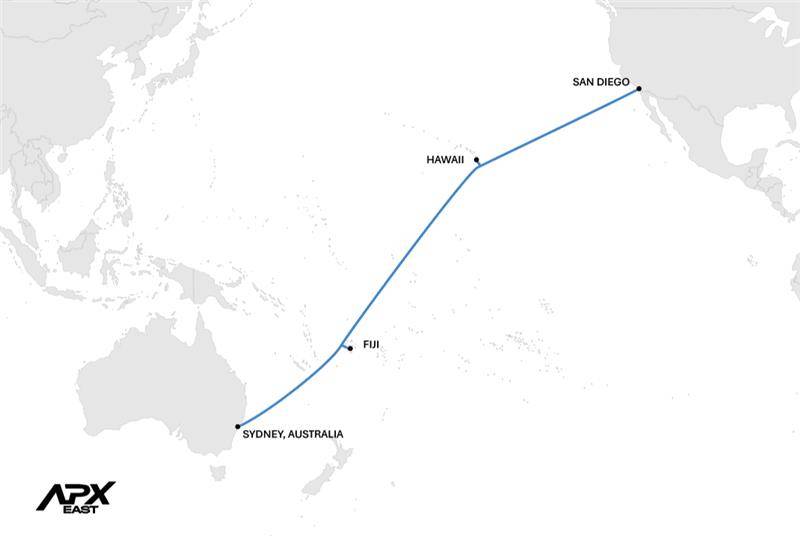
SUBCO announced its latest submarine cable project, APX East, a new express hypercable between Australia and the United States, planned to be Ready for Service (RFS) Q4 2028.
APX East is a 16 fiber pair system that will be the first to offer hyperscalers, neoclouds and carriers, direct fiber connectivity between Australia and mainland US without any landing or interconnection in between. Offering a high level of reliability, security and simplicity, it will also be the lowest latency path between the two nations.
APX East delivers latency, security and simplicity benefits while enabling a Q4 2028 RFS, with a Hawaii branch to follow in Q4 2029.
“Hyperscalers and neoclouds are looking to deploy 3GW of AI factories in Australia between now and 2028. This is going to need between 100Tb-200Tb of international capacity to deliver those tokens to the world Any future system with a 2029 or 2030 RFS simply won’t work. APX-East is an all-deepwater system between Sydney and California, that reduces permitting risk, providing accelerated installation and completion," said Bevan Slattery, Founder & Co-CEO of SUBCO.
APX East highlights:
- First express cable system between Australia and the United States not requiring optical regeneration, capable of being single-end power fed across the entire system.
- APX East will be the single longest continuous subsea optical path in the world, and the longest system able to support single-end power.
- First hypercable to land in a new location north of Sydney’s existing cable protection zone, providing diversity from all announced hypercables landing in the Southern Cable Protection Zone.
- Australia’s first sovereign-owned international hypercable reducing reliance on US hyperscalers for Australian connectivity needs.
- Future branches to Hawaii and Fiji are additional to the trunk and not required for the main system to be ready for service. These branches are expected to be operational in 2029 and are optional for customers seeking additional resiliency to existing or future networks, or to regenerate capacity to support network growth.





 August 2026