

The Fate of Macroalgae and Why it Matters
© Sebastian / Adobe Stock
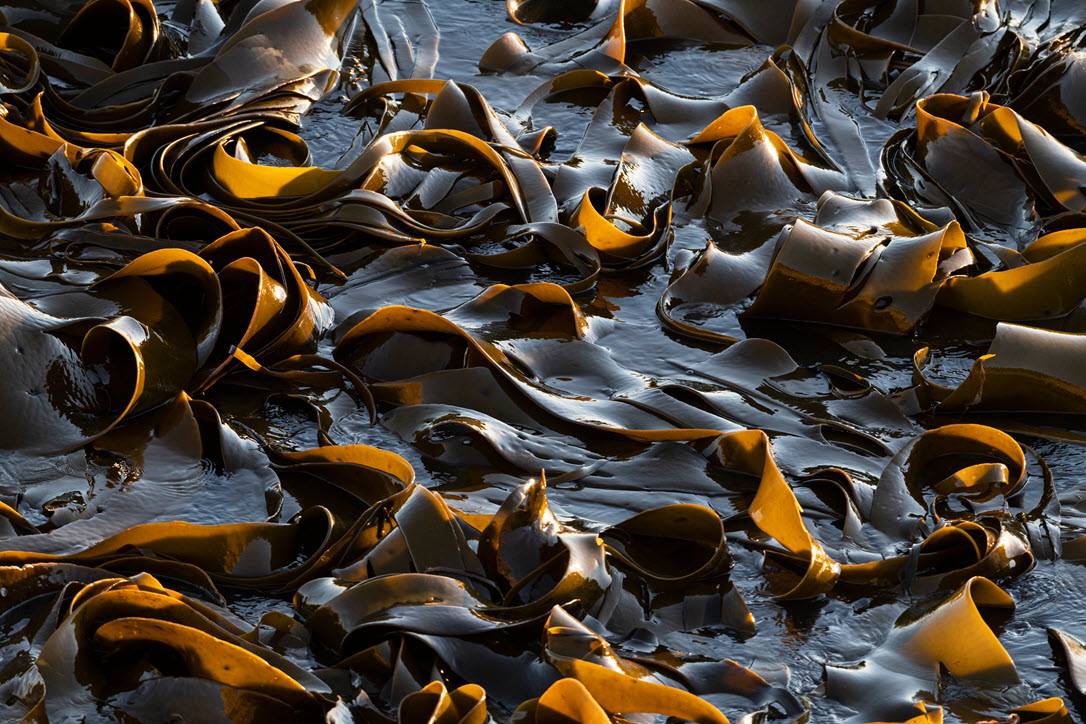
Macroalgae, or seaweeds (including kelp), are highly productive coastal habitats capable of absorbing significant quantities of atmospheric carbon dioxide. Previous studies have estimated that globally, 4–44 teragrams (1Tg = one million metric tons) per year of macroalgal-derived carbon may reach depths of 200m, where it may be sequestered for at least 100 years.
TheFebruary issue of Marine Technology Reporter magazine includes a feature on the fate of macroalgae in southwest Greenland. The study team, co-led by the Leibniz Institute for Baltic Sea Research Warnemünde and Helmholtz-Zentrum Hereon in Germany, used a combination of satellite imagery, ocean drifter tracking, numerical modelling and advanced turbulence analyses to demonstrate that extensive mats of macroalgae can travel hundreds of kilometers offshore there. That macroalgae export from Greenland contributes to long-term carbon burial in the Arctic.
Another recent study, led by researchers at the University of South Florida and NOAA, used AI to process large amounts of data to give a broader global picture of floating macroalgae. They found that between 2003 and 2022, macroalgal mats expanded around the globe, indicating that conditions are favorable for the growth of floating macroalgae.
In open water, this macroalgae can provide critical habitat for marine life and have a positive impact on fisheries, serving as a nursery for many species. But in coastal waters, the decaying biomass can harm tourism, economies, and the health of people and marine life, say the researchers.
There are still many unknowns about the ecology of macroalgal mats, and in “A horizon scan of biological conservation issues for 2026” a team of international researchers raised concerns in their top 15 issues.
“Collectively, macroalgae cover more area than that of all other coastal wetlands and coral reefs combined. However, they have received little conservation attention despite the threats that ocean warming and unsustainable local levels of herbivory pose to seaweeds. Recent exponential growth in seaweed aquaculture is also causing accidental introduction of novel pathogens and epiphytes. A knowledge base and biosecurity framework are lacking, hindering effective management and conservation efforts.”
Ongoing climate change by the end of the century is projected to result in overall macroalgae range contraction with losses of over 10% species and 17-22% of localities. Highly suitable areas for coastal seagrass and brown macroalgal beds are projected to decline by 78-96% whilst expansions are anticipated in polar regions.
“If realized, these growing threats to this under-studied group of ecosystem engineers are likely to have far-reaching implications for marine biodiversity.”









 August 2026