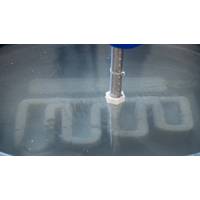
Underwater 3D Printing of Concrete Ready for DARPA Assessment
ocean. By 3D-printing concrete underwater, the new approach could transform on-site maritime construction and the repair of critical infrastructure that connects continents.“We want to be constructing without being disruptive,” said Sriramya Nair, assistant professor of civil and environmental engineering in the David A. Duffield College of Engineering, who leads the effort. “If you have a remotely operated underwater vehicle that shows up on site with minimal disturbance to the ocean, then there is a way to build smarter and not continue the same practices that we do on the land.&rdquo
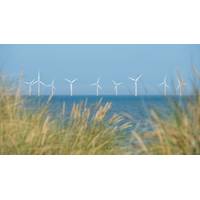
Modelling Identifies Optimal Offshore Renewables Sites
devices that convert the ocean’s tides, current and waves into electricity – hold tremendous potential for producing sustainable energy at a reasonable cost,” says Anderson de Queiroz, co-author of a paper on the work and an associate professor of civil, construction and environmental engineering at North Carolina State University. “We also know that putting wind turbines and marine hydrokinetic devices in the same location makes it possible to ensure a reliable flow of energy from offshore sites.“However, the initial cost of building these offshore sites is considerable
Survey Sequence Important to Predicting Underwater Landslides
data.Although data from personnel with different expertise are needed to tell the story of the land below the sea, the order in which they perform their tasks toward site characterization is important, says Zenon Medina-Cetina, associate professor in the Department of Civil & Environmental Engineering. This sequence, if violated due to budgetary or time constraints, could lead to uncertainty in the prediction of landslides.“It is very important to start with the geophysicist and then bring in the geologist and then have the geomatics group working with the geotechnical engineers

Unlocking Ocean Power: $3.6M for Community-centric Wave Energy Converters
in today’s market because engineers haven’t settled on the best way to harvest it or assess the technology.“Everybody knows what a wind turbine looks like because the research community has rallied behind a single idea,” said Jeff Scruggs, U-M professor of civil and environmental engineering and the project’s co-principal investigator. “For wave energy converters, that’s not the case. When you look at the devices that companies are deploying for their trials, they are nothing like each other. Everybody’s got their own idea about the best way to harvest
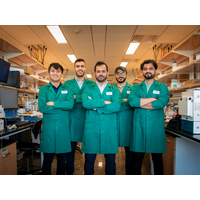
UH Researchers Developing Electrochemical Oceanic Carbon Capture Technology
A team of scientists at the University of Houston (UH) led by Mim Rahimi, assistant professor of environmental engineering at UH’s Cullen College of Engineering, are developing a negative emissions technology called electrochemical direct ocean capture (eDOC), which helps the ocean cleanse itself of harmful carbon dioxide.Funded by a $250,000 grant from the US Department of Energy, Rahimi and his team are working to create electrochemical tubes to remove dissolved inorganic carbon from synthetic seawater. Preliminary research on the project was sponsored by UH Energy’s Center for
Grandeur Subserv Acquires Gaps M5 USBL for Shallow Water Ops
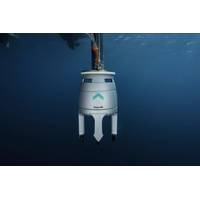
Grandeur Subserv Ltd., a company specializing in underwater and environmental engineering services, recently acquired Exail Gaps M5 USBL system for shallow water geophysical surveys on the Nigerian coast. Looking for an agnostic acoustic positioning system compatible with third-party transponders and capable of accurately tracking any asset in very shallow water, the Gaps M5 USBL system was recommended.“As part of a survey to determine the location of pipelines or hazards that could impede drilling on the Escravos field, we have to track sensors in water depths ranging from 8 to 100 m, which is
TECH FILE: Acoustic Tech Used to Understand Climate Change in the Arctic
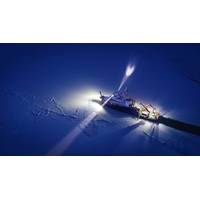
. Now it melts out in May. It used to come back in September or October. Now the ice comes back in November or December,” says Professor Jim Thomson, Senior Principal Oceanographer at the University of Washington’s Applied Physics Lab and a Professor in the Department of Civil & Environmental Engineering.Jim Thomson readies a fixed mooring equipped with a Signature500 ADCP for deployment in the Beaufort Sea. The instruments were left in situ for a year. Photo ©: Onpoint Outreach.Research necessary as melting ice exposes coastlines to harsh waves and erosionThe implications of the Arctic&rsq
PCCI Hires Carey as Chief Engineer
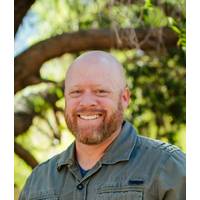
, port security barriers, and submarine cable shore landings. He received a Bachelor of Science in Mechanical Engineering from California Polytechnic State University. He possesses OSHA, HAZWOPER, and confined space entry certifications.Alexandria, Va. based PCCI provides marine and environmental engineering, ocean facility installation support, all-hazards emergency response planning and training services, and hyperbaric systems engineering for industry and governments worldwide
COVE Internship Project Begins Despite COVID-19 Pandemic
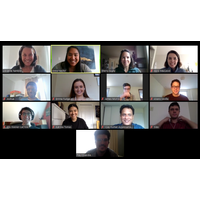
, or have completed, their studies at Acadia University, Dalhousie University, Nova Scotia Community College (NSCC) and the Nova Scotia College of Art and Design (NSCAD). Their backgrounds range from a Senior Ship’s Officer with a diploma in business administration, electronics technician, environmental engineering, computer science, mechanical engineering, interdisciplinary design, and electronic commerce.IBM and Accenture have donated their time and resources in a week-long orientation course for the interns prior to the project start date allowing the interns to hit the ground running on their


 August 2026