
Pendulum System Extracts Energy from Ocean Currents
Source: URV
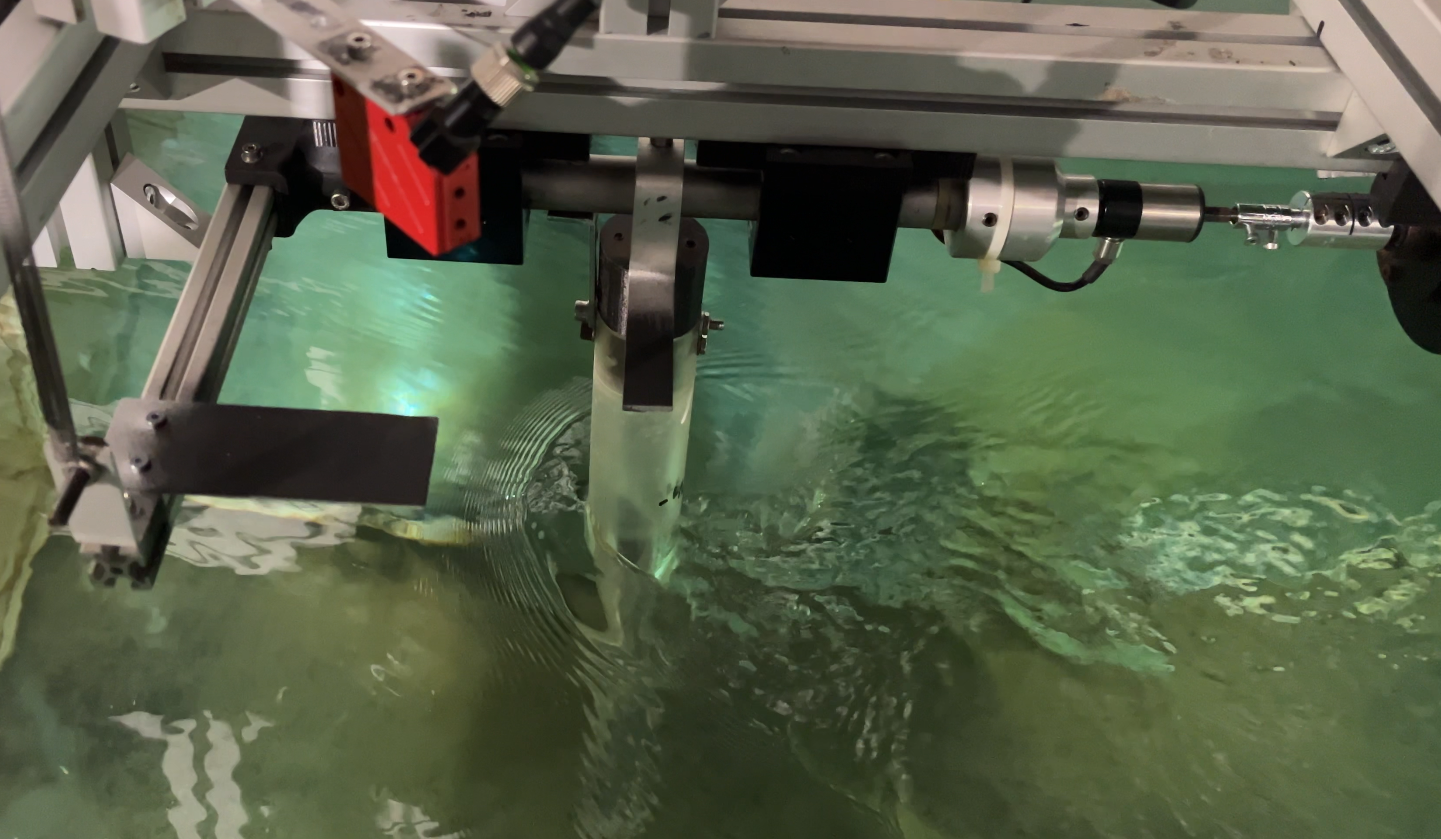
Researcher Francisco Huera at Universitat Rovira i Virgili (URV) in Spain has designed a device that harnesses the energy of water currents from the vibrations that occur when water passes around a cylinder and creates vortices behind it.
This involves a submerged cylindrical tube hanging from an axis that oscillates like a pendulum when the water current makes it vibrate.
“The beauty of this system is that only the cylinder is in the water; everything else — the shaft, the transmissions and eventually the generator — can be outside,” explains the researcher, who has designed and tested the system in a water channel at the Fluid-Structure Interaction Laboratory of the URV.
Currently, the most efficient way to harness the energy of ocean currents is with axial-flow or cross-flow turbines, the underwater equivalent of wind turbines. These are systems that, theoretically, can achieve efficiencies of more than 50%, but which in practice can only harness up to 25-35% of the energy carried by the fluid in the area occupied by the turbine.
These turbines are complex structures, with many moving underwater components that are exposed to corrosion and the growth of marine organisms and which require costly maintenance. Furthermore, there are still no commercial underwater arrays of tidal turbines, with development still at the prototype and pilot-testing stage.
The system analyzed in this study takes an entirely different approach: instead of a rotor with blades, it has a cylinder that vibrates. The tests were carried out in a water channel, using a scaled-down cylinder exposed to flow and connected to a shaft that rotates on air bearings. A sensor measures the oscillation angle and an electromagnetic brake applied to the shaft allows the mechanical power available when the system vibrates to be studied.
The results of the various tests have yielded power coefficients of around 15%, values similar to those of other energy-harvesting systems based on cylinder vibrations studied in previous research.
This simplicity opens up the possible use of the system in environments where conventional turbines are difficult to install or maintain. The system is primarily intended for tidal currents where water moves continuously, but the principle could also be applied to rivers with sufficient flow and suitable cross-sections, without the need to build dams or diversion channels, and it could even be used to harness energy from wind.
The next step will be to optimize the way power is extracted from the system—for example, by adjusting the brake torque according to position or hydrodynamic load—and to study to what extent the range of useful speeds can be extended and how multiple devices can be made to interact to increase the energy obtained per unit area.
The research is part of a broader line of work on flow-induced vibrations. Traditionally, these vibrations have been regarded as a problem in large oceanic structures, such as the pipelines connecting oil platforms to the seabed, because they cause fatigue and can compromise the integrity of the installations. Huera had, in fact, already worked on systems to prevent these vibrations and even holds a European patent aimed at reducing this risk. Now, the same phenomenon is being turned into a resource to be explored as a source of energy.






 February 2026